Lesson 02 — Surveillance, Freedom, and Power
Learners analyze surveillance as an asymmetry of visibility — many watched by few — and connect that asymmetry to freedom and power. They read contrasting cases where watching is used for care and for control, weigh who is protected and who is chilled, and distinguish the facts of surveillance from the values of what should be watched.
Objectives
Objectives
- D10.S1.10.01 Analyze how data, surveillance, and automation affect privacy, freedom, and who has power in a society.
Essential question
When many people can be watched but few do the watching, how does that asymmetry shape freedom and who holds power?
Key vocabulary
Materials
Standard materials
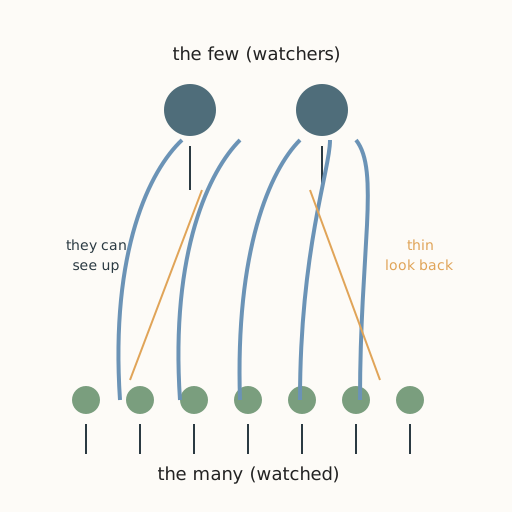
- Asymmetry diagram · 1 per learner A diagram of many people at the bottom and a few watchers at the top, with arrows showing who can see whom
- Surveillance case cards · 1 set per group Short, sourced cases of surveillance used for care and for control, in different places
Low-tech / no-cost
- A shared board or large paper Draw the asymmetry diagram together and add arrows for each case
- Voice and discussion Discuss the cases aloud; no printed cards needed
Enriched / lab & device
- Sourced cases of mass surveillance and resistance · 1 per group Two contrasting, sourced cases — one where surveillance protected people, one where it controlled them — with links to verify
- A shared digital document · 1 A shared page to map who watches and who is watched in each case
Works in different contexts
- large-group Build the asymmetry diagram whole-class, then groups analyze one case each and report back
- multi-age Younger learners say what it feels like to be watched; older learners write the freedom-and-power analysis
- self-directed A learner reads the cases, fills the asymmetry diagram, and writes one paragraph on freedom and power
- level-grouped A group ready to extend compares surveillance "for care" and "for control" and argues where the line sits
- outdoor-only Discuss who can see whom in a shared outdoor place — the watcher and the watched — and how the same eyes can mean safety or control
Lesson 2 — Surveillance, Freedom, and Power
Summary
Learners analyze surveillance as an asymmetry of visibility — many watched by few — and connect that asymmetry to freedom and power. They read contrasting cases where watching is used for care and for control, weigh who is protected and who is chilled, and distinguish the facts of surveillance from the values of what should be watched.
Objectives
- Analyze how surveillance affects privacy, freedom, and who has power in a society. (D10.S1.10.01)
Connection
Imagine a room where everyone can see everyone. Now imagine a room where one person sees everyone, but no one sees the one. Those rooms feel different: in the first you speak freely; in the second you begin to watch your own words, even when no one has threatened you. Surveillance is the second room. It is not only cameras — it is the record of where you go, whom you call, what you read, and the power that comes to whoever holds that record. The same watching that keeps a crowd safe at a festival can, in another’s hands, silence a person who would speak out. The question is not whether watching exists; it is who watches whom, and what that does to freedom.
Materials
- Asymmetry diagram
- Surveillance case cards
Preparation
- Copy the asymmetry diagram and the case cards.
- Retrieval: from Lesson 1, recall the data trail we leave and who collects it. Today we ask what the concentration of that collection does to freedom and power.
- Prepare one worked example of reading a case and naming who watches and who is watched.
Facilitator note
This lesson is written to the learner (“you”). The idea to land: surveillance is an asymmetry of visibility — the many are watched by the few — and that asymmetry redistributes power: it can protect (the many can hold the few accountable) or control (the few can chill the many into self-censorship). Hold both directions honestly; surveillance is not one thing. The ethics lens: watching can be a duty of care or a tool of domination, so we must ask for what and by whom. The egalitarian lens: surveillance rarely falls evenly — the powerful are often the watchers and the marginalized the watched, and the digital divide means some are over-exposed while others are invisible (S-281). The global lens: states and communities differ sharply in how they watch and why — some watch for public health, some for protest control; no one arrangement is the human default. The technology lens: cheap sensors and storage made mass surveillance possible where it was once impossible. The environment lens: surveillance infrastructure — cameras, servers, networks — carries material and energy costs. Power here is the capacity to shape what others can do (S-275). Distinguish evidence (who is watched) from values (who should be). Hold questions open (philosophy §11). Preview: next lesson turns to automation — when machines act on that data, who gains and who loses.
Procedure
- Recall (5 min). From Lesson 1: what was the single most revealing mark on your day trail? Who could collect it?
- Meet the asymmetry (10 min). Look at the diagram. Surveillance is systematic watching and record-keeping. The diagram shows asymmetric visibility: the many can be seen by the few, but the few are hard to see. Power is the capacity to shape what others can do (S-275) — and the record of a life is a form of power over that life.
- Worked example (10 min). Watch one case read step by step — a transit system that tracks every rider’s card: (a) who watches (the operator, and whoever they share with); (b) who is watched (every rider); (c) the protection it offers (faster service, finding a lost person); (d) the chill it can create (avoiding certain routes, altering behavior because the trip is recorded).
- Guided practice (15 min). In a group, read two contrasting case cards — one where watching is used for care, one for control. For each, name who watches, who is watched, what freedom it protects or shrinks, and who holds the power.
- Independent practice (10 min). In your journal, answer in three sentences: does surveillance change how freely you act when you know you are watched? If you wrote only “yes” or “no” without reasoning, mark “not yet.”
- Close (5 min). Share one contrast. The line between protection and control is drawn by who watches, and by whether the watched can watch back — that is accountability.
Differentiation
- Support: Provide one pre-annotated case (who watches / who is watched already labeled) and sentence starters.
- Extension: Find a case where surveillance both protects and chills the same people, and explain the tension.
- Expression: Learners may map the cases with arrows instead of writing, or have a partner read their reasoning aloud.
Assessment
- Formative (peer + self): Can the learner identify who watches and who is watched in a case, name a freedom protected or shrunk, and say who holds power?
- Portfolio artifact (unit): The completed asymmetry diagram with one annotated case, added to the “technology and power” section.
Home connection
With a family member, list the places in your day where you are watched (a camera, a card, a phone). For one, ask: does this watching protect us or shape us — and how would we know?
Resources
- On privacy as a recognized right (protection from arbitrary interference): UN, Universal Declaration of Human Rights, https://www.un.org/en/about-us/universal-declaration-of-human-rights (S-149).
- On uneven digital benefits, surveillance, and the digital divide: World Bank, World Development Report 2016: Digital Dividends, https://www.worldbank.org/en/publication/wdr2016 (S-281).
- On power as the capacity to shape what others can do: Steven Lukes, Power: A Radical View (S-275).