Lesson 09 — Ecosystem Services: Nature's Free Labor
Learners explain what ecosystem services are — the work living systems do for people for free — using pollination, clean water, and soil as anchors. They classify services into provisioning, regulating, supporting, and cultural, and connect them to the biodiversity that provides them, previewing the next lesson.
Objectives
Objectives
- D10.S3.10.01 Explain what ecosystem services are, such as pollination, clean water, and soil, and how biodiversity underpins them.
Essential question
What work does the living world do for us for free — pollination, clean water, soil — and what happens if we stop counting it?
Key vocabulary
Materials
Standard materials
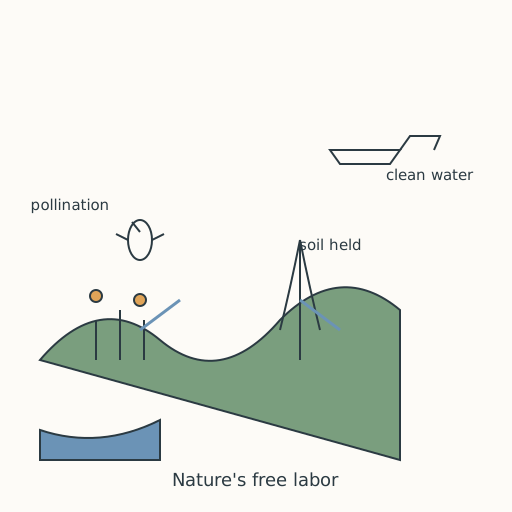
- Ecosystem-services diagram · 1 per learner A diagram of an ecosystem with arrows labeling the services it provides — pollination, clean water, soil, climate, and culture
- Service-matching cards · 1 set per group Cards naming services and the living things that provide them, to match
Low-tech / no-cost
- A shared board or large paper Draw the ecosystem and its services together, with arrows
- Voice and movement Act out a pollinator, a root holding soil, a wetland filtering water; no printed cards needed
Enriched / lab & device
- Device with web access · 1 per pair Look up a local ecosystem's documented services (a wetland, forest, reef, or river)
- A sourced valuation example · 1 per group One example of people putting a money value on a free service, to read and discuss
Works in different contexts
- large-group Build the services diagram whole-class, then groups each match one service to its providers
- multi-age Younger learners name a service a plant or animal gives; older learners classify it and explain the dependence
- self-directed A learner studies the diagram, matches the cards, and writes one paragraph on a service they rely on
- level-grouped A group ready to extend classifies services into provisioning, regulating, supporting, and cultural, and argues why one is hardest to replace
- outdoor-only Find a real ecosystem service outdoors — shade, soil held by roots, a pollinator at work — and name what it provides
Lesson 9 — Ecosystem Services: Nature’s Free Labor
Summary
Learners explain what ecosystem services are — the work living systems do for people for free — using pollination, clean water, and soil as anchors. They classify services into provisioning, regulating, supporting, and cultural, and connect them to the biodiversity that provides them, previewing the next lesson.
Objectives
- Explain what ecosystem services are, such as pollination, clean water, and soil. (D10.S3.10.01)
Connection
A bee moves pollen and your food appears. A wetland holds water and filters it until it runs clean. Roots grip soil so the rain does not wash a field into the river. None of this work appears on anyone’s payroll, yet every meal, every glass of clean water, and every stable field depends on it. We call this nature’s free labor — the services living systems provide. Because it is free, it is easy to forget; because it is essential, forgetting it is dangerous. Seeing the work is the first step toward not destroying it.
Materials
- Ecosystem-services diagram
- Service-matching cards
Preparation
- Copy the ecosystem-services diagram and the service-matching cards.
- Retrieval: from Grade 9, recall the greenhouse effect and the carbon cycle connecting living things, oceans, atmosphere, and rock (D10.S3.09.01). Today we name the benefits those living systems provide.
- Prepare one worked example of matching a service to its provider.
Facilitator note
This lesson is written to the learner (“you”). The idea to land: ecosystem services are the benefits people receive from living systems — provisioning (food, water), regulating (climate, flood, disease), supporting (soil, nutrient cycling), and cultural (meaning, recreation) — and they are provided for free by biodiversity, so losing biodiversity loses the services. The environment lens is the spine. The egalitarian lens: the people who depend most directly on these services — smallholder farmers, fishers, foragers — are often the least able to pay for a replacement, so their loss is a justice question (S-437). The global lens: every place has its own services (a mangrove nursery, a mountain watershed, a desert’s shade), and no single ecosystem is the default. The ethics lens: treating free services as worthless is a moral error — they have value beyond price. The technology lens: machines can substitute for some services (a water-treatment plant for a wetland) but often at great cost and never for all — the natural version is often irreplaceable. Anchor the science: pollination as the transfer of pollen that makes seeds (S-330); soil as the living surface that supports growth (S-259); clean water through the water cycle and filtration (S-212). Distinguish evidence (what services exist) from values (what they are worth) (philosophy §5). Preview: next lesson asks how biodiversity underpins all of these.
Procedure
- Recall (5 min). From Grade 9: what does the carbon cycle connect, and why does it matter that living things are in it?
- Meet the services (10 min). Look at the diagram. An ecosystem service is a benefit people get from a living system. Four kinds: provisioning (things we take — food, water, wood, medicine); regulating (processes that keep conditions stable — climate, floods, disease, pests); supporting (the base that makes the rest possible — soil, nutrients, photosynthesis); and cultural (meaning, beauty, recreation, knowledge).
- Worked example (10 min). Watch one service traced step by step — a wetland’s clean water: (a) the service (regulating: water filtration and flood control); (b) the providers (reeds, microbes, soil); (c) who relies on it (downstream communities); (d) what a treatment plant would cost to replace it.
- Guided practice (15 min). In a group, match the service-matching cards: each service to its provider and its kind (provisioning, regulating, supporting, or cultural). For two matches, name who relies on that service.
- Independent practice (10 min). In your journal, name one ecosystem service you rely on this week, and what living thing provides it. If you named the service without its provider, mark “not yet.”
- Close (5 min). Share one service. The pattern: every service rests on living things — which is exactly where the next lesson goes.
Differentiation
- Support: Provide a pre-matched set with one pair already done, and sentence starters.
- Extension: Classify a list of services and argue which single one, if lost, would be hardest to replace by technology.
- Expression: Learners may act out a service or have a partner read their reasoning — no step requires writing.
Assessment
- Formative (peer + self): Can the learner name ecosystem services (pollination, clean water, soil), classify one by kind, and name its living provider?
- Portfolio artifact (unit): The matched cards or a labeled diagram, as the opening page of the “ecosystem-services and biodiversity” section.
Home connection
With a family member, find one thing your household relies on that a living thing provides for free — shade, food, clean water, a pollinator. Ask: what would you do if it stopped?
Resources
- On pollination as the transfer of pollen that makes seeds: Encyclopaedia Britannica, “Pollination,” https://www.britannica.com/science/pollination (S-330).
- On the global evidence for ecosystem services and their decline: IPBES, Global Assessment Report on Biodiversity and Ecosystem Services, https://www.ipbes.net/global-assessment (S-437).
- On soil as a living surface: FAO Soils Portal, key definitions, https://www.fao.org/soils-portal/about/all-definitions/en/ (S-259).
- On the water cycle and clean water: USGS, Water Science School, “The Water Cycle,” https://www.usgs.gov/special-topics/water-science-school/science/fundamentals-water-cycle (S-212).