Lesson 08 — What Gets Reported and What Gets Left Out
Learners analyze how the framing and selection of a story — what is in the frame and what is left out — shape what people come to believe. They compare two differently-framed reports of the same event, identify each report's angle and omissions, and connect framing back to ownership and to their own habits as readers.
Objectives
Objectives
- D10.S2.10.02 Analyze who owns the media people consume and how concentrated ownership can shape what is reported and left out.
Essential question
How does the framing and selection of a story — what is in the frame and what is outside it — shape what people come to believe?
Key vocabulary
Materials
Standard materials
- Framing comparison · 1 per learner Two real reports of the same event, framed differently, to compare for what is in and out of the frame
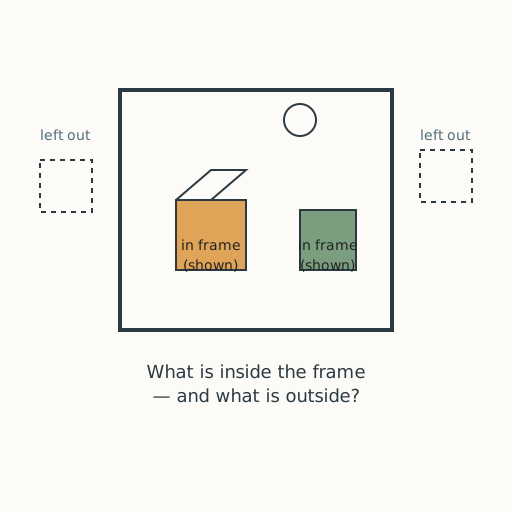
- Frame/omission sheet · 1 per learner A sheet with a frame drawn around a scene, with space to list what is inside and outside it
Low-tech / no-cost
- A shared board or large paper Draw the frame and list what is in and out of it together
- Voice and discussion Compare the two reports aloud; no printed sheet needed
Enriched / lab & device
- Device with web access · 1 per pair Find two differently-framed real reports of one current event and compare them live
- A third report from an independent source · 1 per group To triangulate what both framings leave out
Works in different contexts
- large-group Compare the two reports whole-class, then groups each list one thing in and one thing out of the frame
- multi-age Younger learners name what they notice in a picture; older learners write the frame/omission analysis
- self-directed A learner reads both reports, fills the frame/omission sheet, and writes one paragraph on what changed
- level-grouped A group ready to extend identifies the angle and audience of each report and argues who benefits from each framing
- outdoor-only Frame a real scene outdoors — look at one corner of a place, then step back — and list what the first frame left out
Lesson 8 — What Gets Reported and What Gets Left Out
Summary
Learners analyze how the framing and selection of a story — what is in the frame and what is left out — shape what people come to believe. They compare two differently-framed reports of the same event, identify each report’s angle and omissions, and connect framing back to ownership and to their own habits as readers.
Objectives
- Analyze how media framing and selection shape what is reported and left out. (D10.S2.10.02)
Connection
A photograph is a choice about where to point the lens. Point it at the crowd and you see a celebration; point it at one angry face and the same crowd looks like a riot. News works the same way: every story is a frame, and the frame decides what is inside — and, just as powerfully, what is outside. A flood reported as “government failure” leaves out the river’s neglected floodplain; a protest reported as “violence” leaves out what the people were protesting. You cannot see everything at once; so the question is never whether a frame exists, but whether you know you are looking through one — and what the frame left out.
Materials
- Framing comparison
- Frame/omission sheet
Preparation
- Copy the framing comparison and the frame/omission sheet.
- Retrieval: from Lesson 7, recall who owns the outlets you use and what that ownership might leave out. Today we analyze the how — the frame itself.
- Prepare one worked example of listing what is in and out of a frame.
Facilitator note
This lesson is written to the learner (“you”). The idea to land: every report is framed — a selection of what to show and what to omit — and the frame shapes what people conclude; media literacy is the habit of noticing the frame and asking what it left out. The critical-thinking lens is the spine. The ethics lens: fair reporting names its angle and seeks what it might be missing (S-442). The egalitarian lens: framing decides whose experience is centered and whose is omitted — a question of who gets to be the “we” of a story (S-417). The global lens: the same event is framed differently by different media systems and cultures, and reading across them widens the frame. The technology lens: the feed amplifies the most engaging frame, not the most complete one (S-482). The environment lens: environmental stories are especially vulnerable to framing — a drought framed as “weather” omits the long human causes; notice what the frame hides. Use the event example with care and keep claims hedged. Preview: we now pivot to the Earth itself — ecosystem services and tipping points — the environment half of the unit.
Procedure
- Recall (5 min). From Lesson 7: what is media concentration, and what can it leave out?
- Meet the frame (10 min). Framing is choosing what to include and how to present it. Selection is what a story picks out; omission is what it leaves out. Agenda setting is the power to make some things seem important and others invisible. An angle is the particular point of view a story takes.
- Worked example (10 min). Watch one frame analyzed step by step: two reports of a market fire — one framed as “looters run wild,” another as “families lose their stalls.” (a) What is inside each frame (who is named, what words are used); (b) what is outside (the cause, the history, the people affected); (c) what a reader of each would conclude.
- Guided practice (15 min). In a group, compare the two reports in the framing comparison. Fill the frame/omission sheet: for each, list what is in the frame and what is out, and name the angle.
- Independent practice (10 min). In your journal, answer: what is one thing both frames leave out, and how would you find it? If you only described the frames without the omission, mark “not yet.”
- Close (5 min). Share one omission. The reader’s power is the question: what is outside this frame?
Differentiation
- Support: Provide one report pre-annotated (in-frame / out-of-frame labeled) and sentence starters.
- Extension: Identify the audience each report targets, and argue who benefits from each framing.
- Expression: Learners may draw the frame and list items, or have a partner read their reasoning — no step requires writing.
Assessment
- Formative (peer + self): Can the learner identify what is in and out of a frame, name the angle, and say how framing shapes what a reader concludes?
- Portfolio artifact (unit): The frame/omission sheet with one report comparison, completing the “media ownership analysis” section.
Home connection
With a family member, take one news story and ask: what is inside this frame, and what is left out? Where would you look to fill the gap?
Resources
- On the five core questions of media literacy (what is omitted, who benefits): Center for Media Literacy, Five Core Concepts and Key Questions, https://www.medialit.org/ (S-442).
- On how the feed amplifies the engaging frame over the complete one: Eli Pariser, The Filter Bubble (2011) (S-482).
- On the danger of a single story and whose experience is centered: Chimamanda Ngozi Adichie, “The Danger of a Single Story,” https://www.ted.com/talks/chimamanda_ngozi_adichie_the_danger_of_a_single_story (S-417).