Lesson 11 — Tipping Points: When Change Becomes Hard to Reverse
Learners explain what a tipping point is — a threshold past which a system shifts into a new, often hard-to-reverse state — and why crossing one is hard to undo. Using the valley-and-ball model and cases from coral reefs, lakes, and climate feedbacks, they see how feedback loops lock a change in once the threshold is crossed.
Objectives
Objectives
- D10.S3.10.02 Explain what a tipping point is and why crossing one in an ecosystem or climate can be hard to reverse.
Essential question
What is a tipping point, and why, once a system crosses one, is the change so hard to reverse?
Key vocabulary
Materials
Standard materials
- Tipping-point diagram · 1 per learner A ball in a valley that, pushed past a ridge, rolls into a new, deeper valley — showing a threshold and a hard-to-reverse shift
- Tipping-point case cards · 1 set per group Short, sourced cases of a tipping point — coral bleaching, a lake flipping, a feedback loop — with what pushed each system and why reversing is hard
Low-tech / no-cost
- A shared board or large paper Draw the valley-and-ball diagram and trace each case across the threshold
- Voice and movement Act out a ball rolling over a ridge and into a new valley; no printed cards needed
Enriched / lab & device
- Device with web access · 1 per pair Look up a documented tipping point or feedback loop (coral, ice, a lake, permafrost) to examine
- A feedback-loop diagram with data · 1 per group A real feedback loop — such as warming melting ice that then reflects less — to trace
Works in different contexts
- large-group Build the valley-and-ball diagram whole-class, then groups each trace one case across the threshold
- multi-age Younger learners describe the ball rolling over the ridge; older learners write the threshold-and-feedback analysis
- self-directed A learner studies the diagram, reads a case, and writes one paragraph on why reversing is hard
- level-grouped A group ready to extend traces a feedback loop in a case and explains how it locks the change in
- outdoor-only Find a slope or a worn path outdoors and imagine a heavy stone rolling past the crest — once over, it does not roll back on its own
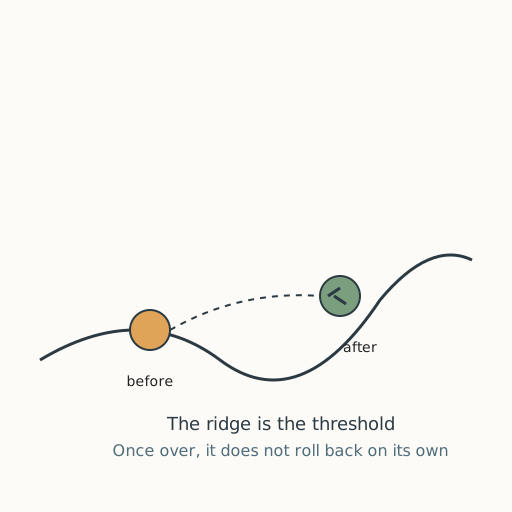
Lesson 11 — Tipping Points: When Change Becomes Hard to Reverse
Summary
Learners explain what a tipping point is — a threshold past which a system shifts into a new, often hard-to-reverse state — and why crossing one is hard to undo. Using the valley-and-ball model and cases from coral reefs, lakes, and climate feedbacks, they see how feedback loops lock a change in once the threshold is crossed.
Objectives
- Explain what a tipping point is and why crossing one in an ecosystem or climate can be hard to reverse. (D10.S3.10.02)
Connection
Push a heavy stone slowly up a hill. Before the crest, a small push moves it a little, and if you stop, it rolls back. But the moment it passes the crest, it runs away down the far side on its own — and no small push will bring it back up. Ecosystems and the climate work the same way: they absorb change for a while, then pass a threshold where the change feeds itself and the system settles into a new state that is very hard to leave. A coral reef can shrug off warm water for a while; past a point, it bleaches, dies, and becomes a field of rubble that does not simply regrow when the water cools. Knowing where the crests are is the difference between steering a system and being carried over it.
Materials
- Tipping-point diagram
- Tipping-point case cards
Preparation
- Copy the tipping-point diagram and the case cards.
- Retrieval: from Grade 9, recall what a feedback loop is and one example of warming speeding up more warming (D10.S3.09.02). Today we add the threshold — the point where a loop takes over.
- Prepare one worked example of tracing a system across a threshold and into a new state.
Facilitator note
This lesson is written to the learner (“you”). The idea to land: a tipping point is a threshold past which a system shifts into a new state that is hard to reverse, because once crossed, feedback loops hold it in the new state (hysteresis) — the system does not simply return when the original pressure is removed. The environment lens is the spine. The global lens: tipping points exist at every scale and place — a lake that flips, a reef that bleaches, an ice sheet that slides — and people experience them differently depending on where they live (S-005). The egalitarian lens: the people who cross a threshold are often not the people who caused it, and the poorest feel a flipped system hardest. The ethics lens: if a change is hard to reverse, we owe the future more care before the crest — prevention outranks repair. The technology lens: human technology is often what pushes a system toward the crest, and technology cannot easily pull it back. Anchor the science: coral bleaching as the loss of the algae that color and feed the coral, driven by warming (S-215); the IPCC as the authority on climate thresholds and feedbacks (S-005); and the hedged Yellowstone example as a reminder that real systems are complex and contested, not a simple story (S-310). Distinguish evidence (a threshold exists) from values (how much risk to accept). Preview: next lesson moves to solutions — the circular economy.
Procedure
- Recall (5 min). From Grade 9: what is a feedback loop, and give one example of warming feeding warming.
- Meet the tipping point (10 min). Look at the diagram. A tipping point is a threshold past which a system shifts to a new state. Hysteresis is the name for a system that does not easily return — the path back is not the path forward. A regime shift is a move from one stable state to another. A feedback loop is what holds the new state in place.
- Worked example (10 min). Watch one case traced step by step — a coral reef under warming: (a) the system before (a living reef, stable); (b) the pressure (warming water); (c) the threshold (bleaching — the coral expels its algae, S-215); (d) the new state (a rubble field) and why reversing is hard (the structure that new corals need is gone; warming continues). The ball is over the ridge.
- Guided practice (15 min). In a group, read two case cards — one ecosystem and one climate feedback. For each, name the pressure, the threshold, the new state, and the feedback loop that holds it there. Draw the ball crossing the ridge.
- Independent practice (10 min). In your journal, explain in two sentences why “just remove the pressure” does not automatically reverse a crossed tipping point. If you only named the pressure without the “why,” mark “not yet.”
- Close (5 min). Share one threshold. The lesson: the cheapest time to steer is before the crest.
Differentiation
- Support: Provide a pre-traced case (pressure/threshold/new state labeled) and sentence starters.
- Extension: Trace a feedback loop in a case and explain, in your own words, how it locks the new state in.
- Expression: Learners may draw the valley-and-ball for their case or have a partner read their reasoning — no step requires writing.
Assessment
- Formative (peer + self): Can the learner name a threshold, the new state, and a feedback loop, and explain why reversing is hard?
- Portfolio artifact (unit): The tipping-point diagram with one annotated case, completing the “tipping-point explanation” for the unit portfolio.
Home connection
With a family member, think of a change that is easy to make but hard to undo — a habit, a budget, a garden. Where is its crest, and how would you know you were near it?
Resources
- On climate thresholds and feedbacks: Intergovernmental Panel on Climate Change, https://www.ipcc.ch/ (S-005).
- On coral bleaching as the loss of the coral’s algae under warming: NOAA, “What is coral bleaching?,” https://oceanservice.noaa.gov/facts/coral_bleach.html (S-215).
- On the complexity of a real ecosystem’s response (hedged): Ripple & Beschta (2012), trophic cascades in Yellowstone (S-310).