Lesson 12 — The Circular Economy: Designing Out Waste
Learners explain the idea of a circular economy — designing out waste so materials stay in use — and compare it with the take-make-waste linear economy. They map a product's life cycle onto each model and see that the difference is a design choice, not a fact of nature.
Objectives
Objectives
- D10.S4.10.02 Explain the idea of a circular economy (designing out waste) and compare it with a "take, make, waste" linear economy.
Essential question
How does a circular economy — designing out waste — differ from the take-make-waste linear economy we mostly live in?
Key vocabulary
Materials
Standard materials
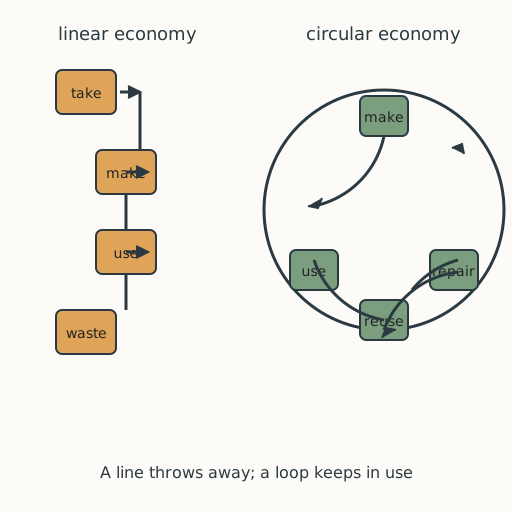
- Linear/circular diagram · 1 per learner Two loops side by side — a one-way arrow (take, make, use, waste) and a closed loop (make, use, repair, reuse, return)
- Product life-cycle cards · 1 set per group Cards naming a product (a phone, a shirt, a bottle, a building) and the stages of its life, to arrange into a loop or a line
Low-tech / no-cost
- A shared board or large paper Draw the two loops together and place the product cards along each
- Found objects A broken object or piece of packaging to examine and ask: what could be repaired, reused, or returned?
Enriched / lab & device
- Device with web access · 1 per pair Look up a real product's circular design — a repair scheme, a return program, a material that stays in use
- A sourced case of a circular business or city · 1 per group One documented example of circular design in practice, to read and discuss
Works in different contexts
- large-group Build the two loops whole-class, then groups each map one product's life cycle onto a loop or a line
- multi-age Younger learners say what happens to a broken toy; older learners map the full linear and circular loops
- self-directed A learner studies the diagram, arranges the cards, and writes one paragraph comparing the two economies
- level-grouped A group ready to extend redesigns a product so its materials stay in the loop, and names the trade-offs
- outdoor-only Find a natural cycle outdoors — a leaf becoming soil — and contrast it with a piece of litter that stays; one loops, one does not
Lesson 12 — The Circular Economy: Designing Out Waste
Summary
Learners explain the idea of a circular economy — designing out waste so materials stay in use — and compare it with the take-make-waste linear economy. They map a product’s life cycle onto each model and see that the difference is a design choice, not a fact of nature.
Objectives
- Explain the idea of a circular economy and compare it with a “take, make, waste” linear economy. (D10.S4.10.02)
Connection
A leaf falls, rots, and becomes soil for the next leaf. A plastic bottle, by contrast, is taken from the earth, made in a factory, used for ten minutes, and thrown away — and it does not become anything; it just piles up. Nature runs in loops; most of what humans make runs in a line: take, make, use, waste. A circular economy is the attempt to build our making on the loop instead of the line — to design things so they can be repaired, reused, and returned to the cycle, and waste is designed out from the start. The difference between the two is not a law of nature; it is a choice of design.
Materials
- Linear/circular diagram
- Product life-cycle cards
Preparation
- Copy the linear/circular diagram and the product life-cycle cards.
- Retrieval: from Grade 9, recall comparing fossil fuels and renewables and analyzing environmental justice (D10.S4.09.01, D10.S4.09.02). Today we add the design question: how a product’s whole life is imagined.
- Prepare one worked example of mapping a product onto the linear and circular models.
Facilitator note
This lesson is written to the learner (“you”). The idea to land: a linear economy takes, makes, uses, and wastes; a circular economy designs out waste so materials stay in use and nature is regenerated — the difference is a design choice, not a fact of nature. The environment lens is the spine. The technology lens: circular design is a technology question — how a thing is made determines whether its materials can return (S-452). The egalitarian lens: waste rarely stays where it is made — e-waste and plastic waste are dumped on poorer communities and countries, so a linear economy exports harm (S-397, S-216). The global lens: many cultures have long practiced circularity — repair, reuse, shared tools — and the linear model is historically recent, not universal. The ethics lens: treating the Earth as an endless supply and an endless bin is a moral choice, and circularity is a form of care for future people. Anchor the framework: the Ellen MacArthur Foundation defines a circular economy as one where materials never become waste and nature is regenerated (S-452); a product’s life cycle runs from materials to making to use to disposal (S-371); food waste is roughly a fifth of food available to consumers (S-410). Distinguish evidence (what the models do) from values (which we should build). Preview: next lesson evaluates a real sustainability solution for benefits, limits, and fairness.
Procedure
- Recall (5 min). From Grade 9: what is a footprint, and how do two different lifestyles compare in the resources they use?
- Meet the two economies (10 min). Look at the diagram. A linear economy is take → make → use → waste. A circular economy is a closed loop: make → use → repair → reuse → return, with regeneration of nature built in. Design for repair means building things to be fixed, not thrown away. A material loop keeps a material circulating instead of landfilling it.
- Worked example (10 min). Watch one product mapped step by step — a mobile phone: (a) linear path (mined metals → factory → short use → e-waste dump, where toxins can harm people and land, S-397); (b) circular path (designed for repair and return → parts recovered → materials re-enter the loop); (c) what has to change at the design stage, not just the disposal stage.
- Guided practice (15 min). In a group, take the product life-cycle cards — a shirt, a bottle, a building. Arrange each onto the linear line, then onto the circular loop. For one, name the single biggest design change that would close its loop.
- Independent practice (10 min). In your journal, write: in one sentence, what does “designing out waste” mean, and give one example. If you only restated the definition without an example, mark “not yet.”
- Close (5 min). Share one loop-closing change. The lesson: waste is a design choice, and so is its absence.
Differentiation
- Support: Provide the product cards pre-sorted onto the linear path, and sentence starters for the circular redesign.
- Extension: Redesign a product so its materials stay in the loop, and name two trade-offs (cost, access, convenience) that make it hard.
- Expression: Learners may arrange cards physically and have a partner read their reasoning — no step requires writing.
Assessment
- Formative (peer + self): Can the learner contrast the linear and circular models and name a design change that closes a product’s loop?
- Portfolio artifact (unit): The linear/circular diagram with one mapped product, as the opening page of the “circular economy” section.
Home connection
With a family member, pick one item your household is about to throw away. Ask: could it be repaired, reused, or returned to a loop — and what would have to be different for that to be easy?
Resources
- On the circular economy and designing out waste: Ellen MacArthur Foundation, “The Circular Economy,” https://ellenmacarthurfoundation.org/ (S-452).
- On a product’s life cycle from materials to disposal: U.S. EPA, Sustainable Materials Management, https://www.epa.gov/smm (S-371).
- On e-waste as a real harm of the linear path: WHO, “Electronic waste (e-waste),” fact sheet, https://www.who.int/news-room/fact-sheets/detail/electronic-waste-%28e-waste%29 (S-397).
- On food waste as an example of linear waste: UNEP, Food Waste Index Report 2024, https://www.unep.org/resources/publication/food-waste-index-report-2024 (S-410).
- On plastic pollution and the move to a circular economy: UNEP, Plastic Pollution, https://www.unep.org/plastic-pollution (S-216).