Lesson 14 — Our Earth Home: Putting It Together
Learners assemble the unit's portfolio and synthesize its four strands — technology, media, ecology, and stewardship — into one stance: neither worship nor fear. They reflect on how the threads connect and write a short personal statement of how they will weigh technology and care for the Earth, closing the unit.
Objectives
Objectives
- D10.S4.10.01 Evaluate a real sustainability solution, such as a circular economy or a restoration project, for its benefits, limits, and fairness.
- D10.S4.10.02 Explain the idea of a circular economy (designing out waste) and compare it with a "take, make, waste" linear economy.
- D10.S3.10.01 Explain what ecosystem services are, such as pollination, clean water, and soil, and how biodiversity underpins them.
- D10.S3.10.02 Explain what a tipping point is and why crossing one in an ecosystem or climate can be hard to reverse.
- D10.S2.10.01 Apply a fact-checking method to a real claim, tracing evidence and separating fact from interpretation.
- D10.S2.10.02 Analyze who owns the media people consume and how concentrated ownership can shape what is reported and left out.
- D10.S1.10.01 Analyze how data, surveillance, and automation affect privacy, freedom, and who has power in a society.
- D10.S1.10.02 Evaluate an emerging technology, such as AI or genetic tools, by weighing its promises and risks for humanity and the environment.
Essential question
How do the threads of this unit — technology, media, and the living Earth — fit together into one way of seeing and one way of living?
Key vocabulary
Materials
Standard materials
- Portfolio checklist · 1 per learner A list of the unit's artifacts, to assemble and self-assess
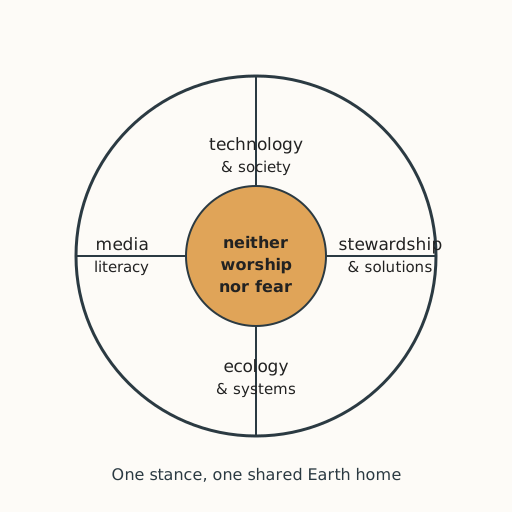
- Unit synthesis map · 1 per learner A one-page map of the four strands and the one stance — neither worship nor fear — connecting them
Low-tech / no-cost
- A shared board or large paper Draw the synthesis map together, connecting the four strands
- Voice and discussion Discuss the connections aloud; no printed sheet needed
Enriched / lab & device
- Device with web access · 1 per pair Build a digital portfolio or a shared document of the unit's artifacts
- A gallery of peers' portfolios · 1 To read and give feedback on two classmates' syntheses
Works in different contexts
- large-group Build the synthesis map whole-class, then each learner assembles their portfolio and shares one connection
- multi-age Younger learners draw one connection between two strands; older learners write the full synthesis
- self-directed A learner assembles the portfolio, completes the synthesis map, and writes a one-page reflection
- level-grouped A group ready to extend writes a short "steward's statement" of how they will weigh technology and care for the Earth
- outdoor-only Gather outdoors and, holding one artifact each, name how it connects to the living place around you
Lesson 14 — Our Earth Home: Putting It Together
Summary
Learners assemble the unit’s portfolio and synthesize its four strands — technology, media, ecology, and stewardship — into one stance: neither worship nor fear. They reflect on how the threads connect and write a short personal statement of how they will weigh technology and care for the Earth, closing the unit.
Objectives
- Synthesize the unit’s strands and evaluate a sustainability solution and the circular economy within a larger stance of stewardship. (D10.S4.10.01, D10.S4.10.02, with all unit objectives revisited)
Connection
For three weeks you have asked four questions: what does technology do to freedom and power? how do I check what I am told? what does the living Earth give us, and where are its breaking points? and how do we build something that lasts? They look like separate subjects, but they are one question: how do we live well, together, on this one shared home, with tools we made and a planet we did not? Putting the threads together is not a summary exercise — it is how a way of seeing becomes a way of living.
Materials
- Portfolio checklist
- Unit synthesis map
Preparation
- Copy the checklist and the synthesis map.
- Retrieval: gather the unit’s artifacts — the data-trail sheet, the asymmetry diagram, the gains/losses chart, the emerging-technology scale, the fact-check worksheet, the two-column fact/interpretation sheet, the ownership map, the frame/omission sheet, the ecosystem-services diagram, the biodiversity pyramid, the tipping-point diagram, the linear/circular diagram, and the sustainability evaluation.
- Prepare one worked example of connecting two strands in a single sentence.
Facilitator note
This lesson is written to the learner (“you”). The idea to land: the unit’s four strands are one stance — neither worship nor fear — applied to technology and the Earth; synthesis is the moment the skills become a way of living as a steward. This is a summative and reflective lesson: the heavy lifting is assembling, connecting, and writing, not new content. The technology and environment lenses are the twin poles the learner learns to hold in tension. The egalitarian lens: a steward asks who gains and who is left out, in every strand — privacy, news, services, solutions. The global lens: this one home is lived in many ways, and the learner’s way is one among them, not the default. The ethics lens: synthesis lands in choice — what the learner will do. Use retrieval (the checklist) and spacing (the artifacts span three weeks) deliberately; give feedback on the statement; treat “not yet” as information, not a verdict. Hold questions open (philosophy §11): the stance is a practice, not a finished answer. Celebrate the work as collective, not ranked.
Procedure
- Gather (5 min). Lay out your artifacts from the unit. What are the four strands, and which artifact belongs to each?
- Meet the synthesis (10 min). Look at the synthesis map. The four strands meet in one stance: neither worship nor fear — the tools we made deserve critical judgment, and the Earth we did not make deserves care. A synthesis is not a list; it is the connection between the parts.
- Worked example (10 min). Watch two strands connected in one sentence: “The same feed that shapes what I believe (media) is powered by the data I leave behind (technology), and a clear-eyed reader is as important as a careful steward.” Note how it names both strands and the connection.
- Guided practice (15 min). In a pair, write two more connecting sentences — one linking technology or media to ecology or stewardship, and one linking the fact-check method to the evaluation of solutions. Read them to each other and improve them.
- Independent practice (15 min). Assemble your portfolio against the checklist. Then write a short steward’s statement (five to eight sentences): how will you weigh technology — neither worshipping nor fearing it — and how will you care for the Earth home, starting with one concrete choice this month? Mark anything you are unsure of “not yet” and name one thing you want to revisit.
- Close (5 min). Share one line from your statement. You are not finished learning this — you are beginning to live it.
Differentiation
- Support: Provide sentence starters for the connecting sentences and the statement; allow the statement to be spoken and transcribed.
- Extension: Write the steward’s statement as a short letter to your future self, naming what you will do and what you will keep questioning.
- Expression: The statement may be written, spoken, drawn as a map, or recorded — the synthesis, not the format, is the goal.
Assessment
- Summative (portfolio): Does the portfolio contain each artifact, and does the steward’s statement connect the strands and name a concrete choice?
- Peer + self: Do the connecting sentences name both strands and a real connection? Does the statement show neither worship nor fear?
- “Not yet” is information: any gap is a thing to revisit, not a verdict.
Home connection
Share your steward’s statement with a family member, and ask them to name one thing they would weigh carefully and one way they care for the Earth. Compare your two homes.
Resources
- The unit’s sources are collected across Lessons 1–13. For the closing stance, revisit the two poles: WITNESS Media Lab on synthetic media (“prepare, don’t panic,” https://lab.witness.org/projects/synthetic-media-and-deep-fakes/, S-393) and the Ellen MacArthur Foundation on the circular economy (https://ellenmacarthurfoundation.org/, S-452).