Lesson 13 — Evaluating a Sustainability Solution: Benefits, Limits, Fairness
Learners evaluate a real sustainability solution — a restoration project, a circular scheme, or a community-managed commons — for its benefits, limits, and fairness. They weigh who gains and who pays, separate evidence from value, and reach a reasoned judgment about whether the solution is worth supporting and how it could be made fairer.
Objectives
Objectives
- D10.S4.10.01 Evaluate a real sustainability solution, such as a circular economy or a restoration project, for its benefits, limits, and fairness.
Essential question
How do I evaluate a real sustainability solution — its benefits, its limits, and whether it is fair to the people it affects?
Key vocabulary
Materials
Standard materials
- Solution evaluation sheet · 1 per learner A three-column sheet — benefits, limits, fairness — for evaluating a real sustainability solution
- Sustainability solution dossier · 1 per learner A sourced dossier on a real solution (a restoration project, a circular scheme, a community-managed commons), with benefits, limits, and fairness questions
Low-tech / no-cost
- A shared board or large paper Fill the three columns together for the solution
- Voice and discussion Discuss the solution aloud; no printed sheet needed
Enriched / lab & device
- Device with web access · 1 per pair Look up a current, sourced report on the solution to add evidence
- Two contrasting solutions · 1 per group Compare two real solutions — one high-tech, one community-based — on the same three columns
Works in different contexts
- large-group Evaluate one solution whole-class, then groups each evaluate a different solution and share their sheets
- multi-age Younger learners name one benefit and one limit; older learners write the full benefits/limits/fairness evaluation
- self-directed A learner reads the dossier, fills the three columns, and writes one paragraph of judgment
- level-grouped A group ready to extend weighs a benefit against a limit for the *same* community, and argues for the fairer design
- outdoor-only Evaluate a real solution you can see or imagine outdoors — a community well, a planted slope, a shared grazing rule — on the three columns
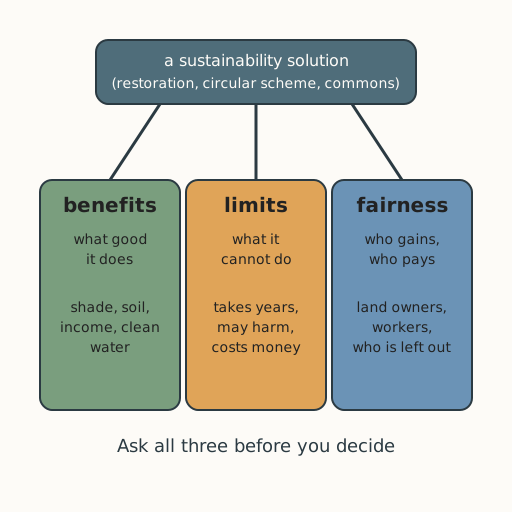
Lesson 13 — Evaluating a Sustainability Solution: Benefits, Limits, Fairness
Summary
Learners evaluate a real sustainability solution — a restoration project, a circular scheme, or a community-managed commons — for its benefits, limits, and fairness. They weigh who gains and who pays, separate evidence from value, and reach a reasoned judgment about whether the solution is worth supporting and how it could be made fairer.
Objectives
- Evaluate a real sustainability solution for its benefits, limits, and fairness. (D10.S4.10.01)
Connection
A plan to plant a million trees sounds unambiguously good — until you ask who owns the land, who gets the shade, and whose grazing or fields the new forest replaces. Every real solution is like this: it does real good, it has real limits, and it is fair or unfair to the people it touches. Sustainability — meeting today’s needs without robbing the future — is not a label to slap on; it is a balance to weigh. The skill is not enthusiasm or cynicism, but the three questions: what good does it do? what can’t it do? and who gains and who pays?
Materials
- Solution evaluation sheet
- Sustainability solution dossier
Preparation
- Copy the evaluation sheet and the dossier.
- Retrieval: from Lesson 12, recall the circular economy and “designing out waste.” Today we evaluate a real solution that tries to do that — and ask whether it is fair.
- Prepare one worked example of filling the three columns for a solution.
Facilitator note
This lesson is written to the learner (“you”). The idea to land: a sustainability solution is judged on three questions — benefits (what good it does), limits (what it cannot do), and fairness (who gains and who pays) — and fairness is where solutions most often fail. The environment lens is the spine. The egalitarian lens is decisive here: benefits and burdens rarely fall on the same people, and environmental justice is the discipline of noticing that (S-483, S-484). The global lens: the same solution (a plantation, a dam, a commons) succeeds or fails depending on local history and who holds the land. The ethics lens: fairness is a value judgment, not a measurement — say so plainly. The technology lens: high-tech and low-tech solutions both deserve the same three questions. Anchor the examples: sustainability defined as meeting today’s needs without compromising the future (S-395); community-managed commons as a documented, effective pattern of stewardship (S-416); the Green Belt Movement as a real restoration effort led by communities (S-059); indigenous cultural burning as place-based stewardship (S-320). Distinguish evidence (what the solution does) from values (whether it is fair) (philosophy §5). Preview: next lesson assembles the whole unit into one portfolio and one synthesis.
Procedure
- Recall (5 min). From Lesson 12: what does “designing out waste” mean, and why is waste a design choice?
- Meet the three questions (10 min). Look at the evaluation sheet. Benefits are the real goods a solution produces. Limits are what it cannot do or where it falls short. Fairness asks who gains and who pays — and whether that distribution is just. A trade-off is what you give up for what you get. Stewardship is caring for a resource so it lasts for others.
- Worked example (10 min). Watch one solution evaluated step by step — a community tree-planting project: (a) benefits (shade, soil held, wood, income); (b) limits (trees take years; monoculture plantings can harm biodiversity if done wrong); (c) fairness (who owns the land, who gets the harvest, whose grazing is displaced — the Green Belt Movement succeeded by putting communities, especially women, at the center, S-059).
- Guided practice (15 min). In a group, read the dossier — a real sustainability solution. Fill the three columns: at least two benefits, two limits, and a fairness analysis naming who gains and who pays.
- Independent practice (10 min). In your journal, write your judgment: is this solution worth supporting, and how could it be made fairer? If you only listed benefits without the fairness question, mark “not yet.”
- Close (5 min). Share one fairness finding. The lesson: a solution is as good as its most left-behind person.
Differentiation
- Support: Provide a half-filled sheet (one benefit and one limit pre-listed) and sentence starters.
- Extension: Weigh a benefit against a limit for the same community, and argue for the design that is both effective and fair.
- Expression: Learners may record their judgment aloud or have a partner read it — no step requires writing.
Assessment
- Formative (peer + self): Can the learner name benefits and limits of a solution and analyze its fairness — who gains and who pays?
- Portfolio artifact (unit): The completed evaluation sheet and judgment, as the “sustainability-solution evaluation” for the unit portfolio.
Home connection
With a family member, pick one local “green” effort — a recycling scheme, a new well, a planting drive — and ask the three questions: what good does it do, what can’t it do, and who gains and who pays?
Resources
- On sustainability as meeting today’s needs without compromising the future: World Commission on Environment and Development, Our Common Future (Brundtland, 1987) (S-395).
- On community-managed commons as effective stewardship: Elinor Ostrom, Governing the Commons (1990) (S-416).
- On the Green Belt Movement as community-led restoration: Nobel Prize, “Wangari Maathai, Facts,” https://www.nobelprize.org/prizes/peace/2004/maathai/facts/ (S-059).
- On indigenous cultural burning as place-based stewardship: CSIRO, Indigenous cultural burning education resources, https://www.csiro.au/en/education/Resource-Library/Indigenous-STEM-Education-Resources (S-320).
- On environmental justice — burdens and benefits falling unevenly: U.S. EPA, Environmental Justice (S-483); and Robert Bullard, Dumping in Dixie (1990) (S-484).