Lesson 01 — The Weather of a Group
Learners open the unit by learning to read the emotional climate of a group — the shared feeling that runs through a room, a crowd, or a society — and by naming three collective emotions (hope, fear, grief) that such climates are made of. They begin the unit portfolio that will gather their work across all six objectives.
Objectives
Objectives
- D01.S1.11.01 Articulate the emotional climate of a group or society and how collective emotions such as hope, fear, and grief arise.
Essential question
What is the emotional climate of a group, and how do I begin to read it?
Key vocabulary
Materials
Standard materials
- Journal or notebook · 1 per learner Becomes the unit portfolio as lessons accumulate
- Emotional-climate chart (print or draw) · 1 per pair The three collective emotions (hope, fear, grief) with blank rows for learners' own examples
Low-tech / no-cost
- Voice, body, and a shared room Read the room aloud; describe the climate in words instead of a chart
- A stick or line drawn in the ground Mark where the group's climate sits from "heavy" to "light"
Enriched / lab & device
- Short video clips of crowds (a match, a vigil, a market) · 2–3 clips To practice reading a climate at a distance; turn sound on and off to compare
- Shared digital board · 1 For a collective "climate word bank" learners add to in real time
Works in different contexts
- large-group Read the whole room's climate together aloud; invite several learners to name it, then look for where they agree
- multi-age Younger learners name a feeling in the room; older learners name how it arose and who it reaches
- self-directed A learner observes any group they are in (a household, a queue, a feed) and writes three climate words with one cause each
- level-grouped Group by comfort with abstract vocabulary; a ready group extends to naming *contagion* and *climate* with examples from history or media
- outdoor-only Read the climate of an outdoor gathering or marketplace; compare the "weather" of the sky with the "weather" of the group
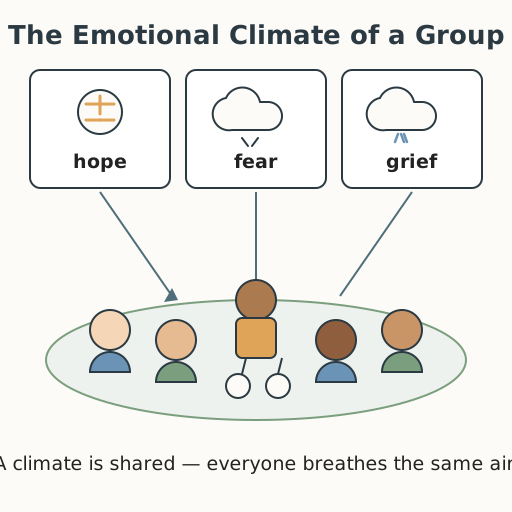
Lesson 1 — The Weather of a Group
Summary
Learners meet the idea of an emotional climate: the shared feeling that runs through a group, a crowd, or a whole society, larger than any one person and yet made of many people’s feelings at once. They practice reading a climate before they try to change one, and they set up the journal that will become this unit’s portfolio.
Objectives
- Articulate the emotional climate of a group or society and how collective emotions such as hope, fear, and grief arise. (D01.S1.11.01)
Connection
Walk into a room right after someone has shared wonderful news, and you feel it before anyone says a word. Walk into a market on a day when trade is bad, or onto a bus the morning after a storm, and a different air is there. Every group has a weather — a shared feeling made of everyone’s feelings at once. Learning to read that weather is the first step to understanding it, and later, to shaping it.
Materials
- A journal or notebook (this becomes your unit portfolio)
- An emotional-climate chart, printed or drawn (the three collective emotions, with blank rows for your own examples)
Preparation
- Arrange seats in a circle or a way everyone can see the whole group.
- Draw or print the emotional-climate chart; have a blank page ready in the journal.
- Retrieval (spaced): in earlier grades you learned to name your own feelings, to hold two feelings at once, and to notice how culture shapes which feelings are shown. This unit turns the same skills outward, toward whole groups and societies.
Facilitator note
This lesson is written to the learner (“you”). The idea to land: an emotional climate is a shared feeling bigger than any one person, and it can be read — named with evidence — before it is judged or changed. Teach reading as a skill with a worked example (S-011), then let learners observe a real group.
The social-emotional lens is the ground here: reading a climate draws on the emotional literacy learners built in earlier grades (CASEL self- and social awareness, S-001; RULER’s label-emotions-with-precision skill, S-015). The ethics lens: how we name a group’s feeling can honor or flatten it — “they’re all panicking” is very different from “there is fear here, and it comes from a real threat.” The egalitarian lens: a climate is felt unevenly — the same news lifts some and wounds others, and who feels hope or fear is not distributed equally. The global lens: climates span nations (the mood of a country after a victory or a loss), so “reading the room” scales up to reading the world. The technology & environment lens: screens now carry a group’s weather across borders — a storm of feeling on one continent can be felt in a room on another within an hour; and the living environment has its own shared states (a drought, a flood) that shape a community’s emotional weather.
Emotional safety first. This unit touches identity, values, and purpose, which are vulnerable. From this first day, make the ground rules explicit and non-negotiable: (1) no one is ever required to share a private feeling or story — “pass” is a complete answer; (2) we observe and name climates and groups, never to single out or shame a person; (3) there are no wrong feelings, only feelings; (4) “not yet” is information, never a verdict. Hold collective emotion as a question to explore, not a fact to accept (philosophy §11). If a learner steps away or stays silent, honor that.
Procedure
- Gather and recall (5 min). Think back, without speaking yet: in earlier grades, what did you learn about your own feelings — naming them, holding two at once, noticing where they live in your body? Keep one of those skills in mind; today we turn the same skill toward a whole group.
- Meet the idea (10 min). An emotional climate is the shared feeling of a group, bigger than any one person, made of many feelings at once. Worked example: after a hard loss, a whole community can carry grief you can feel in the air — the lowered voices, the slower steps, the shared silence. That is a climate of grief. Two others named in this unit are hope (the shared lift when a real opening appears) and fear (the shared tightening when a threat looms). Look at the chart; keep it open.
- Read a real group (15 min). Notice the room you are in right now — by sight, sound, or feel. Without naming any one person, write three words that capture the climate of the group — the shared feeling — and one clue you noticed that led you to each word (a tone, a silence, a speed, a posture — heard as easily as seen). If you are alone, observe any group you were in today.
- Name where it comes from (15 min). For each climate word, ask: where does this shared feeling come from? It usually comes from something the group shares — a history, a condition, a piece of news, a threat, a promise. Write one sentence for each: “the group feels ___ because ___.” This is the beginning of explaining how collective emotions arise.
- Open the portfolio (5 min). Label the first page of your journal “Feelings, Identity & Purpose.” This is where every piece of this unit’s work will gather.
- Close (5 min). Say it aloud or write it: a climate is shared, and it is readable. Name one group whose weather you would like to understand better this unit.
Differentiation
- Mode (expression): Writing is one way, not the only way — respond by speaking, pointing to a word card, arranging found objects, drawing, or gesturing; a response that uses neither writing nor speaking is still a full response.
- Support: Offer a starter bank of climate words (heavy, light, tense, warm, hopeful, worried) and one worked example to copy before writing their own.
- Extension: Compare two climates — the same room before and after news, or a stadium crowd versus a vigil — and name what changed the weather.
Assessment
- Formative (observation): Can the learner name the climate of a group and give at least one evidence clue, rather than only describing their own feeling?
- Portfolio (unit): The journal is begun; the climate reading becomes the first artifact toward D01.S1.11.01.
Home connection
Ask someone at home to describe the “mood” of a place they were in today — a shop, a queue, a workplace, a bus — and what made it that way. Notice: they are reading a climate, the same skill you practiced today.
Resources
- CASEL, Fundamentals of Social and Emotional Learning (self-awareness and social awareness competencies): https://casel.org/fundamentals-of-sel/ (S-001).
- Yale Center for Emotional Intelligence, RULER Approach (labeling emotions with precision, in self and others): https://www.rulerapproach.org/ (S-015).
- On worked examples and guided practice: Kirschner, Sweller & Clark (2006), https://doi.org/10.1207/s15326985ep4102_1 (S-011).