Lesson 02 — How Hope Spreads
Learners analyze how collective hope arises: shared history and shared conditions meet a real opening, and a group's feeling lifts together. They trace one example through the flow and add a hope reading to their portfolio.
Objectives
Objectives
- D01.S1.11.01 Articulate the emotional climate of a group or society and how collective emotions such as hope, fear, and grief arise.
Essential question
How does a shared feeling of hope arise in a group or society?
Key vocabulary
Materials
Standard materials
- Journal · 1 per learner
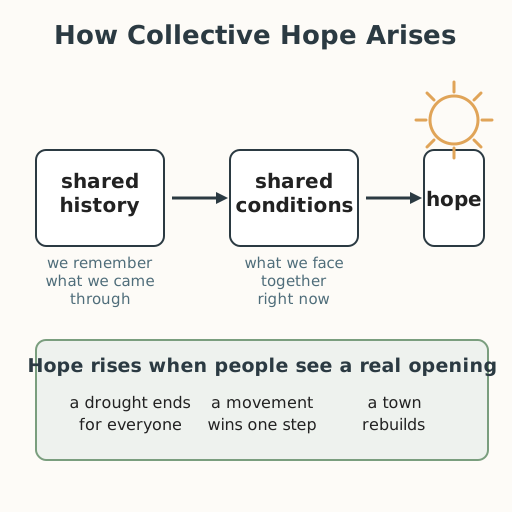
- Hope-flow diagram (print or draw) · 1 per pair Shared history -> shared conditions -> shared feeling (hope)
Low-tech / no-cost
- Voice and memory Retell a shared memory aloud; trace the hope that grew from it
- Three stones or markers in a row Stand one stone for history, one for conditions, one for the feeling that follows
Enriched / lab & device
- News archives or a search engine · 1 per pair Find a documented example of collective hope (a movement, a rebuild, a recovery) and trace its flow
Works in different contexts
- large-group Build one shared hope-flow diagram on the board from many learners' examples; look for the common shape
- multi-age Younger learners tell a time hope rose in their family; older learners analyze the structure (history -> conditions -> hope)
- self-directed A learner chooses one documented example and writes the flow: what history, what conditions, what hope
- level-grouped A ready group critiques the flow — when does shared history *block* hope instead of feed it?
- outdoor-only Find a real "opening" outdoors (a field after rain, a repaired path) and trace the hope it makes people feel
Lesson 2 — How Hope Spreads
Summary
Learners work out the shape of collective hope: a shared history and shared conditions meet a real opening, and a group’s feeling lifts together. They trace one example through that flow — history, conditions, hope — and learn to distinguish hope that is grounded in a real opening from hope that is only wished for.
Objectives
- Articulate the emotional climate of a group or society and how collective emotions such as hope, fear, and grief arise. (D01.S1.11.01)
Connection
After a long drought, the first real rain lifts a whole village — not because any one person decided to feel good, but because everyone shares the memory of the dry months and everyone now sees the same opening. Hope is like that everywhere: a city after a hard-won victory, a family after a feared test comes back well, a movement after a single step forward. Hope is a shared feeling, and it has a shape we can read.
Materials
- Your journal
- A hope-flow diagram (shared history → shared conditions → shared feeling)
Preparation
- Draw or print the hope-flow diagram (see the asset).
- Retrieval (spaced): from Lesson 1, recall what an emotional climate is and name the three collective emotions. Today we take the first one — hope — apart to see how it arises.
Facilitator note
This lesson is written to the learner (“you”). The idea to land: collective hope has a structure — shared history + shared conditions + a real opening → a shared feeling — and reading that structure lets a learner both explain and (carefully) cultivate hope. Teach the flow with a worked example first (S-011), then let learners trace their own.
The social-emotional lens: hope is an emotion, but here it is a collective one, read in a group’s words and postures (CASEL social awareness, S-001). The ethics lens: there is a difference between hope grounded in a real opening and hope that glosses over harm — honest hope does not demand that people ignore what is wrong. The egalitarian lens: openings do not open equally — who gets to feel hope about a change often tracks who will actually benefit from it. The global lens: liberation movements, harvests, and rebuilds across the world are living laboratories of collective hope; read them as examples, never as one people’s possession. The technology & environment lens: screens can spread hope fast (a livestreamed victory, a shared image of recovery), and the living world is itself a source of shared hope (a returning species, a healed field) — but an environment under strain can also drain hope, and that, too, is a climate to read honestly.
Emotional safety. Hope is real but fragile; some learners may be in a place where hope feels far away. Do not require anyone to manufacture or perform hope. Frame the lesson as reading how hope arises, not as feeling it on command. “Pass” always holds.
Procedure
- Recall (5 min). From yesterday: what is an emotional climate? Name the three collective emotions this unit centers. Keep them in front of you.
- Work out the shape (15 min). Worked example, traced together. Shared history: a community remembers years of drought. Shared conditions: the wells are low, the ground is cracked, everyone is rationing. A real opening: the rain finally comes, and the reservoir begins to refill. Shared feeling: hope rises — you can hear it in the voices and see it in the faces. Write the flow: shared history → shared conditions → a real opening → shared hope.
- Trace your own example (20 min). Choose one example of collective hope — a harvest after a hard season, a movement celebrating a step won, a neighborhood rebuilding after a flood, a team after a long losing streak. Write the four parts for your example. Then add the honesty check: is the opening real, or only wished? A hope built on a real opening can last; a hope built on nothing but wanting is different. Note which yours is.
- Peer-check (10 min). Trade with a partner. Read their flow and check: are all four parts present, and does the hope follow from the opening rather than leap out of nowhere? Give one thing that works and one question that sharpens it.
- Close (5 min). In your journal, finish one sentence: Hope in a group usually follows a real ______. Put the hope-flow page in your portfolio.
Differentiation
- Mode (expression): Writing is one way, not the only way — respond by speaking, pointing to a word card, arranging found objects, drawing, or gesturing; a response that uses neither writing nor speaking is still a full response.
- Support: Provide the four sentence starters (“We remember… / Right now we face… / Then a real opening appeared: … / And so we felt…”) and one filled example to copy.
- Extension: Analyze a failed hope — a time a group’s hope collapsed — and name which of the four parts broke.
Assessment
- Formative (peer + self): Does the learner’s example show the four-part flow, with the honesty check applied (real opening vs. wished)?
- Portfolio: The hope-flow page, gathered toward D01.S1.11.01.
Home connection
Ask someone at home about a time the whole family, village, or neighborhood felt hope rise at once. What had they shared, and what opening made it real?
Resources
- CASEL, Fundamentals of Social and Emotional Learning (social awareness — reading a group): https://casel.org/fundamentals-of-sel/ (S-001).
- On worked examples and guided practice: Kirschner, Sweller & Clark (2006), https://doi.org/10.1207/s15326985ep4102_1 (S-011).