Lesson 10 — Deciding When Nothing Is Certain
Learners extend the decision loop to decisions made under genuine uncertainty, where no option is certain. They practice the three-part move — what I know, what I value, what I'll do if I'm wrong — and learn that missing a mark is repaired, not a verdict.
Objectives
Objectives
- D01.S3.11.01 Make decisions that align their actions with their values, even under pressure or uncertainty.
Essential question
How do I act in line with my values when I cannot know the outcome?
Key vocabulary
Materials
Standard materials
- Journal · 1 per learner
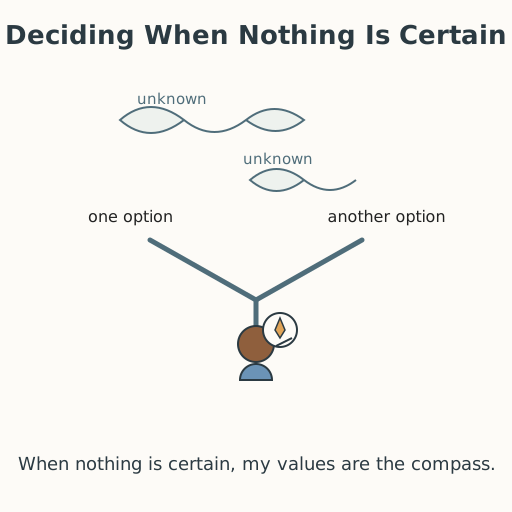
- Fog-of-uncertainty diagram (print or draw) · 1 per learner A figure at a fork under fog, holding a compass
Low-tech / no-cost
- Voice and a partner Talk through an uncertain decision aloud; the partner asks "what do you know, what do you value?"
- Two real paths to choose between outdoors Stand at the fork and decide by your compass, not by certainty
Enriched / lab & device
- A decision-log app or shared doc · 1 per learner To keep adding entries across the unit
Works in different contexts
- large-group Work one uncertain decision whole-class, then learners add a private entry to their log
- multi-age Younger learners name one thing they can know and one they cannot; older learners write a full uncertain-decision entry with a repair plan
- self-directed A learner writes one uncertain-decision entry and self-checks the three-part move: what I know, what I value, what I'll do if I'm wrong
- level-grouped A ready group argues when it is right to *wait* rather than decide — and when waiting is itself a decision
- outdoor-only Stand at a real fork in a path, name what is unknown, and choose by your compass
Lesson 10 — Deciding When Nothing Is Certain
Summary
Learners practice decisions made under uncertainty — where no option guarantees an outcome. They add a three-part move to the decision loop: what I know, what I value, what I’ll do if I’m wrong. They learn that a wrong turn is repaired and reflected on, not a verdict — and that a “good-enough” decision made honestly is often the best available.
Objectives
- Make decisions that align their actions with their values, even under pressure or uncertainty. (D01.S3.11.01)
Connection
Sometimes you can see the whole board; sometimes you are choosing a path in fog. The decision to start a project, to trust someone, to change direction, to leave a place — these come with no guarantee. Waiting for certainty can be its own kind of trap, because certainty may never come. The mature skill is not to know the outcome; it is to choose by your values and stay able to repair. A compass works in fog. That is what it is for.
Materials
- Your journal
- A fog-of-uncertainty diagram (see the asset)
Preparation
- Print or draw the fog-of-uncertainty diagram.
- Retrieval (spaced): from Lesson 9, recall the five steps of the decision loop. Today we add what to do when step 3 — “consider options” — is shrouded in fog.
Facilitator note
This lesson is written to the learner (“you”). The idea to land: under uncertainty, you cannot optimize for a certain outcome, so you optimize for honesty and repairability — decide by your values, name what you know and don’t know, and keep a repair path open. Teach the three-part move with a worked example (S-011).
The ethics lens: acting under uncertainty is where character shows — the question is not “what will happen?” but “what kind of choice is this?” The egalitarian lens: uncertainty is not distributed equally — some people can afford to be wrong, and others cannot; a fair decision weighs who carries the downside of a wrong call. The global lens: leaders, communities, and nations decide in fog all the time (a harvest, an evacuation, a treaty), and the same discipline — name the unknown, decide by values, keep repair open — applies at every scale. The technology & environment lens: our sense of certainty is often shaped by screens that feel certain but are not (a confident-sounding post, a smoothed-over prediction), and environmental decisions are classic fog — you cannot know the full future of a climate choice, yet you must choose. Naming what is unknown is itself an act of intellectual honesty.
Emotional safety. Normalize being wrong. The “repair” step exists precisely so a miss is not a shame. Model a wrong decision of your own and how you repaired it. No learner is required to share a high-stakes private dilemma; hypotheticals are always available.
Procedure
- Recall (5 min). Name the five steps of the decision loop. Which one gets hardest when the fog rolls in? (Usually “consider options” — because you cannot see the outcomes.)
- Meet the three-part move (15 min). When you cannot know the outcome, run these
three questions:
- What do I know? — the few solid facts, honestly separated from guesses.
- What do I value? — which values apply, and what would they point toward.
- What will I do if I’m wrong? — my repair path: how I’ll notice, own, and fix a bad call. Worked example: deciding whether to speak up about an unfair rule, not knowing how people will react. I know the rule exists and who it hurts. I value fairness and courage. If I’m wrong about the reaction, I’ll apologize for any misstep, learn, and try a better way next time. Copy the move into your journal.
- Run it on a real decision (20 min). Choose one uncertain decision — starting something, trusting someone, changing course — and answer the three questions in writing. If you prefer, use this public one: whether to join a community effort to repair a shared space, when you are not sure it will succeed.
- Name the “good-enough” truth (10 min). Write one sentence: a decision made honestly in fog, with a repair path open, is usually better than a decision never made. Then add today’s entry to your decision log.
- Close (5 min). Put the log entry in your portfolio. Remember: the compass works in fog — that is its whole job.
Differentiation
- Mode (expression): Writing is one way, not the only way — respond by speaking, pointing to a word card, arranging found objects, drawing, or gesturing; a response that uses neither writing nor speaking is still a full response.
- Support: Provide the three questions as a fill-in template and one worked example to copy.
- Extension: Take a past uncertain decision you now see was wrong, and write what your repair path would have been — and what you learned.
Assessment
- Formative (self): Does the log entry separate what is known from what is guessed, tie the choice to a value, and include a concrete repair path?
- Portfolio: The uncertain-decision entry, gathered toward D01.S3.11.01.
Home connection
Ask an adult about a decision they made without knowing how it would turn out. What did they hold onto, and what was their plan if it went wrong?
Resources
- CASEL, Fundamentals of Social and Emotional Learning (responsible decision-making): https://casel.org/fundamentals-of-sel/ (S-001).
- On worked examples and guided practice: Kirschner, Sweller & Clark (2006), https://doi.org/10.1207/s15326985ep4102_1 (S-011).