Lesson 09 — The Values Compass Under Pressure
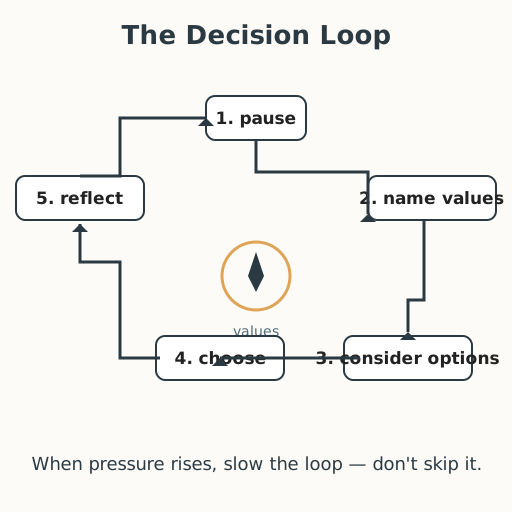
Learners learn a five-step decision loop — pause, name values, consider options, choose, reflect — and practice it on real decisions made under pressure. They begin a values-aligned decision log for the portfolio.
Objectives
Objectives
- D01.S3.11.01 Make decisions that align their actions with their values, even under pressure or uncertainty.
Essential question
How do I make a decision that keeps my actions aligned with my values, even under pressure?
Key vocabulary
Materials
Standard materials
- Journal · 1 per learner
- Decision-loop diagram (print or draw) · 1 per learner Pause -> name values -> consider options -> choose -> reflect
Low-tech / no-cost
- Voice and a partner Talk through the loop aloud on a real decision; the other person holds the space
- Five steps drawn in the ground Stand on each step in turn as you move through a decision
Enriched / lab & device
- A decision-journal app or shared doc · 1 per learner To keep a running decision log across the unit
Works in different contexts
- large-group Work one decision whole-class on the board, then each learner runs their own privately
- multi-age Younger learners practice pausing before reacting; older learners run the full loop and write a decision log entry
- self-directed A learner runs the loop on one real decision and self-checks that each step is present
- level-grouped A ready group tests the loop against a genuinely hard case where two values conflict
- outdoor-only Walk the five steps in a real space, saying each step aloud as you stand on it
Lesson 9 — The Values Compass Under Pressure
Summary
Learners meet a decision loop — a five-step discipline for acting in line with their values even when pressure is high: pause, name your values, consider your options, choose, reflect. They practice it on real decisions, notice how pressure (including peer pressure) tries to skip the loop, and begin a values-aligned decision log.
Objectives
- Make decisions that align their actions with their values, even under pressure or uncertainty. (D01.S3.11.01)
Connection
The hardest decisions are the ones that arrive fast and loud — a friend dares you to join in, a crowd is angry and wants you to agree, a chance to win asks you to cut a corner. In those moments the pressure is doing everything it can to make you skip the thinking. A compass is useless if you never look at it. This lesson gives you a small, repeatable loop for looking — even when everything is moving fast.
Materials
- Your journal
- A decision-loop diagram (see the asset)
Preparation
- Print or draw the decision-loop diagram.
- Retrieval (spaced): from Lesson 5, recall the values you named — they are the needle of the compass you will use today.
Facilitator note
This lesson is written to the learner (“you”). The idea to land: values alignment under pressure is a skill, and skills are taught with a worked example and practiced — the five-step loop is that scaffold (S-011). Pressure, including peer pressure, is developmentally real at this age (adolescence is a period of heightened sensitivity to peers, Steinberg, S-229), so treat resisting it as a skill to practice, not a character flaw to shame.
The ethics lens: this is responsible decision-making made explicit (CASEL, S-001) — the loop forces a pause in which “what is right?” and “what do I value?” are actually asked. The egalitarian lens: a decision is not only about the chooser — the loop’s “consider options” step includes who is helped and who is hurt, so fairness is built into the discipline rather than bolted on. The global lens: the same loop scales — communities and nations under pressure make decisions the same way, and learners can read a public decision (a policy, a movement’s choice) with the same five steps. The technology & environment lens: pressure now arrives through screens (a fast-moving post, a group chat, an algorithm that rewards reacting), and decisions now often carry environmental weight (what to buy, what to throw, what to stand for) — the loop works for all of it.
Emotional safety. Use decisions that are real but not traumatic. Do not require any learner to disclose a private dilemma; they may work with a hypothetical or a public example. Celebrate the process, not the “right” answer — there is often no single right answer, only a more or less honest one.
Procedure
- Recall (5 min). Which values did you name in Lesson 5? Write your top two where you can see them.
- Meet the loop (15 min). Worked example, together. The situation: your friends
are laughing at someone and want you to join in. Run the loop:
- Pause — stop the autopilot; notice the pressure.
- Name your values — fairness, kindness.
- Consider options — join in, stay silent, say something, leave. For each: who is helped, who is hurt?
- Choose — the option that best fits your values (maybe: “that’s not funny; leave them be”).
- Reflect — afterwards: did it feel right? what would you keep or change? Copy the loop into your journal.
- Run your own (20 min). Choose one real decision you face or recently faced — one where the pressure was on. Run it through all five steps, writing each. If you do not want to use a private one, use this public one instead: a rumor about someone is spreading in a group chat, and everyone expects you to pass it on.
- Peer-check (10 min). Trade loops with a partner. Check: are all five steps present, and does the “choose” actually follow from the values named? Give one thing that is strong and one question that could sharpen it.
- Close (5 min). Start your decision log: one entry, dated, with the five steps. This log will grow across the unit and into your portfolio. Remember: pressure wants you to skip the loop; the loop is how you keep your compass in your hand.
Differentiation
- Mode (expression): Writing is one way, not the only way — respond by speaking, pointing to a word card, arranging found objects, drawing, or gesturing; a response that uses neither writing nor speaking is still a full response.
- Support: Provide the worked example as a fill-in template and a short menu of options for step 3.
- Extension: Run the loop on a decision where two of your own values conflict, and write how you weighed them.
Assessment
- Formative (peer + self): Does the learner’s decision log show all five steps, with the choice traceable to the named values?
- Portfolio: The first decision-log entry, gathered toward D01.S3.11.01.
Home connection
Ask an adult to describe a time they had to decide something hard under pressure. With them, see if their story maps onto the five steps — and what they learned.
Resources
- CASEL, Fundamentals of Social and Emotional Learning (responsible decision-making): https://casel.org/fundamentals-of-sel/ (S-001).
- Steinberg (2014), Age of Opportunity (adolescent sensitivity to peers) (S-229).
- On worked examples and guided practice: Kirschner, Sweller & Clark (2006), https://doi.org/10.1207/s15326985ep4102_1 (S-011).