Lesson 03 — Movement as Regulation: How Moving Shifts Your State
Learners move their bodies in a simple, adaptable way, observe how their state shifts, and learn the evidence for movement's effect on mood — endorphins, monoamines, and BDNF among the mechanisms — so they can use movement deliberately as a regulation tool.
Objectives
Objectives
- D03.S1.11.01 Use mind-body practices such as breathing, movement, and mindfulness deliberately to regulate their own state and explain why they work.
Essential question
How does moving my body change how I feel and think, and what is the evidence for it?
Key vocabulary
Materials
Standard materials
- Movement-shifts-state chart (printed or drawn) · 1 for the group A three-figure sequence — heavy/still, in motion, settled
- Practice log · 1 per learner
- Space to move (or a chair/seated option) · as available
Low-tech / no-cost
- Body and space Walking, stretching, or seated movement need no equipment
- Voice for counting and cues The facilitator or a learner leads the movement aloud
Enriched / lab & device
- Short physical-activity video or app · 1 for the group Optional guided movement, if a device is available
- Heart-rate display (optional, with consent) · 1 per group To observe heart rate rise and settle with movement and rest
Works in different contexts
- large-group Use a whole-room movement (march in place, stretch) so everyone moves together without travel or equipment
- multi-age Let each learner choose the intensity that fits them; movement is adapted, never ranked
- self-directed A learner chooses one movement (walk, stretch, dance) and records state before and after
- level-grouped Pair learners to design a two-minute movement together; a ready group explains the mood mechanism
- outdoor-only Walk or move outdoors; note how the environment (air, light, sound) adds to the effect
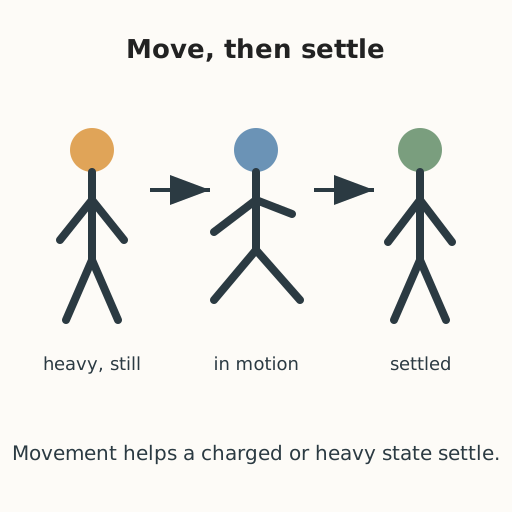
Lesson 3 — Movement as Regulation: How Moving Shifts Your State
Summary
Learners move in a way that fits their own body, notice how their state changes, and learn what the evidence says about why movement lifts mood and clears thinking. They leave able to use movement deliberately — not as punishment or weight control, but as a way to shift how they feel.
Objectives
- Use movement deliberately to regulate your own state and explain the evidence for why movement affects mood and thinking. (D03.S1.11.01)
Connection
Think of a day you felt heavy, stuck, or irritable — and then you walked somewhere, played, danced, or carried something, and afterward the world looked different. Movement is not only about fitness or appearance; it changes your chemistry and your mind. A farmer after a morning of labor, a student between lessons, a dancer before a show — all use the same lever: a body in motion talks back to the brain.
Materials
- Movement-shifts-state chart
- Practice log
- Space to move (with a seated option always available)
Preparation
- Clear space for safe movement.
- Prepare a short movement sequence that works standing, seated, and wheeling.
Facilitator note
This lesson combines a practice (movement) with evidence (mechanisms), so hold both. Model the movement first, then guide it, then let learners adapt it (Kirschner, Sweller & Clark, 2006; S-011). The evidence is hedged, not a sales pitch: research shows physical activity improves mood and reduces symptoms of depression and anxiety, and describes several mechanisms — endorphins (natural opioid-like chemicals), monoamines (serotonin, dopamine, noradrenaline), and BDNF (brain-derived neurotrophic factor) — but no single chemical is the whole story (Mikkelsen et al., 2017; S-408). WHO guidance adds that regular activity supports significant physical and mental health benefits (S-341).
Anti-ableism and dignity. Movement is never a test of a body. Every movement can be done seated, wheeling, lying, or at low intensity. No one is required to reach a target heart rate or intensity. The point is the shift in state, not performance. For learners who cannot move, or can move very little, offer a non-motor alternative: motor imagery — vividly imagining a movement you enjoy, which activates some of the same brain pathways as doing it — or simply noticing the urge to move and the small real shifts of breath and posture without changing them. The evidence and the before/after noticing are open to every body, moving or still. Never frame movement as a way to shrink or fix a body — bodies are not problems to solve.
The ethics lens: moving to feel well is a kind act toward yourself. The egalitarian lens: movement is for every body, adapted freely, never ranked. The global lens: people move in countless culturally shaped ways — work, dance, sport, play — and all of them can shift state. The technology lens: trackers and apps count movement, but the benefit does not require a device; it is worth asking whether a tracker helps or distorts your relationship with your body. The critical-thinking lens: read the evidence carefully — “movement helps” is not the same as “more is always better.”
Procedure
- Recall (5 min). From memory: why does slow breathing calm you? Write the mechanism in one sentence, then check your log.
- Before (5 min). Mark your state on the spectrum. Write two words for how you feel before moving.
- Move (10 min). Follow a simple sequence, adapting every part to your body: gentle marching or tapping in place, big arm circles, a slow reach up and fold forward, a side-to-side sway, a shake-out of hands and feet. Do it seated or standing — whatever fits you. Two minutes is enough; more is welcome. If moving is not possible or comfortable for you, use motor imagery instead: close your eyes and vividly imagine a movement you enjoy, or simply track the small, real shifts of breath and posture without changing them.
- After (5 min). Mark your state again. What changed? Did anything feel lighter, warmer, clearer, or the same?
- The evidence (10 min). Read or listen to the mechanism: movement can improve mood and reduce symptoms of depression and anxiety; possible mechanisms include endorphins, monoamines, and BDNF (Mikkelsen et al., 2017; S-408). Discuss: what does “one mechanism among several” tell you about how to read health claims?
- Explain it back (10 min). In your log, complete: “Movement can shift my state because…” and “A way I can move that fits my body and my place is…” Share with a partner.
- Close (5 min). One slow breath. Notice your state. Movement is a tool you carry with you.
Differentiation
- Support: Offer a seated-only sequence and sentence starters for the log entry; offer motor imagery or “notice the urge to move” as a non-motor alternative.
- Extension: Ask learners to find one additional peer-reviewed detail about the movement–mood link and note it with a source.
Assessment
- Formative (self + peer): Can the learner describe their before/after state and name at least one mechanism (endorphins, monoamines, BDNF) with appropriate hedging?
- Artifact (portfolio): The before/after state note and “why it works” entry in the practice log.
Home connection
Once this week, when you feel stuck or heavy, move for two minutes in a way that fits your body and your space — stretch, walk, dance, carry something. Log what happened. Movement is a tool, not a chore.
Resources
- Mikkelsen et al. (2017) — Exercise and mental health, Maturitas: https://doi.org/10.1016/j.maturitas.2017.09.003 (S-408).
- WHO — Physical activity fact sheet: https://www.who.int/news-room/fact-sheets/detail/physical-activity (S-341).