Lesson 04 — Attention as a Practice: Mindfulness Across Traditions
Learners practice returning attention to a chosen anchor and understand mindfulness as an ancient, cross-cultural skill of noticing the wandering mind without judgment, now studied by science as a modest, still-growing tool for attention and stress.
Objectives
Objectives
- D03.S1.11.01 Use mind-body practices such as breathing, movement, and mindfulness deliberately to regulate their own state and explain why they work.
Essential question
What is mindfulness, where does it come from, and how does returning my attention to an anchor help regulate my state?
Key vocabulary
Materials
Standard materials
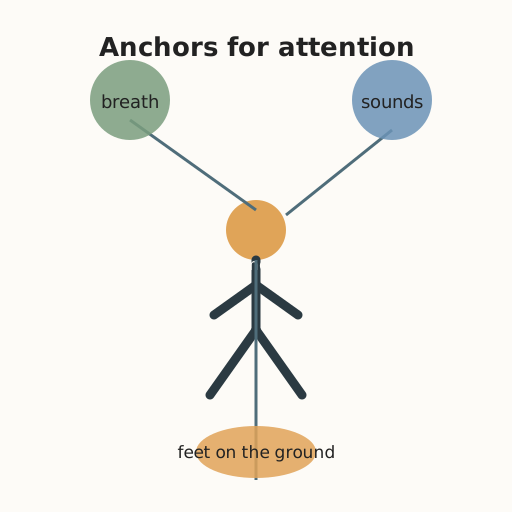
- Attention-anchors chart (printed or drawn) · 1 for the group A seated figure with three anchors — breath, sounds, feet on the ground
- Practice log · 1 per learner
Low-tech / no-cost
- Voice and body Guide attention to breath, sounds, and the feeling of the feet; no chart needed
- A quiet moment The practice itself is the material
Enriched / lab & device
- Short guided audio (optional) · 1 for the group A brief, secular or multi-tradition guided attention practice, if available
- Timer with a gentle chime · 1 for the group To mark one-minute sits without a jarring sound
Works in different contexts
- large-group Guide the practice aloud once for the whole room; keep eyes optional and the voice calm
- multi-age Younger learners use very short sits (30–60 seconds); older learners can extend to two minutes
- self-directed A learner sets their own timer, chooses one anchor, and records how many times their mind wandered without judging it
- level-grouped Pairs take turns as "guide" and "practitioner"; a ready group researches the origin of one mindfulness tradition
- outdoor-only Use natural anchors — the sound of wind, the feel of the ground, the sight of a leaf moving
Lesson 4 — Attention as a Practice: Mindfulness Across Traditions
Summary
Learners practice returning attention to a chosen anchor — breath, sounds, or the feet on the ground — and learn that mindfulness is not a new product but a very old, cross-cultural skill of noticing when the mind wanders and bringing it back without judgment. They connect the practice to its living traditions and to modern, appropriately hedged research.
Objectives
- Use mindfulness (deliberate attention) to regulate your own state, and explain what it is and where it comes from. (D03.S1.11.01)
Connection
Have you ever walked into a room and forgotten why, or read a whole page and realized you were thinking about something else? The mind wanders; that is what minds do. The skill is not to stop the wandering — it is to notice it and gently come back. People have practiced this skill for thousands of years, in many lands, and it needs no equipment: just attention, an anchor, and patience.
Materials
- Attention-anchors chart
- Practice log
- A timer with a gentle chime (optional)
Preparation
- Prepare a quiet space and a gentle way to mark time.
Facilitator note
This lesson holds two things side by side, without ranking them: the living contemplative traditions that developed mindfulness (Buddhist meditation lineages in South and East Asia, and other contemplative practices worldwide), and the modern secular study of mindfulness as a psychological skill. Be honest about both. Frame mindfulness as a practice that comes from real cultures and real people, not a self-help invention, and avoid presenting it as a religion-free “technique” stripped of its roots without acknowledging where it comes from (UNESCO’s intangible cultural heritage frame, S-056; the mindfulness component of self-compassion, Neff, S-222).
Evidence is hedged. Research suggests mindfulness may help with attention, stress, and wellbeing, but effects are often modest and studies vary; it is not a cure for anything and not a replacement for medical or mental-health care. State this plainly. CASEL lists self-management — which includes regulating attention and impulses — as a core competency (S-001).
Safety. Attention practice is generally safe, but some learners may find stillness hard or distressing. Always offer movement or eyes-open options and never require a long, silent, closed-eyes sit. Learners may opt out entirely.
The ethics lens: practicing an old tradition requires respect for its origins, not erasure. The egalitarian lens: attention practice costs nothing and belongs to everyone, while commercial “mindfulness” products raise the question of who profits from an ancient shared practice. The global lens: this skill appears in many cultures under many names. The technology lens: apps now deliver the practice, but the skill predates — and does not require — the device.
Procedure
- Recall (5 min). Two tools so far: breathing and movement. From memory, write one sentence on how each works, then check your log.
- Meet the wandering mind (5 min). Watch your own thoughts for thirty seconds: count how many times your mind drifts from what you meant to focus on. Do not judge the number — noticing is the skill.
- The anchors (5 min). Look at the chart. An anchor is anything steady you can return attention to: your breath, the sounds around you, the feeling of your feet on the ground. Pick one.
- Practice (10 min). Sit comfortably (or stand, or lie). Bring attention to your anchor. When your mind wanders — and it will — notice, and gently return. Try one minute; try two if you like. A gentle chime can mark the end.
- Where does this come from? (10 min). Discuss or read: mindfulness grows out of contemplative traditions — most famously Buddhist meditation lineages of South and East Asia — practiced for over two thousand years, and appears in other forms in many cultures. Modern psychology studies it as a secular skill. Why does it matter to know where a practice comes from?
- Explain it back (10 min). In your log: “Mindfulness is…” and “It helps me regulate my state because…” (hedged — “may help,” “one tool among many”).
- Close (5 min). Three slow breaths. Where is your state now? A wandering mind, brought back kindly, is the practice itself.
Differentiation
- Support: Use 30-second sits with an eyes-open anchor (a leaf, a mark on the wall); allow walking or rocking attention practice.
- Extension: Ask learners to briefly research one contemplative tradition’s name for this skill and share it respectfully.
Assessment
- Formative (self + observation): Can the learner return attention to an anchor after noticing a wandering mind, and explain the practice and its roots without overclaiming?
- Artifact (portfolio): The “mindfulness is / it helps because” entry in the practice log.
Home connection
For one minute today — waiting for water to boil, riding a bus, sitting outside — choose an anchor and return to it whenever you notice you have drifted. No special time or place required.
Resources
- Neff — Self-Compassion (mindfulness as a component of a healthy attitude toward oneself): https://doi.org/10.1080/15298860309027 (S-222).
- UNESCO — Intangible Cultural Heritage (practices passed between generations): https://ich.unesco.org/ (S-056).
- CASEL — Fundamentals of Social and Emotional Learning: https://casel.org/fundamentals-of-sel/ (S-001).