Lesson 05 — My Mind-Body Practice Plan
Learners consolidate the unit's first strand by building a personal mind-body practice plan — choosing breathing, movement, and attention practices, setting a realistic dose, and writing why each works — as the first major portfolio artifact.
Objectives
Objectives
- D03.S1.11.01 Use mind-body practices such as breathing, movement, and mindfulness deliberately to regulate their own state and explain why they work.
Essential question
How do I put breathing, movement, and attention together into a practice I will actually use — and explain, in my own words, why each part works?
Key vocabulary
Materials
Standard materials
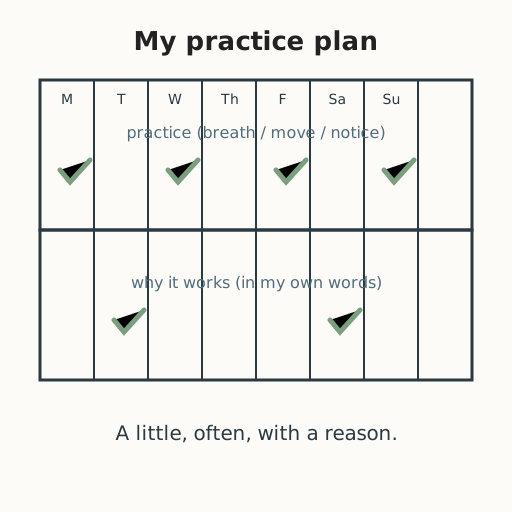
- Practice-plan grid (printed or drawn) · 1 per learner A simple week grid for a chosen practice and a "why it works" note
- Practice log (accumulated from lessons 1–4) · 1 per learner
Low-tech / no-cost
- Paper and pencil Draw the week grid by hand
- Voice Explain the plan aloud to a partner instead of writing
Enriched / lab & device
- Digital planner or calendar · 1 per learner To schedule practice reminders across the week
- Recording device (with consent) · 1 per pair To capture a one-minute spoken explanation of why each practice works
Works in different contexts
- large-group Share a few example plans anonymously on the board; keep personal plans private unless a learner chooses to share
- multi-age Younger learners build a two-day plan; older learners build the full week with reasons
- self-directed A learner builds and commits to their own plan and writes a self-check for the end of the week
- level-grouped Pair learners to peer-review each other's "why it works" explanations for accuracy and hedging
- outdoor-only Anchor each practice to an outdoor spot or time (breath at sunrise, movement on a path, attention under a tree)
Lesson 5 — My Mind-Body Practice Plan
Summary
Learners turn three tools — breathing, movement, attention — into one plan they will actually use. They choose practices that fit their body and their life, set a realistic dose (“a little, often”), and write, in their own words, why each works. This is the first major portfolio artifact and a retrieval of everything in the strand so far.
Objectives
- Use breathing, movement, and mindfulness deliberately to regulate your own state, and explain why each works. (D03.S1.11.01)
Connection
A tool you never pick up does not help. The difference between knowing about breathing and actually breathing when you need to is a plan — small, specific, and attached to your real days. Whether your days run on a school bell, a farm’s rhythm, a market’s hours, or a caregiver’s schedule, a plan that fits your life is the one you will keep.
Materials
- Practice-plan grid
- Practice log
Preparation
- Print or draw the practice-plan grid.
Facilitator note
This is a consolidation and synthesis lesson: retrieval of lessons 1–4, then production of a plan. Give structure (the grid and sentence frames), then let learners author their own plan — mastery, not ranking. A “little, often” is better than a big “sometimes”; guide learners toward realistic doses they can actually keep, not heroic ones they will drop.
Spacing note. The plan is meant to be used across the rest of the unit, not finished and forgotten. Build in a check-in: invite learners to revisit their plan in lesson 8 or 10 and mark what held up.
Accuracy of explanations. The “why it works” notes must be accurate and hedged: breath → parasympathetic/relaxation response (S-340); movement → mood via several mechanisms (S-408); attention → noticing and returning, with modest, still-growing evidence (S-001, S-222). Correct overclaiming kindly: “cures anxiety” becomes “may help me settle when I am anxious.”
The ethics lens: a plan you can keep is a promise to yourself you can honor. The egalitarian lens: every plan is different because every body and every life is different — none is better. The global lens: practices come from many cultures; using them with respect and a reason honors their roots. The technology lens: decide whether a device or app helps your plan or adds pressure — you choose.
Procedure
- Retrieve (10 min). Without your log, write down: (a) the three tools, (b) one mechanism for each, (c) one caveat/hedge for each. Then open your log and correct or complete what you wrote. This recall is how the learning sticks.
- Choose your practices (10 min). For each tool, pick one concrete version that fits your body and your place. Examples: breath — 4-4-6-2 before sleep; move — two-minute stretch after sitting; attention — one minute on sounds while waiting. Adapt every version to your body (seated, wheeling, lying, standing).
- Set the dose (10 min). Fill the week grid: which practice, on which days, for how long, at what moment of your day. Keep it small enough to keep. “Three days, two minutes” beats “every day, an hour.”
- Write why it works (10 min). Under each practice, write one accurate, hedged sentence in your own words. Use the frames if you need them.
- Peer-check (10 min). Trade “why it works” sentences with a partner. Check for accuracy and honest hedging — is anything overclaimed? Revise if needed.
- Commit and close (5 min). Write one sentence to your future self: “This week I will…” Set a reminder — a note, a mark on the wall, a phone alert if you use one. This plan is now a living artifact.
Differentiation
- Support: Provide the sentence frames (“___ works because ___; it may help me ___”); build a two-day plan.
- Extension: Ask learners to add a “what if I miss a day?” recovery note — a kind plan for restarting without self-criticism.
Assessment
- Summative (portfolio): The practice plan — a chosen practice, realistic dose, and accurate, hedged “why it works” explanation for each tool.
- Self: A one-line self-check at the end of the week (“what held up, what would I adjust”).
Home connection
Try your plan for real. At the end of the week, mark what you kept and what you would change. Missing a day is information, not failure — the plan is yours to adjust.
Resources
- Harvard Health — breath control and the stress response (S-340).
- Mikkelsen et al. (2017) — exercise and mental health (S-408).
- Dunlosky et al. (2013) — retrieval practice and spacing strengthen learning: https://doi.org/10.1177/1529100612453266 (S-039).