Lesson 06 — Diverse Bodies, Diverse Experiences
Learners analyze how disability, illness, and diverse bodies shape experience by contrasting the medical model (which locates the problem in the person) with the social model (which locates it in barriers that can be removed), and practice finding those barriers in their own environment.
Objectives
Objectives
- D03.S1.11.02 Analyze how disability, illness, and diverse bodies shape experience, and design practices that honor a wide range of bodies.
Essential question
How do disability, illness, and diverse bodies shape experience — and where does the 'problem' really live: in the person or in the environment?
Key vocabulary
Materials
Standard materials
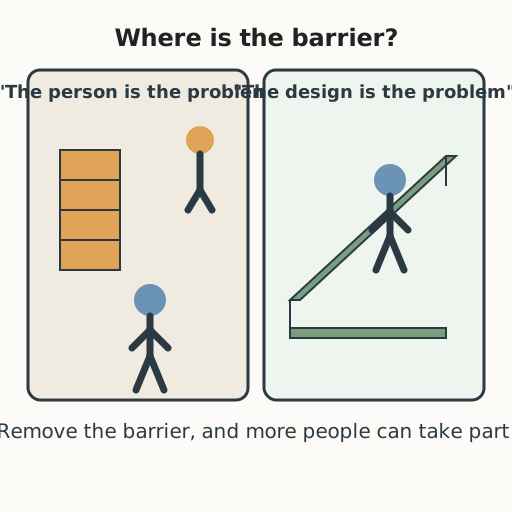
- Social-model chart (printed or drawn) · 1 for the group Two panels — "the person is the problem" vs. "the design is the problem"
- Practice log · 1 per learner
Low-tech / no-cost
- Voice and a drawn two-panel chart Draw the two models in the ground or on paper
- Real objects in the room Use the actual environment (a step, a narrow doorway, a high shelf) to find barriers and imagine removals
Enriched / lab & device
- Short first-person accounts (video or text) · 1 for the group Disabled and chronically ill people describing their own experience, if available
- Digital accessibility checklist · 1 per pair A list of common barriers to scan a space or product against
Works in different contexts
- large-group Use a whole-room barrier hunt with quick pair-share; keep the discussion grounded in the environment, not in any learner's body
- multi-age Younger learners hunt for one physical barrier; older learners add a social or attitudinal barrier
- self-directed A learner analyzes their own environment for barriers and writes a short social-model reflection
- level-grouped Group learners new to the social model together for a worked example; a ready group drafts an anti-ableism norm for the room
- outdoor-only Hunt for barriers and access in the outdoor space — paths, seating, shade, surfaces, sound and visual cues
Lesson 6 — Diverse Bodies, Diverse Experiences
Summary
Learners analyze how disability, illness, and diverse bodies shape experience by learning two ways of seeing the “problem”: the medical model, which locates it in the person, and the social model, which locates it in barriers — steps, attitudes, designs — that can be removed. They hunt for those barriers in their own space, so that “accessibility” becomes concrete rather than abstract.
Objectives
- Analyze how disability, illness, and diverse bodies shape experience. (D03.S1.11.02)
Connection
Imagine you use a wheelchair and the only way into a building is three steps. Or you are Deaf and a lesson is spoken with no captions. Or you have a chronic illness and every activity assumes you have endless energy. In each case, the difficulty is not “in” you — it is in the environment that was built for only some bodies. Millions of people live this every day, everywhere on Earth. Seeing it clearly is the first step to changing it.
Materials
- Social-model chart
- Practice log
Preparation
- Prepare the two-panel chart.
- Identify a few barriers in the room or nearby to use as examples.
Facilitator note
This is the unit’s anti-ableism core. Teach it with care and precision. The medical model frames disability or illness as a problem inside the individual to be fixed or cured. The social model — developed by disabled people themselves — frames disability as the gap between a person and an environment that does not accommodate them; the barrier is the problem, and barriers can be removed. Both models describe real experiences; the social model is a tool for justice, not a claim that impairment or pain does not exist.
Never ask learners to disclose. Do not call on anyone to name their own condition, and do not use any learner as an example. Ground everything in the environment and in respected, first-person accounts from disabled and chronically ill people. Avoid “inspiration” framing (praising disabled people for living) — it is patronizing. Avoid deficit language (“suffers from,” “confined to a wheelchair”): say “uses a wheelchair,” “lives with,” “has.”
The ethics lens: dignity means designing for everyone, not expecting people to overcome avoidable barriers. The egalitarian lens: who does a space include, and who does it quietly leave out? The global lens: the social model travels — every society builds environments that include some bodies and exclude others. The technology lens: technology can remove barriers (captions, ramps, screen readers, prosthetics) or create new ones (an app that only works for people who can see a screen).
Procedure
- Recall (5 min). You now have three regulation tools. From memory, name them and one reason each works. Then check your log.
- Meet two models (10 min). Study the chart. Left panel: “the person is the problem” — a figure at the bottom of stairs, asked to change. Right panel: “the design is the problem” — the same figure reaching the top because a ramp was built. Discuss: in each panel, who is asked to change?
- Words that respect (5 min). Notice the language: a person uses a wheelchair (not is “confined to” one); a person lives with a condition (not “suffers from” it). Why do words carry respect — or its absence?
- Barrier hunt (15 min). In pairs, find three barriers in your room or nearby: a step, a narrow doorway, a high shelf, a message only in one form, an activity that assumes one kind of body. For each, write what kind of body it leaves out.
- Flip it (10 min). Choose one barrier. Write one sentence describing how it could be removed or redesigned so more people can take part. Share one idea.
- Close (5 min). Reflect: where have you seen a space already made more accessible — a ramp, a caption, a quiet room? Accessibility is ordinary, and it is everyone’s work.
Differentiation
- Support: Provide a picture-based barrier checklist; allow drawing the barrier and the fix.
- Extension: Ask learners to write a short social-model analysis of one everyday product or space, naming the barrier and the removal.
Assessment
- Formative (self + peer + observation): Can the learner distinguish the medical and social models and identify a concrete barrier and its removal?
- Artifact (portfolio): The barrier-and-flip note in the practice log.
Home connection
At home or in your neighborhood, notice one barrier (a step, a sign, a surface, a missing cue) and one example of access already built in. Write or tell someone about both. Change begins with noticing.
Resources
- UNICEF — Inclusive education (removing barriers so every child can take part): https://www.unicef.org/education/inclusive-education (S-092).
- The Center for Universal Design (NC State) — The Principles of Universal Design: https://design.ncsu.edu/research/center-for-universal-design/ (S-369).
- UNESCO — International Charter of Physical Education, Physical Activity and Sport: https://www.unesco.org/en/sport-and-anti-doping/international-charter-sport (S-342).