Lesson 07 — Designing Practices for Every Body
Learners apply the social model by designing mind-body practices that adapt to many bodies: the same breathing, movement, or attention practice offered standing, seated, wheeling, lying, or with different sensory channels, so that no body is the "default" and no one is left out.
Objectives
Objectives
- D03.S1.11.02 Analyze how disability, illness, and diverse bodies shape experience, and design practices that honor a wide range of bodies.
Essential question
How do I adapt a mind-body practice — breathing, movement, or attention — so it honors a wide range of bodies, abilities, and needs?
Key vocabulary
Materials
Standard materials
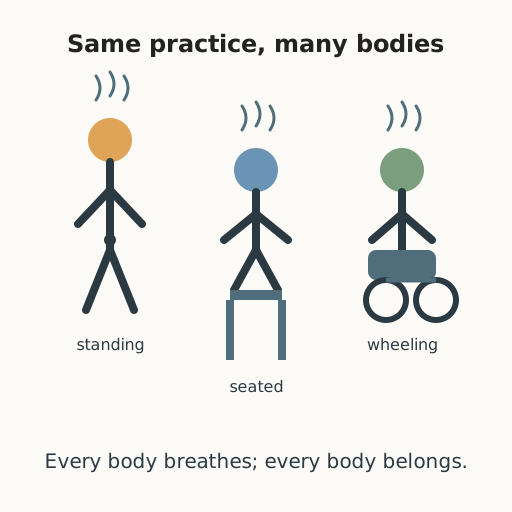
- One-practice-many-bodies chart (printed or drawn) · 1 for the group The same breathing practice shown standing, seated, and wheeling
- Practice log · 1 per learner
Low-tech / no-cost
- Voice and body Demonstrate adaptations of one practice using only the body; no chart needed
- Paper for a design sketch · per learner
Enriched / lab & device
- Universal-design principles handout · 1 per pair The seven principles as a checklist for judging a design
- Video examples of adapted practice (optional) · 1 for the group Disabled practitioners demonstrating the same practice many ways, if available
Works in different contexts
- large-group Design one shared practice whole-class with many adaptations named aloud; record them on a board
- multi-age Younger learners suggest one adaptation; older learners justify it against a universal-design principle
- self-directed A learner designs a three-way adaptation of one practice and writes a short rationale for each way
- level-grouped Group learners by familiarity with the practices; a ready group writes a "how to adapt" guide for others
- outdoor-only Design the practice for an outdoor setting, accounting for surfaces, weather, and sound/visual cues
Lesson 7 — Designing Practices for Every Body
Summary
Learners turn the social model into design: they take one mind-body practice and produce three or more adaptations so it honors a wide range of bodies — standing, seated, wheeling, lying, low-energy, and different sensory needs. The result is the strand’s second portfolio artifact and a direct answer to the essential question of inclusion.
Objectives
- Design mind-body practices that honor a wide range of bodies, abilities, and needs. (D03.S1.11.02)
Connection
A breathing exercise that can only be done standing on two legs quietly leaves out a person who cannot stand. A “mindful listening” task that relies on hearing leaves out a Deaf person. But the same practice, offered three ways, welcomes everyone. Design is not a luxury or an afterthought — it is where dignity is either built in or quietly withheld.
Materials
- One-practice-many-bodies chart
- Practice log
- Paper for a design sketch
Preparation
- Prepare the chart and, if available, the universal-design principles.
Facilitator note
This is a design-and-production lesson, and it is the summative for the strand. Give learners the seven Principles of Universal Design as a concrete checklist — Equitable Use, Flexibility in Use, Simple and Intuitive Use, Perceptible Information, Tolerance for Error, Low Physical Effort, and Size and Space for Approach and Use (S-369) — then let them design. Model one adaptation first (worked example): take the 4-4-6-2 breath and show it standing, seated in a chair, and while wheeling, and note that the “hold” step is optional for anyone who finds it uncomfortable.
No able-bodied default. The chart deliberately shows no single “normal” body; the seated and wheeling versions are not “special cases” but equal ways of doing the same practice. Encourage learners to design for low energy (a lying-down version), pain or fatigue (shorter, gentler), and sensory difference (a visual or tactile anchor instead of an auditory one).
Dignity and agency. Let learners choose which practice to adapt and how many versions to produce. Never grade a design by “how hard” the practice is; grade it by how well it widens access. Avoid language that ranks bodies (“even someone in a wheelchair can do it” is patronizing; “this version works while wheeling” is neutral).
The ethics lens: designing for the widest range is a form of respect. The egalitarian lens: who is included by default, and who has to ask for a “special” version? The global lens: adapted and seated practices exist in movement traditions worldwide — inclusivity is not new. The technology lens: consider whether a device (app, audio, video, screen reader) widens access or depends on resources not everyone has.
Procedure
- Retrieve (5 min). In one sentence each: what is the social model? What is a barrier? Check your log.
- Study the worked example (10 min). Look at the chart: the same breathing practice, three ways. Notice what changes (posture, position, effort) and what stays the same (the slow exhale). List two other ways the same breath could be adapted — lying down? shorter? with a hand on the belly instead of counting?
- Choose and design (15 min). Pick one practice — breath, movement, or attention. Design at least three versions that welcome different bodies and needs. For each, write: who it fits, what changes, what stays the same. Sketch it if drawing helps.
- Check against the principles (10 min). Against the seven universal-design principles, mark which of your versions is most flexible and which could be more flexible. Revise one version to widen access further.
- Peer review (10 min). Exchange designs. Ask: Is there a body or need still left out? What is one way to widen it? Revise if you agree.
- Close (5 min). One sentence: “A practice is truly mine when it can be everyone’s.” What does that mean to you now?
Differentiation
- Support: Provide a fill-in adaptation card (“___ position, ___ length, ___ anchor”); design two versions instead of three.
- Extension: Ask learners to design an adaptation for a specific environmental constraint (small space, loud room, no equipment, outdoors).
Assessment
- Summative (portfolio): A practice adapted three or more ways, each with a “who it fits / what changes / what stays the same” note and a universal-design check.
- Peer: A partner’s check that the design widens access without ranking bodies.
Home connection
Teach your adapted practice to one other person this week — a family member, a friend, a younger learner. Notice what they need to change to make it theirs. Teaching an adaptation is how it becomes real.
Resources
- The Center for Universal Design (NC State) — The Principles of Universal Design: https://design.ncsu.edu/research/center-for-universal-design/ (S-369).
- UNESCO — International Charter of Physical Education, Physical Activity and Sport: https://www.unesco.org/en/sport-and-anti-doping/international-charter-sport (S-342).