Lesson 08 — Movement Traditions I: Yoga, Qigong, and Martial Arts
Learners compare three living movement traditions — yoga (South Asia), qigong and tai chi (China), and martial arts (many lands) — asking what each offers for health and community, and practicing the respect that treats them as living cultures rather than borrowed techniques.
Objectives
Objectives
- D03.S2.11.01 Compare movement traditions across cultures, such as yoga, martial arts, dance, and sport, and what each offers for health and community.
Essential question
What do movement traditions such as yoga, qigong, and martial arts offer for health and community — and why does it matter to treat them as living cultures, not specimens?
Key vocabulary
Materials
Standard materials
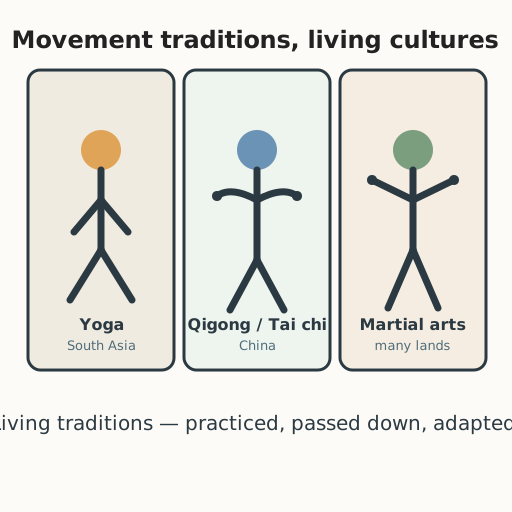
- Movement-traditions chart (printed or drawn) · 1 for the group Three panels — yoga, qigong/tai chi, martial arts — each a living culture
- Practice log · 1 per learner
Low-tech / no-cost
- Voice and body Demonstrate one gentle, safe gesture from each tradition verbally; no chart needed
- Paper for a comparison table · per learner
Enriched / lab & device
- Short video clips of each tradition (with respectful sourcing) · 1 for the group Real practitioners demonstrating, if available and culturally appropriate
- Library or web access for research · 1 per pair To look up a tradition's origins and current practice
Works in different contexts
- large-group Use a three-column comparison on the board; invite learners to contribute what their families or communities practice
- multi-age Younger learners match a tradition to a simple health benefit; older learners analyze lineage and respect
- self-directed A learner researches one tradition's origins and writes a short, respectful profile with sources
- level-grouped Group learners who know a tradition personally to share (by choice); a ready group researches one tradition in depth
- outdoor-only Practice a gentle, safe stance or breath from each tradition outdoors, noting how setting shapes practice
Lesson 8 — Movement Traditions I: Yoga, Qigong, and Martial Arts
Summary
Learners compare three living movement traditions — yoga, qigong/tai chi, and martial arts — asking what each offers for health and for community, and learning the difference between learning with a culture and taking from it. They begin a cross-cultural comparison they will complete in the next lesson.
Objectives
- Compare movement traditions across cultures and what each offers for health and community. (D03.S2.11.01)
Connection
Every culture on Earth has ways of moving that carry more than exercise — they carry breath, discipline, belonging, and meaning. A yoga class in one city, a tai chi group practicing at dawn in a park, a martial-arts school where respect is taught with every stance: these are not interchangeable “workouts.” Each is a living tradition with a history, a lineage, and a community of people who keep it alive.
Materials
- Movement-traditions chart
- Practice log
- Paper for a comparison table
Preparation
- Prepare the three-panel chart and a simple three-column comparison table (tradition | origin | health offer | community offer).
Facilitator note
This lesson and the next form the strand’s cross-cultural comparison. Teach traditions as living cultures, not specimens. That means: name where each comes from; name the real people and communities who practice it; and be honest that when a tradition travels, questions of respect and appropriation arise — practicing a tradition is different from reducing it to a fitness fad while erasing its origins. Hold this as a question, not a lecture: how do we honor a practice’s roots while welcoming everyone who wishes to learn?
Accuracy (hedged). Yoga is a South Asian system of postures, breath (prāṇāyāma), and meditation with roots well over two thousand years old, now practiced worldwide. Qigong and tai chi are Chinese movement-and-breath arts developed over centuries, often practiced for health and longevity. Martial arts are a worldwide family of disciplined movement traditions — kalaripayattu in India, karate and judo in Okinawa/Japan, kung fu in China, capoeira in Brazil, wrestling traditions across continents — each with its own philosophy. These are widely documented general descriptions; treat them as starting points for learners’ own respectful research, not as the final word. UNESCO’s intangible cultural heritage framing treats such practices as knowledge passed person-to-person within communities (S-056), and UNESCO also recognizes traditional sports and games as living heritage (S-287).
Safety. If learners try any stance or gesture, keep it gentle, optional, and non-competitive; no one is demonstrating mastery or being corrected in front of the group. Many practices require a teacher — emphasize that this lesson is an introduction, not instruction.
The ethics lens: respect for origins is part of the practice itself. The egalitarian lens: traditions are not ranked — none is “the best exercise.” The global lens: the same human need for movement flowers differently in every culture. The technology lens: apps and videos now teach these traditions, raising the question of whether a screen can transmit a lineage — and who profits.
Procedure
- Retrieve (5 min). What is the social model, and what is one barrier you found last lesson? Check your log.
- Meet three traditions (15 min). Study the chart. For each — yoga, qigong/tai chi, martial arts — note: where it comes from, what it emphasizes, who keeps it alive. Add anything your own family or community practices, if you wish.
- Health and community (10 min). In pairs, fill two columns of your table: what does it offer for health? (breath, flexibility, balance, discipline, strength) and what does it offer for community? (lineage, teacher and student, shared practice, belonging). Use hedged language — “may support,” “traditionally valued for.”
- Respect vs. taking (10 min). Discuss: when a tradition travels far from its home, what is the difference between learning it with respect and taking it while erasing where it came from? Write one sentence of your own position.
- Try one, gently (5 min). If you wish, try a single safe, gentle gesture — a slow breath with a long exhale (yoga’s breath), a slow flowing arm raise (qigong), a rooted stance (martial arts). Adapt it to your body; pass if you prefer.
- Close (5 min). One word for what a “living tradition” means to you now.
Differentiation
- Support: Provide sentence frames for the comparison table; allow drawing the three traditions.
- Extension: Ask learners to research one additional tradition (e.g., capoeira, kalaripayattu) and add it to the table with a source.
Assessment
- Formative (self + peer + observation): Can the learner place each tradition’s origin and describe one health offer and one community offer, with hedged, respectful language?
- Artifact (portfolio): The three-column comparison table (continued next lesson).
Home connection
Ask someone in your family or community: What movement did our people practice — work, dance, sport, or a tradition with a name? Write what you learn. If no one is able to answer, that too is information about how traditions are kept or lost.
Resources
- UNESCO — Intangible Cultural Heritage: https://ich.unesco.org/ (S-056).
- UNESCO — Traditional Sports and Games: https://www.unesco.org/en/sport-and-anti-doping/traditional-sports-and-games (S-287).
- WHO — Physical activity fact sheet: https://www.who.int/news-room/fact-sheets/detail/physical-activity (S-341).