Lesson 03 — Building Close, Trusting Relationships
Learners break "trust" down into the concrete blocks it is built from — reliability, honesty, care, and repair — and see that close, trusting relationships are built, not found. They map one relationship they maintain against the blocks and name one block they want to strengthen.
Objectives
Objectives
- D02.S1.11.02 Build and maintain close, trusting relationships and offer the same support to others.
Essential question
What are close, trusting relationships actually built from — and what is my part in building them?
Key vocabulary
Materials
Standard materials
- Journal · 1 per learner
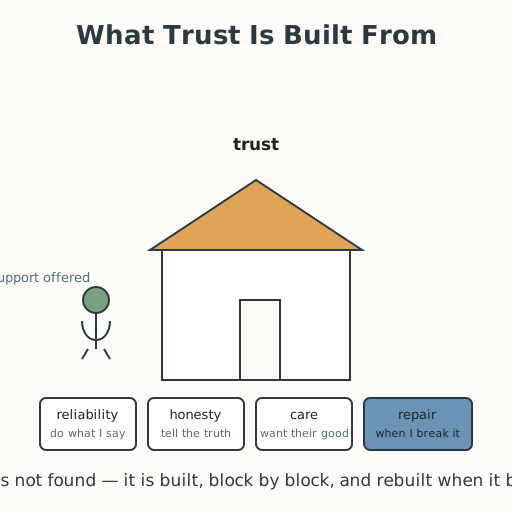
- Building-trust diagram (print or draw) · 1 per learner A house of trust built from reliability, honesty, care, and repair
Low-tech / no-cost
- Voice and a partner Talk through the trust blocks and share one you are strong at and one you want to grow
Enriched / lab & device
- A short profile or film clip of a lasting partnership or friendship · 1 A real example of trust built and maintained over time, chosen with care
Works in different contexts
- large-group Build one large trust-house diagram together, then each learner adds one block they want to grow
- multi-age Younger learners name who they trust and one reason; older learners analyze the trust blocks and a relationship they maintain
- self-directed A learner maps their own relationships against the trust blocks in a private journal entry
- level-grouped A ready group compares trust across kinds of relationship — family, friends, co-workers, communities — and what changes
- outdoor-only Build a small structure from found materials, each part standing for one trust block; discuss which block it is hardest to set in place
Lesson 3 — Building Close, Trusting Relationships
Summary
Learners see that trust is not a feeling that happens to them but a structure they build — from reliability (doing what they say), honesty (telling the truth), care (wanting the other’s good), and repair (fixing it when they break it). They map one relationship they maintain against these blocks and name one block they want to strengthen.
Objectives
- Build and maintain close, trusting relationships and offer the same support to others. (D02.S1.11.02)
Connection
Think of a person you trust with something important — a secret, a hard day, a mistake. Ask yourself why them. Almost certainly it is not because they are fun or clever, though they may be both. It is because, over time, they did what they said they would, told you the truth, showed they wanted your good, and — when they hurt you — made it right. Trust is not magic and it is not found by luck; it is built, block by block, by ordinary actions repeated over time. This lesson names the blocks so you can build them on purpose.
Materials
- Your journal
- A building-trust diagram (see the asset)
Preparation
- Print or draw the building-trust diagram.
- Retrieval (spaced): from Lessons 1–2, recall the listening loop and the steelman. Trust is the ground those skills stand on; today we build it.
Facilitator note
This lesson is written to the learner (“you”). The idea to land: close, trusting relationships are built from concrete, repeatable actions — reliability, honesty, care, and repair — not from luck or chemistry. Teach with a worked example of one trust block in action; keep the mapping private so no one is pressured to rank their real relationships aloud.
The ethics lens: trust is a moral relation — it is the shape that keeping promises takes between people, and breaking it has real consequences for another’s safety. The egalitarian lens: trust is reciprocal — it is built between equals, and it is as owed to the quiet or less powerful person as to the loud one; no relationship form (kin, chosen family, friendship, partnership) is ranked above another here. The global lens: every culture has its own ways of building and marking trust — oaths, shared work, hospitality, gift — but the underlying blocks (reliability, honesty, care, repair) appear across them, in many forms. The social-emotional lens: naming the blocks makes an often-invisible bond visible and therefore growable.
Emotional safety. Relationship topics touch personal experience. No forced disclosure; mapping is private. Include a broad view of “relationship” — family, friends, chosen family, co-workers, neighbors — so no learner’s life is excluded or ranked. Offer opt-outs and remind learners they may write only what they choose to share.
Procedure
- Recall (5 min). Think of one person you trust. In one line, why do you trust them? Hold that reason; today we give its parts names.
- Meet the blocks (10 min). Worked example, together. Here is one block in action:
reliability — a friend says they will help you move, and they show up. Now the
full structure of trust has four blocks:
- Reliability — do what I say I will do.
- Honesty — tell the truth, even when it is awkward.
- Care — genuinely want the other’s good, not just my own.
- Repair — when I break trust, own it and make it right. A relationship can survive a broken block if repair is strong; it is the block that lets the others be rebuilt.
- Map one relationship (20 min). Privately, choose one relationship you maintain (family, friend, chosen family, neighbor, teammate). For each block, write one small, true thing: how does this relationship show reliability? honesty? care? repair? Then mark the block you most want to strengthen.
- Reflect (15 min). In your journal: Which block is strongest in this relationship? Which is the one I want to grow, and what is one concrete thing I could do this week? Keep it private unless you choose to share.
- Close (5 min). Put the diagram and your private reflection in your portfolio. Say or write: trust is built, and I can build it.
Differentiation
- Mode (expression): Map the blocks by drawing, listing, or speaking into a recording; no single written form is required.
- Support: Offer sentence starters (“One way we show reliability is…”) and allow learners to map a relationship they admire rather than one of their own.
- Extension: Compare two relationships — one where trust is strong and one where it is strained — and locate the difference in specific blocks.
Assessment
- Formative (self): Does the map name a concrete example for each trust block in one relationship, and identify one block to grow with one next action?
- Portfolio: The trust map and reflection, gathered toward D02.S1.11.02.
Home connection
With someone at home, ask: “What is one small thing I do that helps you trust me?” Listen without defending — this is the repair and care block in action.
Resources
- CASEL — relationship skills (building and maintaining healthy relationships): https://casel.org/fundamentals-of-sel/ (S-001).
- On worked examples and guided practice: Kirschner, Sweller & Clark (2006), https://doi.org/10.1207/s15326985ep4102_1 (S-011).