Lesson 04 — Maintaining Trust: Repair and Support
Learners learn to maintain trust by repairing it when broken: a three-step conversation of listening, taking responsibility without excuses, and agreeing together on how to make it right. They also name a concrete support they can offer one relationship, and draft a "support offered" reflection.
Objectives
Objectives
- D02.S1.11.02 Build and maintain close, trusting relationships and offer the same support to others.
Essential question
How do I repair trust when I have broken it, and how do I offer the support that keeps a close relationship strong?
Key vocabulary
Materials
Standard materials
- Journal · 1 per learner
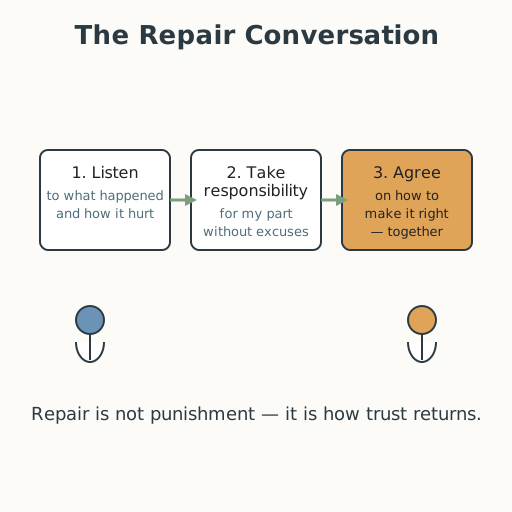
- Repair-conversation diagram (print or draw) · 1 per learner Three steps — listen, take responsibility, agree on making it right
Low-tech / no-cost
- Voice and a partner Role-play the repair conversation on a small invented mistake
Enriched / lab & device
- A short scene or story of a genuine repair between people · 1 A real or fictional example of trust restored, chosen with care
Works in different contexts
- large-group Model the repair conversation whole-class, then practice in pairs; collect one thing each learner will do
- multi-age Younger learners practice a simple "I hurt you — I'm sorry — how do I make it right?"; older learners run the full three-step repair
- self-directed A learner writes the repair conversation for a real or imagined rift, then drafts a support plan for one relationship
- level-grouped A ready group analyzes where repair fails (defensiveness, excuses) and practices accepting responsibility cleanly
- outdoor-only Act the three steps as a short walk — stop, turn, and face the other at "take responsibility"
Lesson 4 — Maintaining Trust: Repair and Support
Summary
Building trust is one thing; keeping it is another. Learners learn to maintain trust by repairing it when it breaks: a three-step conversation — listen to what happened and how it hurt, take responsibility for my part without excuses, and agree together on how to make it right. They also name a concrete support they can offer one relationship, and write a reflection that pairs the repair with the support.
Objectives
- Build and maintain close, trusting relationships and offer the same support to others. (D02.S1.11.02)
Connection
Every relationship will be strained at some point — not because it is failing, but because people are imperfect and lives are hard. What separates relationships that last from those that quietly end is not the absence of hurt; it is the presence of repair. When you break something with someone, the relationship does not automatically die. It waits to see whether you will own it and make it right. And it is kept alive in the quiet times by support — the small, steady acts that say “I am on your side.” This lesson gives you the tools for both.
Materials
- Your journal
- A repair-conversation diagram (see the asset)
Preparation
- Print or draw the repair-conversation diagram.
- Retrieval (spaced): from Lesson 3, recall the four blocks of trust — reliability, honesty, care, repair. Today we practice the block that fixes the others: repair.
Facilitator note
This lesson is written to the learner (“you”). The idea to land: repair is a teachable skill — listen, take responsibility without excuses, agree on making it right — and it is what keeps trust alive when it breaks; support is what keeps it strong between breaks. Model the repair conversation with a worked example, then let learners role-play a small, invented mistake (never a real, unhealed harm).
The ethics lens: repair is the moral opposite of defensiveness — it puts rightness and the other person ahead of my own pride. The egalitarian lens: a genuine apology does not pull rank; the person who holds more power is equally called to own their part, and repair restores the standing of the person who was hurt. The global lens: repair is a cross-cultural practice — from restorative justice traditions (Diné hózhó, Indigenous peacemaking circles) to formal apologies between states — and appears wherever people decide a relationship matters more than being right. The social-emotional lens: accepting responsibility without excuses is emotional regulation under pressure — the hard, grown-up move.
Emotional safety. Repair touches real hurt. Use only small, invented mistakes for role-play; never require a learner to re-enact a real harm or apologize on demand. Opt-outs are honored. Frame “taking responsibility” as owning my part, not as self-punishment or shame.
Procedure
- Recall (5 min). What are the four blocks of trust? Which one fixes the others when they break? (Repair.) Today we practice it.
- Meet the repair (10 min). Worked example, together. A small, invented mistake:
you borrowed a friend’s tool and returned it late and damaged. Watch the three steps:
- Listen — hear what happened and how it hurt, without interrupting or defending.
- Take responsibility — “I was careless with your tool, and I’m sorry. That was my fault.” No “but.”
- Agree on making it right — “How can I make this right? I can repair it or replace it.” — decided together. Notice what is absent: excuses, blame, “you’re overreacting.”
- Practice in pairs (20 min). Role-play a small invented mistake from the list (a broken promise, a thoughtless word, a forgotten favor). Person A owns the mistake and runs the three steps; Person B responds honestly. Then switch. Keep it light — this is practice, not a real confession.
- Write the support (15 min). In your journal, complete both halves: One repair I can practice: (the three steps in my own words). And One support I will offer this week to a relationship I care about: (specific and small).
- Close (5 min). Put the diagram and the reflection in your portfolio. Say or write: repair keeps trust alive; support keeps it strong.
Differentiation
- Mode (expression): Respond by role-play, writing, or drawing the three steps; expression is flexible.
- Access (deaf, hard-of-hearing, non-speaking): Role-play the repair non-verbally if needed — write or sign each step, or act it with gesture and a written or signed “I’m sorry — how do I make it right?” Reading or watching the partner’s account fully is the listening; a written, signed, drawn, or typed apology is a full repair.
- Support: Offer a starter script for each step and keep the invented mistakes trivial and safe.
- Extension: Write the repair conversation you would want to have in a real strained relationship, and identify the one line that feels hardest to say and why.
Assessment
- Formative (self + peer): In the role-play, did the person run all three steps — listen without defending, take responsibility without “but,” and agree together on making it right?
- Portfolio: The repair script and the support reflection, gathered toward D02.S1.11.02.
Home connection
Think of one small support you can offer someone at home this week, and do it — without announcing it. Notice whether the relationship feels any different after.
Resources
- Zehr (1990), Changing Lenses — repair over punishment, with Indigenous roots named (S-161); IIRP — restorative practices: https://www.iirp.edu/ (S-022).
- CASEL — relationship skills: https://casel.org/fundamentals-of-sel/ (S-001).
- On worked examples and guided practice: Kirschner, Sweller & Clark (2006), https://doi.org/10.1207/s15326985ep4102_1 (S-011).