Lesson 05 — Empathy for People I Have Never Met
Learners face empathy's hardest stretch: feeling with people they will never meet. They learn that empathy is real but partial — it weakens with distance and numbers (psychic numbing, the identifiable-victim effect) — and that names, stories, and shared needs are the bridges that carry it across. They write an empathy bridge to one distant other.
Objectives
Objectives
- D02.S2.11.01 Apply empathy to people they have never met, such as those far away or in future generations.
Essential question
How do I feel with — and care about — people I have never met, who live far away or in circumstances nothing like mine?
Key vocabulary
Materials
Standard materials
- Journal · 1 per learner
- Empathy-across-distance diagram (print or draw) · 1 per learner A signal crossing distance, carried by a name, a story, and a shared need
Low-tech / no-cost
- Voice and a partner Tell the story of one distant person's day and find the shared needs beneath it
Enriched / lab & device
- A short profile or film of one named person in a distant place · 1 A real individual's story, chosen with dignity, to carry empathy across distance
Works in different contexts
- large-group Read one named person's story together, then each learner writes their own bridge of name, story, and shared need
- multi-age Younger learners find what is the same between themselves and the distant person; older learners analyze the limits of empathy and the role of story
- self-directed A learner chooses one distant person's story and writes what bridges the gap and what still does not
- level-grouped A ready group examines psychic numbing — why one named face moves us more than a million — and how to widen care anyway
- outdoor-only Trace the journey of one everyday object to a distant person's hands, and imagine their day at each stop
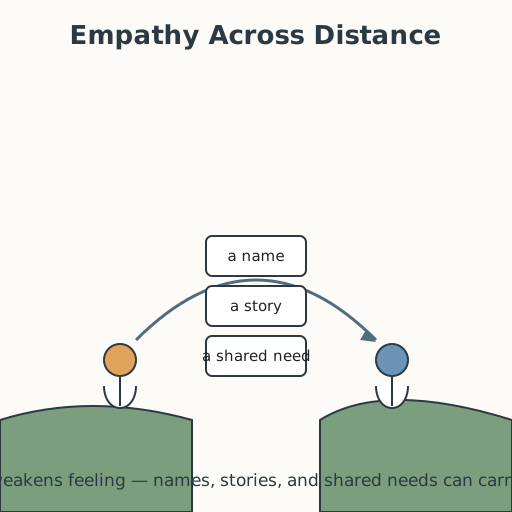
Lesson 5 — Empathy for People I Have Never Met
Summary
Learners take empathy to its hardest reach: people they will never meet. They learn an honest truth — empathy is real but partial: it weakens with distance and as numbers grow (Slovic’s psychic numbing and the identifiable-victim effect) — and that names, stories, and shared needs are the bridges that carry care across. They write an empathy bridge to one distant other.
Objectives
- Apply empathy to people they have never met, such as those far away or in future generations. (D02.S2.11.01)
Connection
You can feel a friend’s sadness the moment you see their face. But what about a fisher whose coast is vanishing thousands of kilometers away, or a child in a city you will never visit, whose day looks nothing like yours? There is no face in front of you, no voice in the room — and yet they are as real as your friend. Feeling with them does not happen automatically; it has to be built. This lesson shows you the bridges — a name, a story, a shared need — and why they matter.
Materials
- Your journal
- An empathy-across-distance diagram (see the asset)
Preparation
- Print or draw the empathy-across-distance diagram.
- Retrieval (spaced): from Lesson 2, recall “staying open to being changed.” Empathy for a distant other asks the same openness — toward a life unlike yours.
Facilitator note
This lesson is written to the learner (“you”). The idea to land: empathy is real but partial — it fades with distance and numbers — so caring for distant others requires bridges: a name, a story, a shared need. Teach the empathy/psychic-numbing distinction with a worked example; keep the value question open (how wide should care go is a choice, not a test).
The ethics lens: whether distant strangers count in my choices is a core ethical question, and the lesson invites reasoning, not a single answer. The egalitarian lens: empathy’s documented limits are themselves an unfairness — if care runs only on feeling, the far and the many get less of it; building bridges is a more reliable equalizer. The global lens: the distant other is not an abstraction — they are someone’s neighbor with a name and a day; treat real people with dignity, never as props. The technology lens: screens both help and hurt — they can carry a distant face and story close enough to feel, and they can flood us until we numb (Slovic, S-414).
Emotional safety. This lesson can surface overwhelm or guilt about the world’s suffering. Frame it as widening care by choice and practice, not as a demand to feel everything or save everyone. No learner is asked to disclose personal reactions; “I am still working this out” is a complete answer.
Procedure
- Recall (5 min). When was a time a single person’s story moved you more than a big number about many people? Why do you think that is? Hold the thought.
- Meet the partial empathy (10 min). Worked example, together. Research shows a strange and important thing: we feel more for one named face than for a statistic. One child’s name and story can move us to act; a report about thousands can leave us numb — this is the identifiable-victim effect and psychic numbing (Slovic, S-414). Empathy is real, but it is partial: it runs strongest toward the near, the familiar, and the single. That is not a failure — it is how feeling works. So caring for the many and the far cannot run on feeling alone.
- Build the bridge (20 min). Choose one distant person or place — a coast, a
city, a valley far away. Find and write three bridges:
- A name — who is one real person there? (or imagine one with care)
- A story — what is one ordinary thing in their day?
- A shared need — what do they need that you also need? (safety, food, water, belonging, a future) Notice: the shared need is where the bridge lands.
- Write the bridge (15 min). In your journal: Here is one distant other, here is the bridge (name, story, shared need), and here is what I now feel or wonder. Keep it honest — a genuine question is a fine ending.
- Close (5 min). Put the diagram and the bridge in your portfolio. Say or write: feeling fades with distance, but names, stories, and shared needs carry it across.
Differentiation
- Mode (expression): Build the bridge by writing, speaking, drawing, or arranging found objects; expression is flexible.
- Support: Offer a pre-chosen distant person’s short story and sentence frames for each bridge.
- Extension: Compare two bridges — one that moves you and one that does not — and analyze why (nearness? similarity? a single name?).
Assessment
- Formative (self): Does the bridge name a distant other and include all three elements — a name, a story, and a shared need — and state what the learner feels or wonders?
- Portfolio: The empathy bridge, gathered toward D02.S2.11.01.
Home connection
Ask someone at home: “Is there someone far away whose story stays with you?” Listen for the name, the story, and the shared need — the three bridges.
Resources
- Slovic (2007), psychic numbing and the identifiable-victim effect (S-414).
- Bloom (2016), Against Empathy — empathy’s narrowness; reasoned compassion (S-413).
- Batson (1987), empathic concern vs. personal distress (S-230); Decety & Cowell (2014), empathy and perspective-taking (S-231).
- On worked examples and guided practice: Kirschner, Sweller & Clark (2006), https://doi.org/10.1207/s15326985ep4102_1 (S-011).