Lesson 06 — Empathy for Future Generations
Learners extend empathy beyond distance to time: the generations not yet born. They see that their choices — about land, water, climate, debt, knowledge, and care — are seeds handed forward, and they write a letter to a person in the future naming what they hope to pass on.
Objectives
Objectives
- D02.S2.11.01 Apply empathy to people they have never met, such as those far away or in future generations.
Essential question
How do I extend empathy to people who do not exist yet — the generations after me — and what do I owe them?
Key vocabulary
Materials
Standard materials
- Journal · 1 per learner
- Future-generations timeline (print or draw) · 1 per learner A timeline from now to generations after, with a seed passed hand to hand
Low-tech / no-cost
- A seed or small plant Hold it and imagine the person who will harvest from it long after you
Enriched / lab & device
- A short text or data set on one intergenerational decision · 1 e.g., a long-lived structure, a forest, a debt, or a climate choice that outlasts its makers
Works in different contexts
- large-group Build one long timeline on the wall and place decisions on it — which outlast us and which fade
- multi-age Younger learners name what they want to hand on to their own children; older learners analyze one intergenerational decision in depth
- self-directed A learner writes a letter to a person in 2100 and lists what they hope that person will still have
- level-grouped A ready group debates how to weigh the far future against urgent present needs, holding both honestly
- outdoor-only Plant or tend something slow-growing and discuss who will see it fully grown
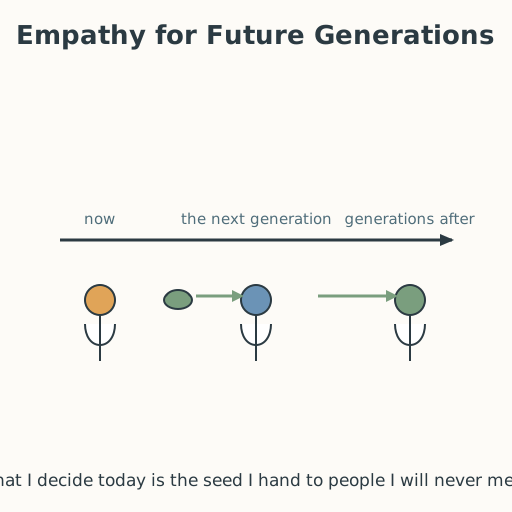
Lesson 6 — Empathy for Future Generations
Summary
Learners stretch empathy one step further — beyond distance to time. The people of the next century are people they will never meet, yet their choices today shape those lives. Learners see their decisions as seeds handed forward, and write a letter to a person in the future naming what they hope that person will still have.
Objectives
- Apply empathy to people they have never met, such as those far away or in future generations. (D02.S2.11.01)
Connection
Some of the things you touch today will outlive you: a forest, a building, a river, a language, a debt, a habit of care. The people who will live with them are not born yet — but they are coming, as surely as you arrived. You cannot see their faces or hear their voices, which is exactly why it is so easy to forget them. Yet your choices are already a letter you are writing to them, whether you sign it or not. This lesson helps you write it on purpose.
Materials
- Your journal
- A future-generations timeline (see the asset)
Preparation
- Print or draw the future-generations timeline.
- Retrieval (spaced): from Lesson 5, recall the three bridges — name, story, shared need. Future generations have no name or story yet; the shared need is all we can know — and it is enough to start from.
Facilitator note
This lesson is written to the learner (“you”). The idea to land: future generations are real others we will never meet, and intergenerational choices — land, water, climate, knowledge, debt, care — are how we already shape their lives. Teach with a worked example of one intergenerational decision; hold the “how much do we owe them” question open (it is a live ethical debate, not a settled answer).
The ethics lens: whether and how much we owe people who do not exist yet is a central question of intergenerational ethics, and learners reason about it rather than being told. The egalitarian lens: future people cannot vote, lobby, or speak — they are the ultimate voiceless party, so fairness asks us to speak for them; and the burdens of today’s choices (climate, pollution) fall unevenly on the young and the yet-unborn, who contributed least (IPCC, S-005). The global lens: many cultures hold the unborn and the ancestors in mind when deciding — stewardship and legacy are widespread ideas, not one region’s. The environment lens: the climate and living world are the clearest “letters to the future” — what we emit and protect now is read by people in 2100. The technology lens: some technologies (a dam, a data archive, a long-lived material) commit the future for decades or centuries; their makers rarely meet their inheritors.
Emotional safety. The future can feel heavy or abstract. Keep it grounded and hopeful: focus on what a learner can hand forward, not on despair. No one is told what to believe about how much is owed; the letter is personal and may be kept private.
Procedure
- Recall (5 min). What three bridges carried empathy to a distant other? (Name, story, shared need.) Future generations have no name and no story yet. What is left? (The shared need — clean water, breathable air, a livable future.)
- Meet the intergenerational choice (10 min). Worked example, together. A village decides whether to cut a slow-growing forest now for quick income, or protect it for wood, water, and shade decades later. The people who planted nothing but will inherit the choice are not born. The question “sustainable development” tries to hold: meeting today’s needs without taking away the future’s ability to meet theirs (Brundtland, S-395). Notice: this is a decision about people you will never meet.
- Map the seeds (15 min). On your timeline, list three or four things your life is already handing forward — land, water, climate, a language, a skill, a habit, a debt, a technology. For each, ask: who inherits this, and what will it mean for them?
- Write the letter (20 min). In your journal, write a short letter to a person in the year 2100 — someone you will never meet. Tell them: Here is what I hope you still have; here is what I worry I am taking from you; and here is one thing I want to do, even now, to hand something good forward. It may be small; small, steady care outruns grand gestures.
- Close (5 min). Put the timeline and the letter in your portfolio. Say or write: my choices are a letter to people I will never meet — and I can write it well.
Differentiation
- Mode (expression): Write the letter, draw it, or record it as a spoken message; expression is flexible.
- Support: Offer sentence frames for the letter and a list of “seeds” to choose from.
- Extension: Research one real intergenerational decision (a treaty, a forest, a dam, a debt) and argue where the future’s interests were honored or forgotten.
Assessment
- Formative (self): Does the letter name what the learner hopes a future person still has, what they worry about taking, and one concrete thing they will do to hand something forward?
- Portfolio: The timeline and the letter, gathered toward D02.S2.11.01.
Home connection
Ask someone older at home: “What did the people before you hand forward to you — and what do you hope to hand to me?” Listen for the seeds.
Resources
- World Commission on Environment and Development (1987), Our Common Future (Brundtland Report) — the definition of sustainable development as not compromising future generations (S-395).
- IPCC — climate science on burdens borne by future generations: https://www.ipcc.ch/ (S-005).
- On worked examples and guided practice: Kirschner, Sweller & Clark (2006), https://doi.org/10.1207/s15326985ep4102_1 (S-011).