Lesson 07 — Empathy vs Fairness: When They Pull Apart
Learners face the moment empathy and fairness pull apart: the one person in front of us versus the many affected by a rule. They learn to name the trade-off, hear both sides at their strongest, and make a weighing they can defend — without pretending either value is false.
Objectives
Objectives
- D02.S2.11.02 Weigh empathy for individuals against fairness to a group when the two conflict.
Essential question
When caring for one person in front of me conflicts with being fair to the whole group, how do I weigh the two?
Key vocabulary
Materials
Standard materials
- Journal · 1 per learner
- Empathy-vs-fairness balance diagram (print or draw) · 1 per learner A scale with one named face on one side and a group on the other
Low-tech / no-cost
- Voice and a partner Discuss a dilemma aloud (or in writing, sign, or gesture), arguing each side, then decide — no chart needed
Enriched / lab & device
- A short case study of a real empathy-vs-fairness dilemma · 1 e.g., a hiring choice, a rescue priority, a school rule — chosen with care
Works in different contexts
- large-group Pose one dilemma to the whole group, collect positions on a spectrum, then debrief the reasoning
- multi-age Younger learners weigh a simple sharing dilemma; older learners analyze a harder structural one
- self-directed A learner works a dilemma alone and writes their weighing, naming what they had to give up
- level-grouped A ready group debates a dilemma where no option is clean, and must state the strongest version of the losing side
- outdoor-only Use a physical scale or a stick balance with stones to literally weigh the one and the many, then discuss
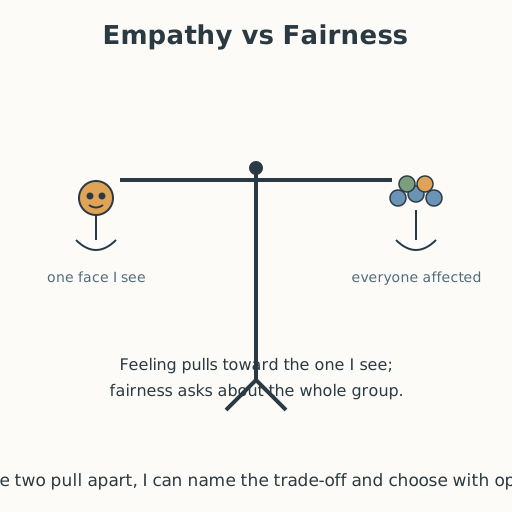
Lesson 7 — Empathy vs Fairness: When They Pull Apart
Summary
Empathy and fairness usually point the same way — but not always. Sometimes caring for the one person in front of us conflicts with being fair to the many. Learners learn to name the trade-off, hear each side at its strongest, and make a weighing they can defend. The point is not to pick a “right” answer, but to choose with open eyes instead of letting feeling or rule silently win.
Objectives
- Weigh empathy for individuals against fairness to a group when the two conflict. (D02.S2.11.02)
Connection
Imagine your closest friend did something that broke a rule the whole group depends on. Your heart says: protect my friend. Fairness says: the rule applies to everyone, or it means nothing. Both voices are real. Neither is a villain. This is not a rare dilemma — it happens in families, schools, workplaces, and states, every day. The mature move is not to pretend one voice is silent; it is to weigh them honestly. This lesson gives you the scale.
Materials
- Your journal
- An empathy-vs-fairness balance diagram (see the asset)
Preparation
- Print or draw the empathy-vs-fairness balance diagram.
- Retrieval (spaced): from Lesson 5, recall that empathy is partial — it runs strongest toward the one named face. That very bias is why fairness sometimes has to check it. Today we put the two on a scale.
Facilitator note
This lesson is written to the learner (“you”). The idea to land: empathy and fairness can genuinely conflict, and maturity is naming the trade-off and weighing it — hearing each side at its strongest — rather than pretending one value cancels the other. Teach the weighing with a worked example; keep dilemmas hypothetical or lightly structured so no learner is cornered.
The ethics lens: this is a live question in moral philosophy — impartiality versus partiality, the one versus the many — and learners reason through it rather than receive a verdict. The egalitarian lens: rules exist so that the powerful and the liked do not quietly win; fairness is the equalizer, and it is especially needed exactly when our empathy pulls toward the familiar face. The global lens: every society weighs kinship and rules differently — some lean on the letter of the law, others on the relationship — and none has “solved” the tension; it is a human constant. The critical-thinking lens: the skill is articulating the strongest case for both sides before deciding — the same steelman discipline from Lesson 2, now applied to a hard choice.
Emotional safety. Learners may feel loyalty to real people in real dilemmas. Use invented or lightly structured cases; no one is asked to reveal a personal conflict. Emphasize that there is no “correct” weighing to report — the assessed skill is naming the trade-off and reasoning, never the answer reached.
Procedure
- Recall (5 min). Why does empathy run strongest toward the one named face? (It is partial — near, familiar, single.) Why might fairness need to check it? Hold both.
- Meet the scale (10 min). Worked example, together. A dilemma: your team’s rule is
that anyone who misses practice sits out the match. Your best friend missed practice —
for a family emergency, not laziness. The match matters to everyone. Put it on the
scale:
- Empathy for the one: my friend was needed at home; punishing them doubles their hurt.
- Fairness to the many: the rule protects the team; exceptions for friends mean the rule protects no one. Neither side is wrong. The task is to name what each side sacrifices.
- Practice a dilemma (20 min). In pairs, choose a dilemma from the list (or invent one): a scholarship for one needy student or books for the whole class; a sick relative’s medicine or food for many; one friend’s secret or the group’s safety. Argue each side at its strongest — use the steelman from Lesson 2. Then each of you, for yourself, state a weighing: I would lean this way, because…, and here is what I accept losing.
- Write the weighing (15 min). In your journal: The dilemma; the strongest case for empathy; the strongest case for fairness; my weighing and what I gave up. A defended, honest weighing is the goal — not a “right” answer.
- Close (5 min). Put the diagram and the weighing in your portfolio. Say or write: when empathy and fairness pull apart, I can name the trade-off and choose with open eyes.
Differentiation
- Mode (expression): Weigh by speaking, writing, drawing the scale, or acting both sides; expression is flexible.
- Access (deaf, hard-of-hearing, non-speaking): Weigh the dilemma in writing, sign, or a drawn scale; a partner can read the other’s written or signed strongest case instead of hearing it. Stating both sides at their strongest — and your own weighing — is the skill, in any medium.
- Support: Offer a sentence frame (“The strongest case for the one is…; the strongest case for the many is…; I would lean…”) and a gentle starter dilemma.
- Extension: Write a short essay on a real-world dilemma (a triage rule, an asylum policy, a workplace exception) and defend a weighing against the best objection.
Assessment
- Formative (self + peer): Did the learner state the strongest case for both empathy and fairness, and then state a weighing with a reason and an acknowledged cost?
- Portfolio: The weighing, gathered toward D02.S2.11.02.
Home connection
Ask someone at home: “Tell me about a time you had to choose between one person and everyone. What did you do?” Listen for how they named the trade-off.
Resources
- Bloom (2016), Against Empathy — empathy’s partiality and why fairness sometimes must check it (S-413); Slovic (2007), psychic numbing (S-414).
- Stanford Encyclopedia of Philosophy, Distributive Justice — competing ideas of what fairness means: https://plato.stanford.edu/entries/justice-distributive/ (S-388).
- On worked examples and guided practice: Kirschner, Sweller & Clark (2006), https://doi.org/10.1207/s15326985ep4102_1 (S-011).