Lesson 08 — What Makes Communities Resilient
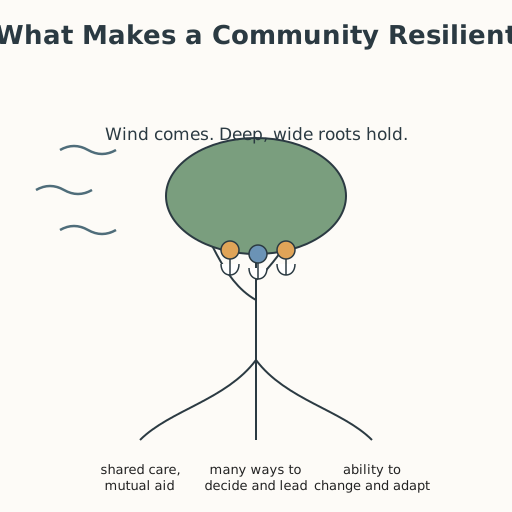
Learners analyze what makes communities resilient — able to survive and recover from shock. Using historical and contemporary examples, they identify three deep roots: shared care and mutual aid, many ways to decide and lead, and the ability to change and adapt. They map one community they know against these roots.
Objectives
Objectives
- D02.S3.11.01 Analyze what makes communities resilient, inclusive, and just, using historical and contemporary examples.
Essential question
What makes a community able to survive and recover from shock — and why do some bend while others break?
Key vocabulary
Materials
Standard materials
- Journal · 1 per learner
- Resilient-community diagram (print or draw) · 1 per learner A tree with deep, wide roots — shared care, many ways to lead, ability to adapt
Low-tech / no-cost
- Voice and a partner Discuss a community you know and name its deep roots and its weak ones
Enriched / lab & device
- Two short case studies of communities before and after a shock · 2 One that recovered well and one that did not, chosen from any world region
Works in different contexts
- large-group Build one big resilience tree; each learner adds a root (a practice that holds the group up)
- multi-age Younger learners name what helps a family or class bounce back; older learners analyze a historical or contemporary case
- self-directed A learner researches one community's shock and recovery and maps its roots and weak points
- level-grouped A ready group compares two shocks (a flood, a war, a market crash, a migration) and extracts the shared resilience factors
- outdoor-only Find a tree with deep roots and one shallow-rooted; discuss what each teaches about communities
Lesson 8 — What Makes Communities Resilient
Summary
Learners analyze resilience — a community’s ability to survive and recover from shock. Using historical and contemporary examples, they identify three deep roots: shared care and mutual aid, many ways to decide and lead, and the ability to change and adapt. They map one community they know against these roots.
Objectives
- Analyze what makes communities resilient, inclusive, and just, using historical and contemporary examples. (D02.S3.11.01)
Connection
Think of a flood, a fire, a factory closing, a war, a crop failure, or a sudden wave of people needing shelter. Some communities come through changed but standing; others shatter and never recover. The difference is rarely luck alone. It is whether the community already had deep roots — people who share care before the crisis, many ways to lead instead of one, and the habit of adapting. This lesson teaches you to see those roots, so you can recognize them where they grow and help plant them where they do not.
Materials
- Your journal
- A resilient-community diagram (see the asset)
Preparation
- Print or draw the resilient-community diagram.
- Retrieval (spaced): from Lesson 3, recall the blocks of trust (reliability, honesty, care, repair). Resilience is trust scaled up to a whole community — the same blocks, grown into roots.
Facilitator note
This lesson is written to the learner (“you”). The idea to land: resilient communities rest on identifiable roots — shared care/mutual aid, distributed leadership, and adaptability — visible in historical and contemporary examples across the world. Teach the roots with a worked example; keep examples global and non-hierarchical (no “advanced vs. backward” community framing).
The ethics lens: resilience is partly a moral fact — communities that care for their weakest members before a crisis are the ones who survive it, which makes care both kind and practical. The egalitarian lens: resilience that depends on one leader or one source fails everyone when that one breaks; widely shared care and leadership are more equal and more durable. The global lens: draw examples from many regions — mutual aid after floods in one place, cooperatives that steady a village economy in another, Indigenous land-care that buffers drought in a third — never implying one region holds the answer. The environment lens: many shocks are environmental (flood, drought, fire, sea-level rise), and the communities that contributed least to them are often the hardest hit (IPCC, S-005) — a fact to hold alongside the value that they are owed help.
Emotional safety. Disaster and loss are heavy. Use examples with hope attached and name agency — what people did to recover, not only what they suffered. Avoid graphic detail; offer opt-outs; remind learners that “not yet ready to discuss this” is honored.
Procedure
- Recall (5 min). What are the four blocks of trust? Now imagine a whole community that behaves this way, at scale. What would it be able to withstand?
- Meet the roots (10 min). Worked example, together. Take a real pattern: a
community hit by a flood. Compare two pictures:
- One where neighbors barely know each other, one leader holds all decisions, and rebuilding copies exactly what was there before.
- One where neighbors already share food and watch each other’s children, many people can lead and decide, and rebuilding asks “what should we change so the next flood hurts less?” The second recovers — not because it is luckier, but because of three roots: shared care and mutual aid, many ways to decide and lead, and the ability to change and adapt.
- Study two examples (20 min). From the provided case studies (or your own knowledge), choose two communities — one historical, one contemporary — from different world regions. For each, name: the shock, the roots it drew on, and the outcome. Look for the three roots at work.
- Map a community you know (15 min). In your journal, choose one community you know (a neighborhood, a school, a faith or cultural group, a town). Write: Here are its deep roots (which of the three does it have, and how do I know?); here is one root that is thin; and here is one thing that could strengthen it.
- Close (5 min). Put the diagram and the map in your portfolio. Say or write: resilience is planted before the storm, in the roots.
Differentiation
- Mode (expression): Map by writing, drawing the tree and roots, or speaking; expression is flexible.
- Support: Provide one worked case study with the roots pre-labeled, and sentence frames for the map.
- Extension: Research one community’s recovery in depth and write a short analysis locating all three roots (or explaining why one was missing and what it cost).
Assessment
- Formative (self): Does the map identify at least two of the three roots in a real community, name one thin root, and suggest one strengthening action?
- Portfolio: The case comparison and the community map, gathered toward D02.S3.11.01.
Home connection
Ask someone at home: “What has our family or neighborhood survived, and what got us through it?” Listen for the roots — shared care, many hands, adapting.
Resources
- Kropotkin (1902), Mutual Aid — cooperation and reciprocity as a widespread human practice (S-163); communal-work traditions (harambee, gotong royong, mink’a/minga, barn-raising) (S-164).
- IPCC — environmental shocks and who bears them: https://www.ipcc.ch/ (S-005).
- On worked examples and guided practice: Kirschner, Sweller & Clark (2006), https://doi.org/10.1207/s15326985ep4102_1 (S-011).