Lesson 03 — Building the Persuasive Speech: Claim, Reasons, Counterargument
Learners construct a persuasive speech as an architecture: a claim, reasons, evidence, and — crucially — the strongest counterargument, stated fairly and answered honestly. They draft the scaffold in their home language and begin turning it into a speech they will deliver.
Objectives
Objectives
- D04.S1.11.02 Construct and deliver a persuasive speech that anticipates and fairly addresses counterarguments.
Essential question
How do I construct a persuasive speech whose argument is strong enough to stand up to the best objection against it?
Key vocabulary
Materials
Standard materials
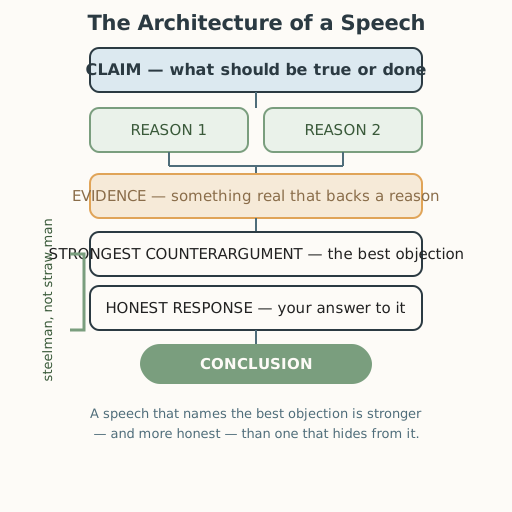
- Speech scaffold sheet · 1 per learner A fill-in form — claim, reason 1, reason 2, evidence, strongest counterargument, honest response — in the learner's home language
- Learning journal · 1 per learner
Low-tech / no-cost
- Paper sheet with the scaffold drawn by hand, or lines drawn in the ground The same six boxes in any writing surface
- Voice and body (or sign, writing, or gesture) Say — or sign or write — your claim, then have a partner give the strongest objection, and answer it in the same channel
Enriched / lab & device
- Recording device · 1 per learner or pair To record a first attempt and hear where the counterargument is weak
- Shared device to look up one piece of evidence · 1 per group To find a real fact that supports one reason
Works in different contexts
- large-group Model the scaffold whole-class on a shared topic, then learners fill their own in small groups, sharing only the counterargument they anticipated
- multi-age Younger learners state a claim and one reason; older learners add evidence, a counterargument, and a rebuttal
- self-directed A learner fills the scaffold alone on a topic they care about, then tests the counterargument box against a remembered objection
- level-grouped Learners ready to extend use Toulmin's claim/data/warrant/rebuttal labels and mark each box with its technical name
- outdoor-only Build the speech around a real community decision (where to plant, how to share water) and rehearse the argument in a circle
Lesson 3 — Building the Persuasive Speech: Claim, Reasons, Counterargument
Summary
Learners build a persuasive speech as an architecture of argument: a claim, reasons, and evidence — and, crucially, the strongest counterargument, stated fairly and answered honestly. They learn the steelman (the opposite of a straw man) and draft a speech scaffold in their home language, ready to be delivered in Lesson 4.
Objectives
- Construct a persuasive speech that anticipates and fairly addresses counterarguments — beginning by building the argument’s skeleton. (D04.S1.11.02)
Connection
When you want a neighbor to help fix a shared wall, a school to change a rule, or your family to try a new idea, you do not just state your wish — you give reasons, and you silently know the objection already (“but it costs too much,” “but we always do it the old way”). A persuasive speech is that ordinary moment made deliberate: you say what you want, why it is right, and — instead of hoping nobody brings up the problem — you bring it up yourself, stated at full strength, and answer it. A position you cannot state the best objection against is a position you do not yet understand.
Materials
- Speech scaffold sheet (claim / reason / reason / evidence / strongest counterargument / honest response)
- Learning journal
Preparation
- Copy or draw the six-box speech scaffold.
- Retrieval: from Grade 9–10, recall the claim-evidence-counterargument scaffold (D04.S3.06.01) and Toulmin’s claim/data/warrant (S-236). Today we carry that scaffold into spoken persuasion, home language first.
- Prepare one worked example: a claim with a strong objection and an honest answer.
Facilitator note
This lesson is written to the learner (“you”). The idea to land: a persuasive speech is built from claim, reasons, evidence, and — its mark of honesty — the strongest counterargument, stated at full strength and answered fairly. The scaffold follows the argument model learners met in earlier grades (claim/reasons/evidence/counterargument, Toulmin’s claim/data/warrant/rebuttal, S-236), now aimed at spoken delivery. The steelman principle — restate the other side’s best version before answering — is the ethical heart: it is the difference between persuading and manipulating.
Model the scaffold once, then let learners build their own (worked example → guided practice → independent work; S-011). The critical-thinking lens: a strong speech invites the hardest objection rather than dodging it. The ethics lens: persuasion that refuses to name the other side is pressure, not argument; fairness to the counterargument is an ethical commitment, not a tactic. The egalitarian lens: whose objections get to be heard is a question of power — a good speech makes room for the quiet objection as well as the loud one. The global lens: the forms of persuasive speech differ across cultures (a griot’s performance, a formal whaikōrero, a debate, a family council), but the demand to answer the other side fairly is shared. Encourage learners to draft in their home language first — fluency of thought comes first, translation later (Lesson 12). Preview: Lesson 4 turns the scaffold into a delivery.
Procedure
- Recall (5 min). From Grade 9–10: what made an argument complete? (A claim, reasons, evidence, and a response to the counterargument.) Today you build that for the spoken word.
- Meet the scaffold (10 min). Look at the speech scaffold sheet. The boxes: claim (what should be true or done), reason 1, reason 2, evidence (something real that backs a reason), strongest counterargument (the best honest objection), honest response (your answer to it). Watch a worked example built together on a shared topic.
- Learn the steelman (8 min). A straw man is the other side made weak so it is easy to knock down — a dishonest trick. The steelman is the other side stated at its strongest, so your answer actually means something. Write in your journal one example of each, in your own words.
- Choose your topic and claim (10 min). Pick something you genuinely want to persuade someone of — a change at school, at home, or in your community. Write your claim as one clear sentence in your home language. Add two real reasons.
- Anticipate the objection (12 min). Write the strongest counterargument you can think of — the one that makes you hesitate. Then write your honest response. If you cannot answer it, that is information: your position needs work, and that is allowed. Revise the claim or reason if the objection exposed a real weakness.
- Close (5 min). Remember: a speech that names and answers the best objection is stronger, and more honest, than one that hides from it. Keep your scaffold — next time you turn it into a delivery, out loud, in front of people.
Differentiation
- Support: Provide a starter claim on a shared, familiar topic and one reason already written; ask learners to add the counterargument and response.
- Extension: Label each box with its Toulmin term (claim, data/grounds, warrant, rebuttal) (S-236) and add a second counterargument with its own response.
Assessment
- Formative (peer + self): Can the learner state a claim, two reasons, evidence, and — most importantly — a counterargument that is a genuine steelman, not a straw man, with an honest response?
- Portfolio artifact (unit): The completed speech scaffold in the home language, added to the portfolio as the “constructed argument” entry.
Home connection
Tell an adult your claim and ask them for the strongest objection they can think of. Do not argue yet — just write it down. That is your steelman for tomorrow.
Resources
- On the argument model (claim, data/grounds, warrant, rebuttal): Toulmin, The Uses of Argument (1958) (S-236).
- On the three appeals a speaker can make: Aristotle, Rhetoric (Stanford Encyclopedia of Philosophy), https://plato.stanford.edu/entries/aristotle-rhetoric/ (S-346).
- On modeling + guided practice before independent work: Kirschner, Sweller & Clark (2006), https://doi.org/10.1207/s15326985ep4102_1 (S-011).