Lesson 04 — Delivering the Persuasive Speech, Fairly
Learners deliver the persuasive speech they built, practicing delivery — voice, pacing, and presence — while holding the ethical center: the counterargument stated fairly and answered honestly. Peers rate fairness, and each learner scores their own delivery against a checklist.
Objectives
Objectives
- D04.S1.11.02 Construct and deliver a persuasive speech that anticipates and fairly addresses counterarguments.
Essential question
How do I deliver a persuasive speech that anticipates and fairly addresses counterarguments — with my voice, body, and honesty working together?
Key vocabulary
Materials
Standard materials
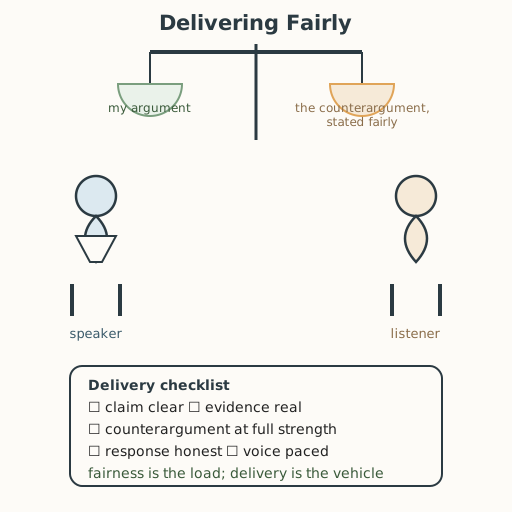
- Delivery checklist · 1 per learner Items — claim clear, reasons given, evidence real, counterargument stated at full strength, response honest, voice paced, counterargument named before answered
- Speech scaffold from Lesson 3 · 1 per learner
Low-tech / no-cost
- Paper checklist written by hand, or marks on the ground The same delivery checklist on any surface
- Voice and body (or sign, writing, or gesture) Practice pacing and emphasis by delivering the speech — spoken or signed — to a partner who attends only to fairness to the other side
Enriched / lab & device
- Recording device · 1 per pair To record the delivery and re-watch for pacing, emphasis, and whether the counterargument was stated fairly
- Shared device or projector · 1 per class To show one short recorded speech and rate its fairness to the other side
Works in different contexts
- large-group Deliver in small circles of five to six rather than to the whole room, so every voice is heard; each circle reports one strong steelman they heard
- multi-age Younger learners deliver a shorter version (claim, one reason, one counterargument); older learners deliver the full scaffold and answer a live question
- self-directed A learner records their own delivery, then plays it back against the checklist, scoring each item honestly
- level-grouped Learners ready to extend add a concession (a point the other side is right about) before their response, and note its effect
- outdoor-only Deliver to a gathered circle, with the wind and distance as real constraints on volume and pacing — practice projecting
Lesson 4 — Delivering the Persuasive Speech, Fairly
Summary
Learners turn their scaffold into a delivery: speaking the claim, reasons, and evidence aloud, and — the mark of the whole lesson — naming the counterargument at full strength and answering it honestly in front of others. Peers rate fairness to the other side, and each learner scores their own delivery against a checklist.
Objectives
- Deliver a persuasive speech that anticipates and fairly addresses counterarguments — with delivery and fair-mindedness working together. (D04.S1.11.02)
Connection
Think of the difference between someone who talks at you and someone who talks with you. The one who talks at you pretends there is no other view; the one who talks with you says, out loud, “here is the strongest reason to disagree with me — and here is what I think about it.” That second person is not weaker for naming the objection; they are stronger, because you stop guarding against the hidden trap and actually listen. Delivery is not decoration — how you hold your voice and body either builds that trust or spends it.
Materials
- Delivery checklist
- Speech scaffold from Lesson 3
Preparation
- Copy the delivery checklist.
- Retrieval: from Lesson 3, recall the six-box scaffold and the steelman principle. Today we speak it.
- Prepare one worked example: read a scaffolded argument aloud once with the counterargument named fairly, once without it, and compare how each lands.
Facilitator note
This lesson is written to the learner (“you”). The idea to land: delivery — voice, pacing, presence — is the vehicle, but fairness is the load; a persuasive speech that fairly addresses its counterargument is delivered as much with honesty as with technique. Grade 11 learners are near-adult speakers; treat them as co-authors of the standard (development.md 9–12 band). Delivery skills (pacing, emphasis, volume, and — where comfortable — gaze) are explicit, coachable techniques — model them and give guided practice (S-011). But do not let polish outrank honesty: the single most important mark on the checklist is was the counterargument stated at full strength, and answered?
Model once, then let learners deliver (worked example → guided practice → independent/performance; S-011). The ethics lens is the spine: fairness to the other side is the moral content of persuasion — a speech can be smooth and still be a con. The egalitarian lens: a fair speech makes room for the objections of the less powerful, not just the loud. The social-emotional lens: public speaking raises real anxiety; name it, allow pauses, and treat a shaky delivery with a steady claim as fully successful — the reverse is not. The critical-thinking lens: the audience’s job is to check whether the counterargument was a steelman or a straw man, and whether the response actually met it. Use peer feedback for fairness, not for ranking; celebrate mastery of the standard, not victory (philosophy §8).
Access. Delivery is any channel that carries the claim and the fair counterargument. A learner may deliver in sign language (with a written summary for hearing peers), through an AAC device or text-to-speech, or by sharing a written copy that a partner reads aloud while the learner is present. The assessed skill is the fairness of the steelman and the honesty of the response — never vocal ability. Eye contact is never required: learners who find it uncomfortable may look at the horizon, their notes, or a fixed point; gaze is offered as an option, not a mark.
Preview: Lesson 5 turns from spoken argument to reading across languages — translation.
Procedure
- Recall (5 min). From Lesson 3: what makes a speech honest? (It names the best objection at full strength and answers it.) Today you speak it aloud.
- Meet the delivery marks (10 min). Look at the delivery checklist. The marks: claim clear, reasons given, evidence real, counterargument at full strength, response honest, voice paced, counterargument named before it is answered. Watch a worked example: the same argument read twice — once hiding the objection, once naming it fairly. Feel the difference.
- Rehearse (12 min). In pairs, read your speech aloud from the scaffold. Your partner listens for one thing only: was the counterargument stated at its strongest, or weakened? Swap roles and repeat.
- Deliver (15 min). In circles of five or six, each learner delivers their speech. Listeners mark the checklist. After each speech, one listener names the strongest steelman they heard and whether the response truly answered it.
- Receive and give (8 min). For each speech, give one piece of feedback in the form: “your counterargument was fair because ___” or “you could state it more strongly by ___.” No ranking — only what served fairness and what could serve it better.
- Close (5 min). Remember: delivery is the vehicle; fairness is the load. Score your own delivery against the checklist and add the sheet to your portfolio. Next time: we cross a border — the same text in two languages.
Differentiation
- Access (deaf, hard-of-hearing, non-speaking, autistic): Deliver in sign, via AAC or text-to-speech, or by sharing a written copy (a partner may read it aloud). “Eye contact” and “voice paced” become “the delivery is clear and the counterargument is stated at full strength, in whatever channel you use” — gaze is optional, and fairness to the other side is the one non-negotiable mark.
- Support: Deliver a shortened version (claim, one reason, one counterargument, response) and receive feedback on fairness alone.
- Extension: Add a concession — one thing the other side is genuinely right about — before your response, and note how it changes the room’s willingness to listen.
Assessment
- Performance + peer: Can the learner deliver the speech with a counterargument stated at full strength and answered honestly? Peers mark the checklist; the learner self-scores.
- Portfolio artifact (unit): The scored delivery checklist (with a note of the speech’s topic and the steelman used), added as the “delivered speech” entry — a spoken record may be substituted where recording is possible.
Home connection
Deliver your speech to one person at home, but with a twist: ask them to interrupt you with their own objection — and answer it on the spot, fairly.
Resources
- On fair-minded argument and answering the strongest objection (steelmanning as the opposite of the straw man): the claim/data/warrant/rebuttal model in Toulmin, The Uses of Argument (1958) (S-236).
- On delivery and the appeals of character, feeling, and reason: Aristotle, Rhetoric (S-346).
- On modeling + guided practice before independent work: Kirschner, Sweller & Clark (2006), https://doi.org/10.1207/s15326985ep4102_1 (S-011).