Lesson 05 — One Text, Many Translations
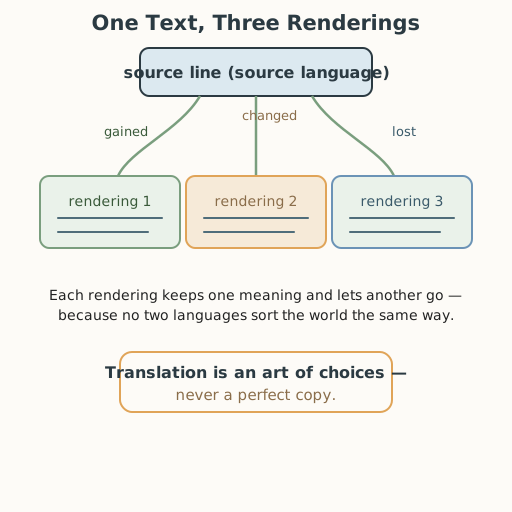
Learners compare the same short text across two or three translations, discovering that translation is an art of choices — every rendering gains something, loses something, and changes something. They learn translation is never a perfect copy, and begin the unit's translation comparison.
Objectives
Objectives
- D04.S2.11.01 Compare texts across languages and translations, noting how translation shapes meaning.
Essential question
How does translation shape meaning — what is gained, what is lost, and what is simply changed — when one text crosses into another language?
Key vocabulary
Materials
Standard materials
- Translation comparison sheet · 1 per learner Two or three translations of one short text in side-by-side columns, with rows for what is gained, lost, and changed
- Learning journal · 1 per learner
Low-tech / no-cost
- Paper with two or three columns, or lines drawn in the ground Same comparison layout on any surface
- Voice and body (or sign, writing, or gesture) Say — or write or sign — one short sentence and have a partner render its meaning, not its words, in another language or another way of saying it
Enriched / lab & device
- A published text in two or more translations · 1 set per pair e.g., a poem, a proverb, or a sacred text in two different translations, to compare choices
- Shared device to look up multiple translations · 1 per group To find two versions of one famous line and compare them
Works in different contexts
- large-group Model the comparison whole-class on one line, then pairs compare a second line and report one gain and one loss
- multi-age Younger learners find one word that changes meaning between languages; older learners compare two full translations of one text
- self-directed A learner finds two translations of a familiar text and fills the comparison sheet alone, writing what each chooses differently
- level-grouped Learners ready to extend connect translation choices to the moderate Sapir–Whorf idea that languages sort the world differently (S-168)
- outdoor-only Use a remembered proverb or song in the community's languages and compare how each says it, aloud
Lesson 5 — One Text, Many Translations
Summary
Learners compare one short text across two or three translations and discover that translation is an art of choices: every rendering gains, loses, and changes something. They learn there is no single “perfect” translation, only decisions a translator makes — and they begin the unit’s translation comparison artifact.
Objectives
- Compare texts across languages and translations, noting how translation shapes meaning — by seeing what each rendering gains, loses, and changes. (D04.S2.11.01)
Connection
Think of a proverb you know in your home language — one that people say with a smile because the words themselves carry the meaning. Now try to say it in another language. The words come out flat, or the joke dies, or the grammar insists on marking time or gender the original never did. You have just met translation: it is not a copy, it is a re-making. Every translator chooses which thread of meaning to keep and which must be let go, because no two languages sort the world in exactly the same way (S-168). To read a translation well is to read it as one voice’s choices — not as the text itself.
Materials
- Translation comparison sheet (gained / lost / changed)
- Learning journal
Preparation
- Select two or three short translations of one text (a proverb, a poem line, a well-known opening) for the worked example.
- Retrieval: from Grade 9–10, recall that the same idea can be said in many languages (D04.S3.04.02, D04.S4.06.01). Today we ask what changes when it is.
- Prepare the worked example marked with one gain and one loss.
Facilitator note
This lesson is written to the learner (“you”). The idea to land: translation shapes meaning — it is an art of choices in which every version gains, loses, and changes something, so a translation is read as one translator’s decisions, not as the text itself. Words carry culture (S-167), and languages sort the world differently in a moderate, well-supported sense (S-168) — so no translation is a perfect copy. Treat this as description of how language works, and hold “translation is an art with gain and loss” as the unit’s guiding value — never ranking one language or one translation above another (global + egalitarian lenses).
Model the comparison once, then let learners compare (worked example → guided practice → independent work; S-011). The global lens is the spine: choose examples beyond one region’s literature — a Persian line of Rūmī (S-419/S-352), a Sundiata proverb carried by griots (S-269), a line from a sacred text, a market proverb — so learners see translation as a worldwide practice, not a Western one. The critical-thinking lens: compare specific choices — a word, a rhythm, a grammatical marker — not vague “feelings” about the versions. The egalitarian lens: no language is “richer” or “poorer”; each encodes its own distinctions (kinship terms, honorifics, animacy), which is why translation gains and loses in both directions. The ethics lens: a faithful translation owes the author care — a careless one can misrepresent a person or a people. Preview: Lesson 6 asks who does the translating — machine or human — and when each is trustworthy.
Procedure
- Recall (5 min). From Grade 9–10: the same idea can be said in many languages. Today you ask what happens to the idea on the way across.
- Meet the comparison (10 min). Look at the translation comparison sheet: rows for gained, lost, changed. Watch a worked example — one short line in two translations. Mark what each version gains, what it loses, and what it simply changes.
- Learn why it happens (10 min). No two languages sort the world in the same way (S-168): one marks time, another marks respect, another marks whether a thing is a person or an object. So a translator must choose. Write in your journal: one distinction your home language makes that another language you know does not (or the reverse).
- Compare two translations (15 min). Take a second short text in two versions. Fill the sheet. Ask: which word choices differ? What does each translator seem to care most about — the sound, the literal words, or the feeling? Which meaning did each let go?
- Make the point precisely (10 min). Write one sentence naming a specific gain and one naming a specific loss. Be exact — not “it sounds different” but “the word for ‘home’ here also means ‘fire,’ and that second meaning is lost.”
- Close (5 min). Remember: a translation is a translator’s choices, not the text itself. Add this page to your translation comparison. Next time: the machine translator and the human one.
Differentiation
- Support: Provide the two translations with the differing words already underlined; ask only “what is gained and what is lost?”
- Extension: Find a third translation of the same text and argue which of the three keeps a specific meaning best — and which keeps the sound best.
Assessment
- Formative (self): Can the learner name one specific thing a translation gains, one it loses, and one it changes, and say which meaning the translator chose to keep?
- Portfolio artifact (unit): The translation comparison sheet, added to the portfolio as the “cross-language and translation comparison” entry.
Home connection
Ask an adult to say a favorite proverb or song line in your shared language, then try together to carry it into another language you both partly know. Notice what refuses to cross.
Resources
- On languages sorting the world differently (moderate linguistic relativity): Sapir & Whorf (S-168).
- On words carrying culture, so translation gains and loses: Everett, Language: The Cultural Tool (2012) (S-167).
- On Rūmī as a widely translated Persian poet: Encyclopaedia Britannica, “Rūmī” (S-419).
- On Sundiata as an oral-tradition epic carried by griots: Niane, Sundiata: An Epic of Old Mali (S-269).
- On modeling + guided practice before independent work: Kirschner, Sweller & Clark (2006), https://doi.org/10.1207/s15326985ep4102_1 (S-011).