Lesson 06 — Translation Tools and Human Judgment
Learners test what machine translation can and cannot do — including the back-translation drift test — and learn that digital tools give quick gist but miss tone, idioms, and nuance, and work unevenly across languages. They conclude that human translation and judgment remain necessary for high-stakes, nuanced, or sensitive text.
Objectives
Objectives
- D04.S2.11.01 Compare texts across languages and translations, noting how translation shapes meaning.
Essential question
What can a machine translator do, what can it not do, and when must a human translator — with judgment, care, and cultural knowledge — step in?
Key vocabulary
Materials
Standard materials
- Tool-vs-human comparison sheet · 1 per learner Columns for the same text — machine output, human rendering, and where each goes wrong or right
- Learning journal · 1 per learner
Low-tech / no-cost
- Paper with two columns, or lines drawn in the ground Same comparison on any surface
- Voice and body (or sign, writing, or gesture) One learner "plays" a literal word-for-word translator while a partner plays a thoughtful human one, and the group notices the difference
Enriched / lab & device
- A digital translation tool (where available) · 1 per pair To translate one short text and then back-translate it, exposing drift
- Shared device · 1 per group To compare machine output for a well-resourced language and a less-resourced one, if both are available
Works in different contexts
- large-group Model one machine vs. human comparison whole-class, then pairs run the back-translation test on one line and report the drift they found
- multi-age Younger learners find one place the machine got a word wrong; older learners explain why it failed and what a human would know
- self-directed A learner (with any device or with a friend fluent in another language) tests a machine translation and writes where it succeeded and failed
- level-grouped Learners ready to extend explain why low-resource languages fare worse in machine translation and why human post-editing is needed for high-stakes text
- outdoor-only Discuss, without any device, when a machine translation could help in real life (a sign, a form) and when only a person will do
Lesson 6 — Translation Tools and Human Judgment
Summary
Learners test what machine translation can and cannot do — including the back-translation drift test — and learn that digital tools give fast, useful gist but miss tone, idioms, and nuance, and work unevenly across languages (S-350). They conclude that human translation, with judgment and cultural knowledge, remains necessary for high-stakes, nuanced, or sensitive text.
Objectives
- Compare texts across languages and translations, noting how translation shapes meaning — by judging who translates: machine or human, and when each is trustworthy. (D04.S2.11.01)
Connection
You have almost certainly pasted a sentence into a phone’s translator and gotten back something almost right — or something hilariously, dangerously wrong: a joke that died, a “you” that should have been a “they,” a polite request that came out as a command. The tool is fast and often good enough to understand a sign or a menu. But translation is not just swapping words; it is choosing meaning, tone, and respect (S-350). Knowing the difference between “good enough for gist” and “good enough to represent a person” is a modern survival skill — and it belongs to this unit’s technology lens.
Materials
- Tool-vs-human comparison sheet (machine output / human rendering / where each goes wrong)
- Learning journal
Preparation
- Prepare one worked example of a machine translation that goes wrong on tone or idiom (from memory, or generated ahead of time).
- Retrieval: from Lesson 5, recall that translation gains, loses, and changes. Today we ask whether a machine can be trusted with those choices.
- Prepare the back-translation demonstration if a device is available.
Facilitator note
This lesson is written to the learner (“you”). The idea to land: machine translation is a powerful tool for quick gist, but it is limited — by word-sense ambiguity, idioms, tone, and nuance, and by working much worse for low-resource languages — so human translation and post-editing remain necessary for high-stakes, nuanced, or sensitive text (S-350). This is the technology lens made concrete: a tool’s effect on humanity is that it democratizes basic access across languages while still requiring human judgment where meaning matters most. Hold the capabilities and limits as evidence, and “human care where meaning matters” as a value — keep them distinct (philosophy §5).
Model one comparison, then let learners test (worked example → guided practice → independent work; S-011). The technology lens is the spine: name what the tool actually does (statistically predicts the most likely next word in a neural model) so the tool is understood, not magic. The egalitarian lens: machine translation is far stronger for well-resourced languages (those with huge digital corpora) and far weaker for low-resource ones — so the tool can widen the very gap it seems to close (S-350). The ethics lens: a bad machine translation in a clinic, a court, or a newsroom can misrepresent a person or a fact — that is why high-stakes settings use human translators and interpreters. The global lens: for many of the world’s ~7,000 languages (S-426), no machine translator exists at all — the human community is the only bridge. The critical-thinking lens: the back-translation test is a habit — run a sentence A→B→A and see what drifts. Preview: Lesson 7 turns from how a text is carried to who wrote it — the author’s position.
Procedure
- Recall (5 min). From Lesson 5: translation is choices, never a copy. Today you ask: can a machine be trusted with those choices?
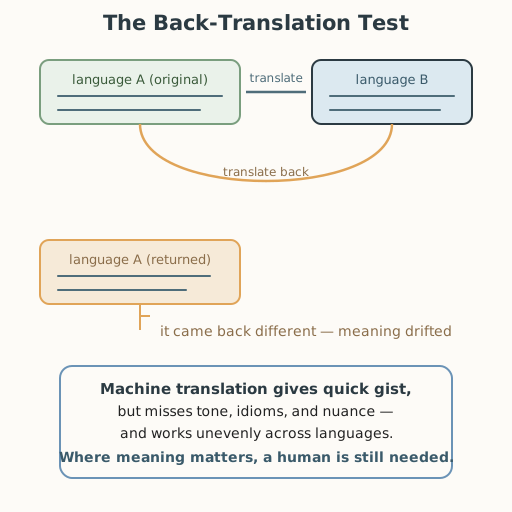
- Meet the tool (10 min). Learn what a machine translator does: it statistically predicts the most likely rendering from huge amounts of paired text — fast, but it does not understand tone, idioms, or context (S-350). Watch a worked example: one sentence the machine got wrong on tone or idiom. Name exactly what it missed.
- Run the back-translation test (15 min). With a tool (or a fluent friend), take a short sentence, translate it into another language, then translate it back. Compare the result to your original. Write what drifted — a word, a level of politeness, a meaning.
- Compare machine and human (10 min). On your sheet, place the machine’s rendering beside a human’s rendering (or your own careful one). Where did each go right or wrong? Which would you trust to represent you to a doctor, a court, or a grandparent?
- Learn the limits (10 min). Machine translation works far better for languages with huge digital presence and far worse for low-resource languages (S-350); for many of the world’s languages, no tool exists at all (S-426). Write one sentence about what this means for fairness.
- Close (5 min). Remember: the tool gives gist; the human gives judgment. Add this page to your translation comparison. Next time: who wrote the text — and how their place shapes it.
Differentiation
- Support: Use a single prepared machine error and ask only “what went wrong, and why would a human have caught it?”
- Extension: Compare machine output for the same sentence in a well-resourced language and (if possible) a low-resource one, and argue how the gap affects equity.
Assessment
- Formative (self): Can the learner name one thing a machine translation got wrong (tone, idiom, nuance, or uneven coverage) and one setting where a human translator is required?
- Portfolio artifact (unit): The tool-vs-human comparison sheet, added to the portfolio as the “translation tools” entry.
Home connection
With an adult, translate one short family sentence with a phone tool and then back-translate it. Laugh at the drift together — then ask: would you trust this tool to speak for you in a serious moment?
Resources
- On machine translation’s capabilities and limits (gist vs. nuance; low-resource languages): Encyclopaedia Britannica, “Machine translation,” https://www.britannica.com/technology/machine-translation (S-350).
- On the number of living languages: Ethnologue — Languages of the World, https://www.ethnologue.com/ (S-426).
- On modeling + guided practice before independent work: Kirschner, Sweller & Clark (2006), https://doi.org/10.1207/s15326985ep4102_1 (S-011).