Lesson 07 — An Author's Place: Culture and History Shape a Text
Learners analyze how an author's cultural and historical position — time, place, language, and relation to power — shapes a text, using a four-question probe and examples from authors who wrote across languages and under pressure (Ngũgĩ, Anzaldúa, and others). They begin the unit's author-position analysis.
Objectives
Objectives
- D04.S2.11.02 Analyze how an author's cultural and historical position shapes a text, and read it against other perspectives.
Essential question
How does an author's cultural and historical position — where and when they wrote, in what language, under what power — shape the text they produced?
Key vocabulary
Materials
Standard materials
- Author-position sheet · 1 per learner Four questions — who wrote this, when and where, in what language and for whom, and how does that position show in the text
- Learning journal · 1 per learner
Low-tech / no-cost
- Paper with the four questions written by hand, or drawn in the ground Same four questions on any surface
- Voice and body (or sign, writing, or gesture) Tell — or write or sign — a remembered story once as yourself, once as someone from another time or place, and notice what changes in the telling
Enriched / lab & device
- Short excerpts from two authors writing from different positions (optional) · 1 set per pair e.g., Ngũgĩ wa Thiong'o on writing in Gikuyu vs. English, and Gloria Anzaldúa on living between languages
- Shared device to look up an author's biography · 1 per group To find one author's time, place, language, and situation
Works in different contexts
- large-group Model the four questions whole-class on one author, then pairs apply them to a second author and share one way position shows in the text
- multi-age Younger learners answer "who wrote this and when"; older learners trace how language and power shape the text's very form
- self-directed A learner chooses one author they admire, looks up their position, and writes how that position shows in a favorite work
- level-grouped Learners ready to extend compare Ngũgĩ's choice to write in Gikuyu with Anzaldúa's mixing of languages, and what each choice says about position
- outdoor-only Use a local song, proverb, or story whose teller's position is known, and ask the four questions aloud in a circle
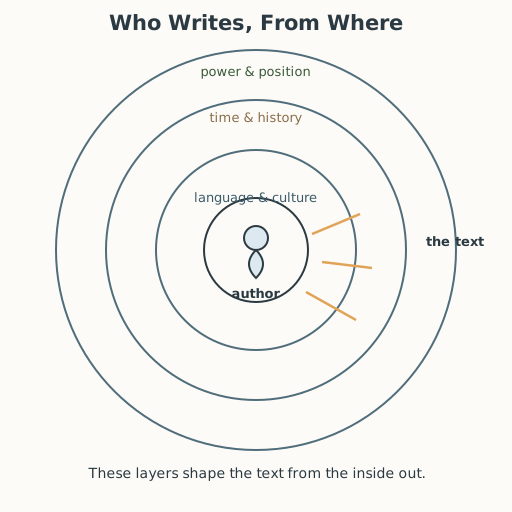
Lesson 7 — An Author’s Place: Culture and History Shape a Text
Summary
Learners analyze how an author’s cultural and historical position — their time, place, language, and relation to power — shapes the text they produce, using a four-question probe. They read brief examples of authors who wrote across languages and under pressure (Ngũgĩ wa Thiong’o, Gloria Anzaldúa, and others) and begin the unit’s author-position analysis.
Objectives
- Analyze how an author’s cultural and historical position shapes a text — by asking who wrote it, when and where, in what language, and under what power. (D04.S2.11.02)
Connection
The same story told by two different people is two different stories. A river that a farmer writes about as water for the fields, an engineer writes about as a flow to be measured, and a poet writes about as a voice in the dark. Who you are — your place, your time, your language, your relation to power — is not a stain on your writing; it is the very lens through which the writing sees. To read deeply is to ask not only what does this say but who is saying it, from where, and to whom — and to notice that every author, including you, writes from somewhere.
Materials
- Author-position sheet (who / when and where / in what language and for whom / how it shows)
- Learning journal
Preparation
- Select one or two short author excerpts (Ngũgĩ wa Thiong’o, Gloria Anzaldúa, or another author whose position is clear) for the worked example.
- Retrieval: from Lesson 5–6, recall how language shapes meaning. Today we ask how the author’s whole situation shapes the text.
- Prepare the four-question worked example on one author.
Facilitator note
This lesson is written to the learner (“you”). The idea to land: a text is written by a situated person — their time, place, language, and relation to power shape the text, and a careful reader asks who wrote this, from where, in what language, and for whom. Two canonical examples carry this: Ngũgĩ wa Thiong’o, who argued that being made to write in the colonizer’s language distanced him from his home world and chose to write in Gikuyu (S-424); and Gloria Anzaldúa, who lived and wrote between languages — Chicano Spanish, English, and more — insisting her languages are her identity, not a deficit (S-425). Present both as their lived arguments, held as testimony to be weighed, never as a single verdict all learners must adopt (inquiry over creed, philosophy §11). A learner who writes comfortably in one language is not “wrong”; they are invited to notice their own position, whatever it is.
Model the four questions once, then let learners apply them (worked example → guided practice → independent work; S-011). The global lens: choose authors from beyond one region — a Persian poet, a West African epic’s griot-keeper (S-269), a Kenyan novelist, a Chicana essayist — so “position” is worldwide. The egalitarian lens: whose position gets to be “literature” and whose is “folklore” is a question of power, not merit. The ethics lens: reading an author’s position faithfully means not reducing a person to their situation — position shapes, it does not determine. The critical-thinking lens: position is one lens among several; the text still speaks beyond it. Preview: Lesson 8 reads the text against other perspectives — including perspectives the author could not or did not include.
Procedure
- Recall (5 min). From Lessons 5–6: language shapes meaning. Today you step back: the author’s whole situation shapes the text — their place, time, language, power.
- Meet the four questions (10 min). Look at the author-position sheet. The four questions: who wrote this? when and where? in what language, and for whom? how does that position show in the text? Watch a worked example on one author — mark the clues of their position in a short excerpt.
- Read two positions (15 min). Read brief excerpts (or summaries) of two authors who wrote across languages and under pressure. For each, fill the four questions. Ask: how did their language and their relation to power show up in the writing itself — not just in the topic, but in the choice of words, the mixing of languages, the audience they address?
- Name your own position (10 min). Turn the probe on yourself: if you wrote a story or essay today, who would be writing it — from where, in what language or mix of languages, for whom, and under what pressures? Write three sentences.
- Connect position to the text (10 min). Choose one of the two authors and write one precise sentence: “Because ___ wrote in ___ under ___, the text does ___” — naming a specific feature (a word choice, a rhythm, a mixing of tongues) that shows the position.
- Close (5 min). Remember: every author — including you — writes from somewhere. Add this page to your author-position analysis. Next time: read that text against other perspectives.
Differentiation
- Access (dyslexic, low-vision, blind): Offer the author excerpts as audio (read aloud by the facilitator or a partner) or in large print, braille, or accessible digital text; learners may answer the four questions aloud, dictate them to a scribe, or type. The analysis of position — not reading speed — is the standard.
- Support: Provide the author’s position already stated in one sentence; ask learners to find one place in the excerpt where it shows.
- Extension: Compare Ngũgĩ’s choice to write in Gikuyu with Anzaldúa’s deliberate mixing of languages, and argue what each choice says about their different positions.
Assessment
- Formative (self): Can the learner name an author’s time, place, language, and relation to power, and point to one specific feature of the text where that position shows?
- Portfolio artifact (unit): The author-position sheet, added to the portfolio as the “author-position analysis” entry.
Home connection
Ask an adult to tell you the story of a song or poem that mattered in their youth — then ask: who wrote it, when, where, and in what language — and can you hear that in the words?
Resources
- On language, culture, and writing in the colonizer’s language: Ngũgĩ wa Thiong’o, Decolonising the Mind (1986) (S-424).
- On living and writing between languages: Gloria Anzaldúa, Borderlands/La Frontera (1987), esp. “How to Tame a Wild Tongue” (S-425).
- On the griot as the keeper of a people’s history: Niane, Sundiata: An Epic of Old Mali (S-269).
- On modeling + guided practice before independent work: Kirschner, Sweller & Clark (2006), https://doi.org/10.1207/s15326985ep4102_1 (S-011).