Lesson 08 — Reading Against Other Perspectives
Learners practice reading a text *against* other perspectives — naming whose voice is absent and reconstructing what the text means from that position — learning that counter-reading does not destroy a text but enriches it. They add the counter-reading to their author-position analysis.
Objectives
Objectives
- D04.S2.11.02 Analyze how an author's cultural and historical position shapes a text, and read it against other perspectives.
Essential question
How do I read a text against other perspectives — the voices the author did not or could not include — without reducing or dismissing the text?
Key vocabulary
Materials
Standard materials
- Counter-reading sheet · 1 per learner Three columns — what the text says, whose voice is missing, and what the text means read from that missing voice's position
- Learning journal · 1 per learner
Low-tech / no-cost
- Paper folded into three columns, or lines drawn in the ground Same three columns on any surface
- Voice and body (or sign, writing, or gesture) Re-tell — or write or sign — a familiar story from the point of view of a character the story never lets speak, and notice what changes
Enriched / lab & device
- A short text with a clear dominant voice and a clear absent voice (optional) · 1 per pair A passage whose silent character or excluded group is easy to name
- Shared device to look up a retelling of a classic from another culture's perspective · 1 per group To find one real counter-reading in the wild
Works in different contexts
- large-group Model the counter-reading whole-class on one passage, then pairs apply it to a second and share the missing voice they found
- multi-age Younger learners name one missing voice; older learners reconstruct the full argument that voice would make against the text
- self-directed A learner takes a favorite text and fills the three columns alone, reconstructing the absent voice's reading
- level-grouped Learners ready to extend weigh whether the counter-reading overturns the text or enriches it — a dialectic rather than a verdict
- outdoor-only Use a local story or song and ask in a circle whose voice it leaves out, and what that voice would say
Lesson 8 — Reading Against Other Perspectives
Summary
Learners practice reading a text against other perspectives — naming whose voice the text leaves out and reconstructing what the text means from that position. They learn that a counter-reading does not destroy a text but enriches it, and they complete the unit’s author-position analysis by reading the author with and against other voices.
Objectives
- Analyze how an author’s cultural and historical position shapes a text, and read it against other perspectives — by asking whose voice is absent and what the text means from there. (D04.S2.11.02)
Connection
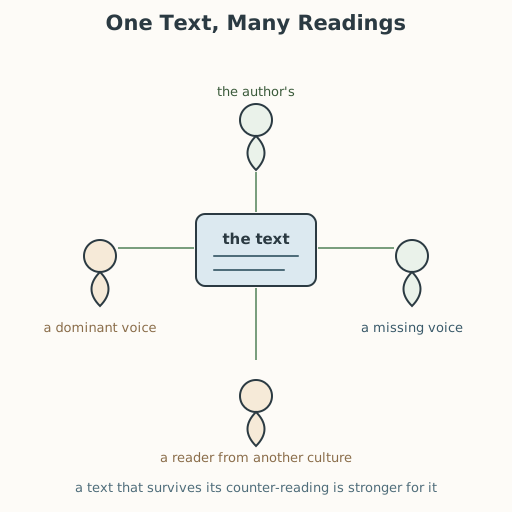
Every story has a silent character: the servant in the tale of the prince, the woman in the story of the war, the colonized people in the colonizer’s history, the quiet sibling in the family legend. You know the feeling of being the one not spoken for — or of reading a story about people like you written by someone who never asked you. Reading against the text means letting the absent voice speak: not to burn the story, but to see what it hid and what it could become. A text that survives its counter- reading is stronger for it.
Materials
- Counter-reading sheet (what it says / whose voice is missing / what it means from there)
- Learning journal
Preparation
- Select a short text with a clear dominant voice and a clear absent voice.
- Retrieval: from Lesson 7, recall the four-question author-position probe. Today we read the text against positions the author did not include.
- Prepare the worked example marking one missing voice.
Facilitator note
This lesson is written to the learner (“you”). The idea to land: a text is shaped by its author’s position — and read against other perspectives, it reveals whose voice it excluded; a counter-reading does not erase the text but completes the picture. This is the second half of the standard: reading the author with their position (Lesson 7) and against other positions (Lesson 8). Frame counter-reading as addition and pressure, never as destruction: the point is not to cancel a text but to notice the frame around it. This protects learners from both naïve acceptance and reflexive dismissal — the mature posture of the 9–12 band (development.md).
Model once, then let learners counter-read (worked example → guided practice → independent work; S-011). The egalitarian lens is the spine: whose voices a text includes and excludes is a question of power, and counter-reading is how the excluded get heard. The ethics lens: reading against a text is fair when it is precise (“this passage assumes X”) and unfair when it is a smear (“this author is simply bad”) — teach the difference. The global lens: a text that is foundational in one culture may read very differently from another culture’s position — hold both readings side by side without ranking them. The critical-thinking lens: weigh whether the counter-reading overturns the text’s meaning or deepens it — often it does both at once. Preview: Lesson 9 turns from reading to writing — your own extended original work begins.
Procedure
- Recall (5 min). From Lesson 7: every author writes from a position. Today you ask what happens when a text is read from a position it never included.
- Meet the counter-reading (10 min). Look at the counter-reading sheet. Three columns: what the text says, whose voice is missing, what the text means from that voice’s position. Watch a worked example: a familiar story, marked with one silent character.
- Find the missing voice (12 min). Read the selected text. Ask: who is spoken about but never speaks? Who is left out entirely? Name the voice, and write what their situation is.
- Reconstruct the counter-reading (12 min). In that voice’s position, re-read the text. What would they notice that the text hides? What would they say back to it? Write three sentences as if from that position — clearly labeled as an exercise in perspective, not a claim about a real person’s views.
- Weigh the readings (8 min). Compare the author’s reading and the counter-reading side by side. Does the counter-reading overturn the text’s meaning, deepen it, or both? Write one sentence of your verdict, with a reason.
- Close (5 min). Remember: one text, many readings — and the strongest text survives being read against. Add this page to your author-position analysis. Next time: you become the author.
Differentiation
- Access (dyslexic, low-vision, blind): Offer the text as audio or large print / braille / accessible digital text; a partner or screen reader may read it aloud, and the three columns may be filled by dictation or typing. The counter-reading — not the reading speed — is assessed.
- Support: Provide the missing voice already named; ask learners to write one thing that voice would notice or say.
- Extension: Find a real published retelling or counter-reading of a classic from another perspective, and compare it to the original in the three columns.
Assessment
- Formative (peer + self): Can the learner name an absent voice in a text, reconstruct what the text means from that position, and weigh whether the counter-reading overturns or deepens the text?
- Portfolio artifact (unit): The counter-reading sheet, added to the portfolio as the “read against other perspectives” entry, completing the author-position analysis.
Home connection
Tell an adult a story your family tells often, then ask together: who in this story never gets to speak? Let the silent character talk for once.
Resources
- On reading a text’s frame and the voices it excludes: the media/perspective analysis in UNESCO’s Media and Information Literacy framework (S-217).
- On whose voices a culture records and whose it silences: Ngũgĩ wa Thiong’o, Decolonising the Mind (1986) (S-424); Anzaldúa, Borderlands/La Frontera (1987) (S-425).
- On modeling + guided practice before independent work: Kirschner, Sweller & Clark (2006), https://doi.org/10.1207/s15326985ep4102_1 (S-011).