Lesson 09 — Extended Original Work: A Sustained Idea
Learners begin an extended, original work — analytical, narrative, or creative — by finding one seed idea worth sustaining, naming the question it explores, and planning its shape. They draft the work's first moves in their home language, setting up the multi-day writing arc.
Objectives
Objectives
- D04.S3.11.01 Write extended, original work — analytical, narrative, or creative — that develops a sustained idea or story.
Essential question
How do I begin an extended, original work — analytical, narrative, or creative — around one idea or story worth sustaining?
Key vocabulary
Materials
Standard materials
- Sustained-work planner · 1 per learner A planning page — seed idea, genre, the one question it explores, the shape it will take, and the first two moves — in the home language
- Learning journal · 1 per learner
Low-tech / no-cost
- Paper planner drawn by hand, or marks in the ground Same planner on any surface
- Voice and body (or sign, writing, or gesture) Say — or sign or write — your idea in one breath (one sentence); if it cannot be held as one idea, it is not yet one seed
Enriched / lab & device
- Examples of sustained openings from essays, stories, or memoirs (optional) · 1 set per pair Three different first pages that set up an idea worth a whole work
- Shared device to look up a published work's premise · 1 per group To see how a real author states the one idea their work sustains
Works in different contexts
- large-group Model the planner whole-class on a shared seed idea, then learners fill their own in pairs, sharing only their one-sentence idea
- multi-age Younger learners plan a short work around one idea; older learners plan a longer one and state the question it explores
- self-directed A learner fills the planner alone, testing whether their idea can be said in one breath and still has room to grow
- level-grouped Learners ready to extend state their idea as a thesis with a counter-thesis to hold in tension across the work
- outdoor-only Find a quiet spot, state your idea aloud to the air, and plan the work's shape in a journal or on the ground
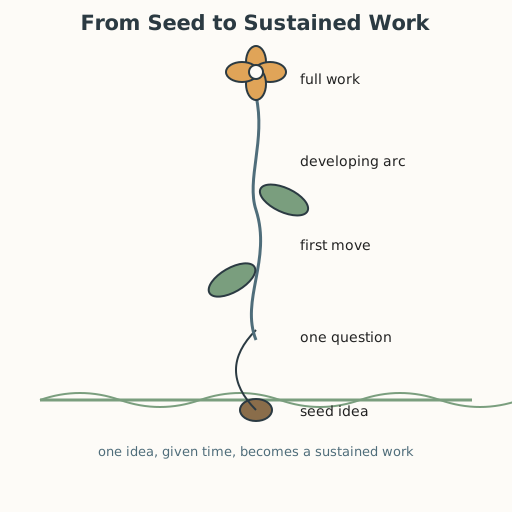
Lesson 9 — Extended Original Work: A Sustained Idea
Summary
Learners begin an extended, original work — analytical, narrative, or creative — by finding one seed idea worth sustaining, naming the single question it explores, and planning its shape. They draft the work’s first moves in their home language, setting up a multi-day writing arc that continues in Lesson 10.
Objectives
- Write extended, original work that develops a sustained idea or story — beginning by finding and committing to one idea worth carrying. (D04.S3.11.01)
Connection
A long work is not a short one stretched out; it is a seed that keeps on giving. A single sentence — a question that nags you, an image that will not leave, a character who wants something — can become an essay, a story, a memoir, if you let it grow instead of rushing it. The difference between writing that runs out of breath and writing that sustains is whether the idea itself has enough life in it to keep opening. Today you find that idea and plant it.
Materials
- Sustained-work planner (seed idea / genre / the one question / the shape / first two moves)
- Learning journal
Preparation
- Copy or draw the sustained-work planner.
- Retrieval: from Grade 9–10, recall writing for real purposes and audiences (D04.S3.09.02) and crafting prose with deliberate style (D04.S3.10.01). Today we write long — one idea sustained.
- Prepare one worked example: a seed idea that opens into a whole work.
Facilitator note
This lesson is written to the learner (“you”). The idea to land: an extended work is built on one idea or story worth sustaining — the writer finds the seed, names the question it explores, and lets it grow across the work. The genre is the learner’s choice: analytical (an essay developing a claim), narrative (a story), or creative (a poem-sequence, a hybrid). Home language first — thought flows in the language the learner dreams in; translation and second-language work come later (Lesson 12). This lesson launches a multi-day arc: Lesson 9 plants, Lesson 10 develops, revises, and completes, with home time in between — the spacing itself is a science-of-learning feature (S-039).
Model the planner once, then let learners plan their own (worked example → guided practice → independent work; S-011). The intellectual lens: the discipline of naming “the one question” separates a sustained work from a pile of sentences. The social-emotional lens: writing long is vulnerable — the idea may be personal; make the room safe for half-formed seeds, and allow learners to choose fiction or analysis to keep distance if they need it. The ethics lens: an idea is a responsibility — a writer chooses what to sustain and thereby what to amplify; invite learners to notice what their idea values. The global lens: sustained works take many shapes across cultures — the griot’s epic (S-269), the essay, the poem-cycle, the family chronicle — none is the “real” form. Preview: Lesson 10 develops the structure and voice, and revises.
Procedure
- Recall (5 min). From Grade 9–10: you have written for real purposes and crafted sentences on purpose. Today you write long — one idea sustained across a whole work.
- Meet the planner (10 min). Look at the sustained-work planner. Its parts: seed idea (one sentence), genre (analytical / narrative / creative), the one question it explores, the shape it will take, and the first two moves. Watch a worked example: a seed that opens into a whole work.
- Find your seed (12 min). In your journal, list three ideas that keep returning to you — a question, an image, a character, a memory, an argument. Choose the one with the most life in it. Write it as one sentence in your home language.
- Name the question (8 min). Every sustained work is an answer to a question it keeps exploring. Write the one question your work is asking. If you cannot, the seed is not ready — pick another. Test it aloud in one breath.
- Plan the shape (10 min). Decide the genre and sketch the work’s arc: where it begins, where it turns, where it lands. Write the first two moves — the opening sentence and the move that follows it. (Do not write the whole thing yet.)
- Close (5 min). Remember: a sustained work grows from one idea, over time. Keep the planner — between now and Lesson 10, let the seed grow in your mind. Next time: structure, voice, and revision.
Differentiation
- Access (non-speaking, deaf, hard-of-hearing, dyslexic, low-vision): The “one breath” test may be done in sign, in writing, or in thought — the check is “is this one idea, not several.” Learners who write by voice may dictate the planner to a scribe or use speech-to-text; the planner’s idea, not the writing hand, is assessed.
- Support: Provide three ready seed ideas to choose from, and a starter question for each.
- Extension: State your idea as a thesis, then write the counter-thesis you will hold in tension across the work — the argument your essay or story will wrestle with.
Assessment
- Formative (self): Can the learner state one seed idea in a sentence, name the single question it explores, and sketch its shape with a first move?
- Portfolio artifact (unit): The sustained-work planner, added to the portfolio as the “extended original work — planning” entry.
Home connection
Before Lesson 10, let your seed grow: as you go about your day, notice one detail — a sound, a phrase, a face — and jot it down. Your work is already rooting.
Resources
- On sustained narrative and the epic as an oral form kept by griots: Niane, Sundiata: An Epic of Old Mali (S-269).
- On spaced retrieval and distributed practice as high-utility techniques: Dunlosky et al. (2013), https://doi.org/10.1177/1529100612453266 (S-039).
- On modeling + guided practice before independent work: Kirschner, Sweller & Clark (2006), https://doi.org/10.1207/s15326985ep4102_1 (S-011).