Lesson 10 — Developing the Extended Work: Structure, Voice, Revision
Learners develop their extended work into a full draft — giving it structure and a voice — and then revise it, reading aloud to find where the structure sags and using a revision checklist to make sure the seed idea stays central from opening to landing. They complete the sustained original work for the portfolio.
Objectives
Objectives
- D04.S3.11.01 Write extended, original work — analytical, narrative, or creative — that develops a sustained idea or story.
Essential question
How do I develop my extended work — give it structure and a voice, and revise it until the idea is fully carried?
Key vocabulary
Materials
Standard materials
- Revision checklist · 1 per learner Items — the idea stays central, the structure carries it, the voice is mine, each part earns its place, the ending lands where the seed pointed
- Draft from Lesson 9 and home time · 1 per learner
Low-tech / no-cost
- Paper checklist written by hand, or marks in the ground Same checklist on any surface
- Voice and body (or sign, writing, or gesture) Read your draft back to a partner — aloud, in sign, or by having them read it to you — and mark where the structure is weak
Enriched / lab & device
- Recording device · 1 per pair To record a read-aloud and hear where the voice flags or the structure sags
- Shared device to format or share the finished work (optional) · 1 per group To prepare the work for the portfolio
Works in different contexts
- large-group Model one revision whole-class on a shared draft, then learners revise in pairs, reading aloud and marking stumbles
- multi-age Younger learners revise for one thing — does each part carry the idea; older learners revise for structure, voice, and the ending
- self-directed A learner reads their draft aloud to themselves, marks every stumble, and revises against the checklist alone
- level-grouped Learners ready to extend give and receive peer feedback in the "what serves the idea / what to try" form, then revise
- outdoor-only Read the draft aloud to a partner under the sky, marking stumbles in the margin as you go
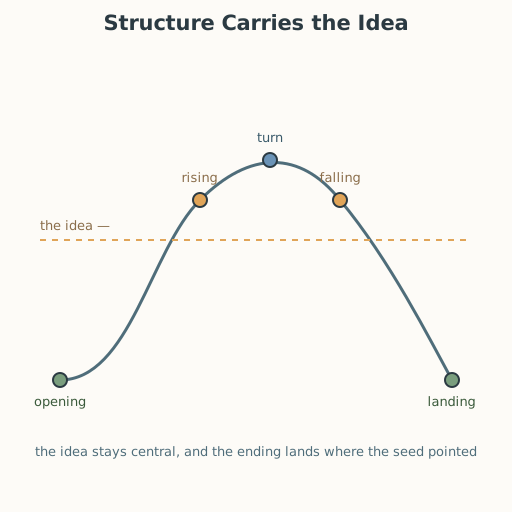
Lesson 10 — Developing the Extended Work: Structure, Voice, Revision
Summary
Learners develop their seed idea into a full draft — giving it structure and a voice — and then revise it, reading aloud to find where the structure sags and using a checklist to confirm the idea stays central from opening to landing. They complete the sustained original work for the portfolio.
Objectives
- Write extended, original work that develops a sustained idea or story — by carrying the seed through structure, voice, and revision to a completed work. (D04.S3.11.01)
Connection
The first draft is you telling yourself the idea; the revision is you telling it to someone else. A draft almost always has a sag — a part where even you, reading aloud, lose interest, because the idea left the room and the sentences kept going without it. Reading a draft back — aloud, in sign, or slowly to yourself — is the oldest and truest editor: the channel you did not write with catches what the mind forgives. To finish a long work is not to make it perfect but to make it whole — every part earning its place in service of the one idea you planted.
Materials
- Revision checklist (idea central / structure carries / voice is mine / each part earns its place / ending lands)
- Draft from Lesson 9 and home time
Preparation
- Copy the revision checklist.
- Retrieval: from Lesson 9, recall the seed idea, the one question, and the first two moves. Today we grow them into a full draft and revise.
- Prepare a worked example: revise one sagging sentence from a shared draft.
Facilitator note
This lesson is written to the learner (“you”). The idea to land: an extended work is finished not when it is long enough but when the idea is carried whole — structure and voice serve the idea, and revision (especially reading aloud) is how the writer finds where the idea dropped. Structure and voice are craft skills: model them and give guided practice (S-011). The read-aloud is a concrete, low-tech revision technique — where the reader stumbles, the structure is weak. Feedback is “what serves the idea / what to try next,” never ranking (philosophy §8).
Model one revision, then let learners revise (worked example → guided practice → independent work; S-011). The intellectual lens: coherence is the discipline — every part must earn its place in the arc. The critical-thinking lens: revision is self-critique made routine — the writer asks of their own sentences what they asked of a text in Lessons 7–8. The social-emotional lens: sharing a draft is vulnerable; read-alouds are in pairs or small circles, and “not yet” is information, not a verdict. The egalitarian lens: every learner’s voice is worth completing, and the work is judged by whether it carries its own idea — not by whose idea is “better.” Preview: Lesson 11 adapts writing across registers — the same content re-clothed for a different audience.
Procedure
- Recall (5 min). From Lesson 9: you planted a seed and wrote the first two moves. Today you grow it into a full draft and revise it whole.
- Meet structure and voice (10 min). Learn the two craft levers: structure — the arc that carries the idea from opening to landing — and voice — the sound of you on the page. Watch a worked example: one sagging sentence, revised so it serves the idea again.
- Draft to the end (15 min). Write your work through to an ending that lands where the seed pointed. Do not stop to polish — reach the end first. (If you need more time, carry it home; the work is yours.)
- Read aloud (10 min). In pairs, read your draft aloud. Mark every place you stumble or lose interest. Ask your partner one question: “where did the idea leave the room?”
- Revise against the checklist (10 min). Use the revision checklist: is the idea central throughout? Does the structure carry it? Is the voice mine? Does each part earn its place? Does the ending land where the seed pointed? Revise the weakest two spots now.
- Close (5 min). Remember: a work is finished when the idea is whole, not when it is long. Add the completed work (or its finished section, if it continues at home) to your portfolio. Next time: the same content in a different register.
Differentiation
- Access (non-speaking, deaf, hard-of-hearing, dyslexic, low-vision): “Reading aloud” is one way to find a sag, not the only way. Read the draft silently and slowly, ask a partner or screen reader to read it back, or sign each paragraph and mark where the idea drops. Learners who write by voice may dictate the draft to a scribe or use speech-to-text. The revision check — does each part carry the seed idea? — is the same in every channel.
- Support: Revise for a single thing — does each part carry the idea — and cut or fix the one place it does not.
- Extension: Give one peer’s draft structured feedback in the form “what serves the idea / one thing to try,” and then apply the same lens to your own.
Assessment
- Formative (peer + self): Can the learner carry the seed idea through a complete structure with a consistent voice, and revise at least one sag using the checklist?
- Portfolio artifact (unit): The completed extended original work, added to the portfolio as the “extended original work” entry (the unit’s central writing artifact).
Home connection
Read your finished work aloud to someone who cares about you. Ask them only: what did you remember most? — and see if it is the idea you meant to plant.
Resources
- On revision as re-seeing, and feedback as “what serves the work”: the writing-process and peer-feedback practice in IES, Teaching Secondary Students to Write Effectively (S-171).
- On spaced retrieval and distributed practice: Dunlosky et al. (2013), https://doi.org/10.1177/1529100612453266 (S-039).
- On modeling + guided practice before independent work: Kirschner, Sweller & Clark (2006), https://doi.org/10.1207/s15326985ep4102_1 (S-011).