Lesson 12 — Writing Across Languages: Translating Your Own Work
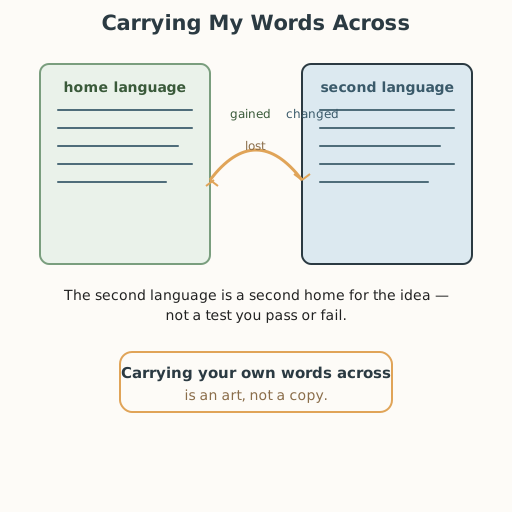
Learners carry their own writing across a language border — translating a passage of their extended work or composing directly in a second language — and record what is gained, lost, and changed. They treat the second language not as a test but as a second home for the idea.
Objectives
Objectives
- D04.S3.11.02 Adapt writing across languages and registers, including translation or writing in a second language where possible.
Essential question
How do I carry my own writing across languages — translating it or composing directly in a second language — and what do I gain and lose on the way?
Key vocabulary
Materials
Standard materials
- Across-languages sheet · 1 per learner Two columns — original (home language) and rendering (second language or translation) — with a row for what was gained, lost, and changed
- Learning journal · 1 per learner
Low-tech / no-cost
- Paper folded into two columns, or lines drawn in the ground Same two columns on any surface
- Voice and body (or sign, writing, or gesture) Speak — or sign or write — your written idea in a second language you partly know, and let a partner or the group note what survives and what changes
Enriched / lab & device
- A bilingual dictionary or translation tool (where available) · 1 per pair As an aid, not a substitute — the learner decides the final rendering
- Shared device to check a word in the target language · 1 per group To confirm one key word's meaning and register before choosing it
Works in different contexts
- large-group Model one self-translation whole-class, then learners translate a short passage in pairs and share one thing they gained and one they lost
- multi-age Younger learners translate a single sentence; older learners translate a full short passage or compose directly in a second language
- self-directed A learner translates their own passage or writes in a second language alone, then reflects on gain and loss in the journal
- level-grouped Learners ready to extend compare two of their own renderings of one line and argue which keeps the meaning best and which keeps the music best
- outdoor-only Take a line you wrote, say it aloud in a second language, and have a listener tell you what reached them and what did not
Lesson 12 — Writing Across Languages: Translating Your Own Work
Summary
Learners carry their own writing across a language border — translating a passage of their extended work or composing directly in a second language — and record what is gained, lost, and changed. They treat the second language not as a test but as a second home for the idea, honoring the unit’s commitment: home language first, multilingualism as wealth.
Objectives
- Adapt writing across languages and registers, including translation or writing in a second language — by carrying one’s own words across a language border with care. (D04.S3.11.02)
Connection
You have already felt this: a thing you can say perfectly in your home language comes out differently in the language you are still learning — flatter, or sharper, or somehow more true, because a new language lets you see your own thought from the outside. Writing across languages is not a test you pass or fail; it is a second home you build for an idea. The goal is not to sound “native” but to be understood — and to learn, by the crossing, what your own words actually meant.
Materials
- Across-languages sheet (original / rendering — gained, lost, changed)
- Learning journal
Preparation
- Copy or draw the two-column across-languages sheet.
- Retrieval: from Lessons 5–6, recall that translation gains, loses, and changes, and that tools give gist while humans give judgment. Today you are the translator.
- Prepare a worked example: one short passage, self-translated.
Facilitator note
This lesson is written to the learner (“you”). The idea to land: adapting one’s own writing across languages is an act of authorship, not a test — the learner translates a passage or composes in a second language, then reflects on gain and loss, holding multilingualism as wealth. Not every learner will be fluent in a second language; the standard says “where possible” — a learner with one language translates into a register they know less or describes what would change, and that is genuine adaptation too. Never rank learners by how many languages they have (egalitarian lens). Home language first: the original is written in the learner’s strongest language before any crossing (philosophy; unit overview).
Model once, then let learners cross (worked example → guided practice → independent work; S-011). The global lens: self-translation is a living practice worldwide — writers who publish in more than one language (Ngũgĩ translating himself between Gikuyu and English, S-424) and communities that carry stories across tongues every day. The egalitarian lens: a “second language” is not worth less than a first, and an accent or an imperfect rendering is not a failure. The intellectual lens: the crossing is a lens — seeing your own sentence in another grammar shows you what it assumed. The social-emotional lens: writing in a second language feels exposed; normalize “not yet,” and praise the attempt as the standard itself. The technology lens: tools may assist, but the learner’s judgment is final — a dictionary helps, a machine does not decide. Preview: Lesson 13 turns from individual writing to policy — whose language is official, and what that does to people.
Procedure
- Recall (5 min). From Lessons 5–6: translation gains, loses, and changes — and the human, not the tool, makes the final call. Today you are the translator of your own words.
- Meet self-translation (10 min). Look at the across-languages sheet: original (home language) and rendering (second language or translation), with a row for gained, lost, changed. Watch a worked example: one short passage carried across, marked for what changed.
- Choose your passage (5 min). Pick a short passage from your extended work (Lessons 9–10), or a few sentences you care about, written in your home language. Write it in the left column.
- Carry it across (20 min). Write the rendering in the right column — translate it into a second language you know, or compose the same idea directly in that language. Use a dictionary or tool as an aid, but the final words are yours. If you have one language, adapt it into a register you know less well and note what that crossing reveals.
- Record gain and loss (8 min). In the bottom row, write one thing you gained (a meaning that became clearer, a sound that fit better), one thing you lost (a word with no equal, a rhythm that broke), and one thing that changed.
- Close (5 min). Remember: the second language is a second home for the idea, not a test. Add this page to your adaptation artifact. Next time: whose language gets to be official — and what that does to people.
Differentiation
- Access (non-speaking, deaf, hard-of-hearing, dyslexic, low-vision): The across-languages sheet is written work — a learner may compose or translate by dictation (to a scribe or speech-to-text), by signing (with a written gloss), or in accessible digital text. The crossing — not the writing hand — is the standard.
- Support: Translate a single sentence with a dictionary, then name one thing that changed.
- Extension: Write two renderings of the same line and argue which keeps the meaning best and which keeps the music best — then combine them if you can.
Assessment
- Formative (peer + self): Can the learner carry a short passage of their own writing across a language (or into an unfamiliar register) and name one thing gained, one lost, and one changed?
- Portfolio artifact (unit): The across-languages sheet, added to the portfolio as the “across-language adaptation” entry.
Home connection
Show your rendering to someone who knows the second language. Ask them only: does it say what I meant? Then tell them what you think got lost — and what you found.
Resources
- On a writer translating between his own languages (Gikuyu and English): Ngũgĩ wa Thiong’o, Decolonising the Mind (1986) (S-424).
- On translation as gain and loss, and words carrying culture: Everett, Language: The Cultural Tool (2012) (S-167).
- On machine tools assisting but not replacing human judgment: Encyclopaedia Britannica, “Machine translation” (S-350).
- On modeling + guided practice before independent work: Kirschner, Sweller & Clark (2006), https://doi.org/10.1207/s15326985ep4102_1 (S-011).