Lesson 13 — Language Policy: Whose Language Is Official?
Learners evaluate language policies — official languages, colonial legacies, and mother-tongue provisions — for their effects on equity and inclusion, using a five-question probe. They learn that a policy is never neutral: every choice about "which language counts" includes some people and excludes others.
Objectives
Objectives
- D04.S4.11.01 Evaluate language policies, such as official languages or language in schools, for their effects on equity and inclusion.
Essential question
How do language policies — which languages are "official," taught, or required — shape who is included, who is excluded, and whether that is fair?
Key vocabulary
Materials
Standard materials
- Policy-evaluation sheet · 1 per learner Five questions — what the policy says, who benefits, who is excluded, what value it assumes, and whether it is fair — with room to write
- Learning journal · 1 per learner
Low-tech / no-cost
- Paper with the five questions written by hand, or drawn in the ground Same five questions on any surface
- Voice and body (or sign, writing, or gesture) Role-play a meeting where one language is made "official" — have speakers of the excluded languages say (or sign or write) what they lose
Enriched / lab & device
- One or two real language-policy examples (optional) · 1 set per pair e.g., an official-language law, a colonial language kept as the language of government, a mother-tongue-education policy
- Shared device to look up a country's language policy · 1 per group To find one real policy and run the five questions on it
Works in different contexts
- large-group Model the five questions whole-class on one policy, then pairs apply them to a second and share one effect on equity
- multi-age Younger learners answer "who is excluded"; older learners trace how a policy became that way and who decided
- self-directed A learner looks up one real language policy and writes an evaluation answering the five questions
- level-grouped Learners ready to extend compare a policy that favors one language with one that supports many, and weigh their effects on inclusion
- outdoor-only Discuss, aloud in a circle, which language is used in a real local institution (school, market, government) and who is left out
Lesson 13 — Language Policy: Whose Language Is Official?
Summary
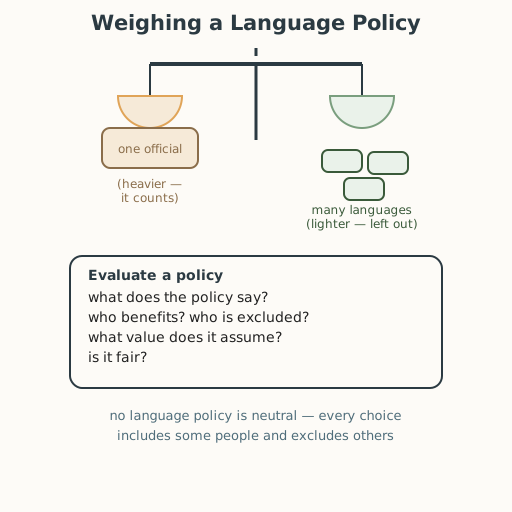
Learners evaluate language policies — official languages, colonial legacies, and mother-tongue provisions — for their effects on equity and inclusion, using a five-question probe. They learn that no language policy is neutral: every choice about “which language counts” includes some people and excludes others.
Objectives
- Evaluate language policies, such as official languages or language in schools, for their effects on equity and inclusion — beginning with which language is official. (D04.S4.11.01)
Connection
Think of every place a “right” language is assumed: the form you must fill in a language that is not yours, the court that hears you only through an interpreter, the sign you cannot read, the meeting you cannot follow. Now imagine the opposite: a country where your language is the one on the signs and the forms and the laws. Which language is “official” is not a matter of grammar — it is a decision about who gets to participate fully and who must struggle to be heard. A language policy is a fairness policy wearing a grammar’s clothes.
Materials
- Policy-evaluation sheet (what it says / who benefits / who is excluded / what value it assumes / is it fair)
- Learning journal
Preparation
- Copy or draw the five-question policy-evaluation sheet.
- Retrieval: from Grade 10, recall how language and power interact — whose language is used in law, medicine, and school (D04.S4.10.01). Today we evaluate the policies that decide.
- Prepare one worked example: a real or familiar language policy, run through the five questions.
Facilitator note
This lesson is written to the learner (“you”). The idea to land: a language policy — which language is official, used in government, law, or public life — is never neutral; it distributes inclusion and exclusion, so it must be evaluated for equity. The standard is evaluative: learners weigh effects, not memorize a verdict. Distinguish evidence (what a policy actually says and does) from values (whether inclusion is the aim — the unit holds it as a value, philosophy §5). Examples span the globe: colonial languages kept as the language of government after independence (Ngũgĩ’s account of English vs. Gikuyu, S-424); official multilingual states; and the worldwide fact that about 40 percent of people lack education in a language they speak or understand (S-019). Present these as cases to weigh, not lessons to absorb.
Model the five questions once, then let learners evaluate (worked example → guided practice → independent work; S-011). The egalitarian lens is the spine: ask who benefits and who is excluded — the same sound, praised in one policy and erased in another, is a question of power. The ethics lens: fairness asks whether every person can be heard and understood in the places that decide their life. The global lens: policies differ enormously — some states recognize many languages, others one — and no single model is the world’s. The critical-thinking lens: read a policy’s assumed value (“one common language unites us” vs. “many languages are wealth”) and test it against the effects. Preview: Lesson 14 zooms into the policy that touches learners most directly — language in schools.
Procedure
- Recall (5 min). From Grade 10: language and power interact — whose language is used in law, medicine, and school. Today you evaluate the policies that decide.
- Meet the five questions (10 min). Look at the policy-evaluation sheet. The five questions: what does the policy say? who benefits? who is excluded? what value does it assume? is it fair? Watch a worked example: one real or familiar policy run through all five.
- Learn the scale (8 min). Learn the global fact: about 40 percent of people lack education in a language they speak or understand (S-019). Write what that single number means for who can learn and who cannot.
- Evaluate a policy (15 min). Choose a policy — a colonial language kept as the language of government, an official-language law, or a many-languages policy. Run the five questions. Name one group the policy includes and one it excludes.
- Name the assumed value (8 min). Every policy stands on a value: “one language unites” or “many languages are wealth.” Write which value your chosen policy assumes, and whether its effects match that value.
- Close (5 min). Remember: a language policy is a fairness policy. Add this page to your language-policy evaluation. Next time: language in schools — the policy that touches you most.
Differentiation
- Support: Provide a single policy already described; ask only “who benefits?” and “who is excluded?”
- Extension: Compare a one-language policy with a many-languages policy and argue which better serves equity and inclusion — and what each trades away.
Assessment
- Formative (self): Can the learner name what a language policy says, who it includes, who it excludes, and the value it assumes — and give a reasoned judgment on its fairness?
- Portfolio artifact (unit): The policy-evaluation sheet, added to the portfolio as the “language-policy evaluation” entry.
Home connection
Ask an adult: which language do the official signs, forms, and meetings use here — and who has trouble with them? Then decide together whether that seems fair.
Resources
- On the 40% figure and the value of mother-tongue education: UNESCO, International Mother Language Day, https://www.unesco.org/en/days/mother-language (S-019).
- On the politics of language in a post-colonial state: Ngũgĩ wa Thiong’o, Decolonising the Mind (1986) (S-424).
- On modeling + guided practice before independent work: Kirschner, Sweller & Clark (2006), https://doi.org/10.1207/s15326985ep4102_1 (S-011).