Lesson 14 — Language in Schools: Equity and Inclusion
Learners evaluate school-language policies — the language of instruction, tests, and the playground — for equity and inclusion, asking whose home language matches the school and whose does not. They distinguish subtractive from additive bilingualism and draft what a fairer policy would do, completing the unit's language-policy evaluation.
Objectives
Objectives
- D04.S4.11.01 Evaluate language policies, such as official languages or language in schools, for their effects on equity and inclusion.
Essential question
How do policies about language in schools — the language of instruction, of tests, of the playground — shape who learns, who is included, and whether that is fair?
Key vocabulary
Materials
Standard materials
- School-language evaluation sheet · 1 per learner Questions — what language is school in, whose home language matches it, whose does not, what happens to each child, and what a fairer policy would do
- Learning journal · 1 per learner
Low-tech / no-cost
- Paper with the questions written by hand, or drawn in the ground Same questions on any surface
- Voice and body (or sign, writing, or gesture) Imagine your classroom run in a language you barely know, and say (or sign or write) one thing you would lose
Enriched / lab & device
- One or two real school-language policy examples (optional) · 1 set per pair e.g., a mother-tongue-first program, a colonial-language-only school system, a bilingual program
- Shared device to look up a school system's language of instruction · 1 per group To find one real policy and run the evaluation on it
Works in different contexts
- large-group Model the evaluation whole-class on one school policy, then pairs apply it to a second and share one effect on a learner
- multi-age Younger learners name what a child taught in an unknown language loses; older learners design a fairer policy and defend it
- self-directed A learner evaluates their own school's (or a known school's) language policy and writes what a fairer version would do
- level-grouped Learners ready to extend distinguish subtractive from additive bilingualism and argue which a fair school pursues
- outdoor-only Discuss aloud what you would keep and what you would lose if this whole school ran in a language you barely knew
Lesson 14 — Language in Schools: Equity and Inclusion
Summary
Learners evaluate school-language policies — the language of instruction, tests, and the playground — for equity and inclusion, asking whose home language matches the school and whose does not. They distinguish subtractive from additive bilingualism and draft what a fairer policy would do, completing the unit’s language-policy evaluation.
Objectives
- Evaluate language policies — including language in schools — for their effects on equity and inclusion, and propose a fairer alternative. (D04.S4.11.01)
Connection
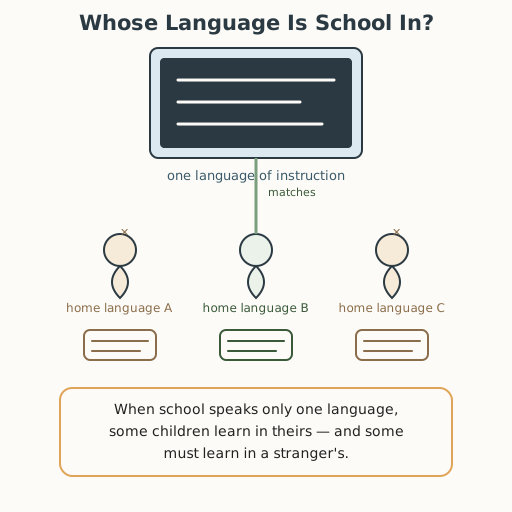
Picture sitting in a classroom where every lesson, every test, every instruction is in a language you barely know. You are not less able — but you are locked out of showing it. Now picture the reverse: the first years in your home language, the other languages added alongside it, your home tongue treated as a foundation instead of a problem. School language is the single policy that most decides who gets to learn at all. About 40 percent of people worldwide lack education in a language they understand (S-019) — which means the classroom, for many, is a locked door with a lesson behind it.
Materials
- School-language evaluation sheet (what language school is in / whose home language matches / what happens to each child / what a fairer policy would do)
- Learning journal
Preparation
- Copy or draw the school-language evaluation sheet.
- Retrieval: from Lesson 13, recall the five-question policy probe. Today we point it at the place learners know best — school.
- Prepare one worked example: a familiar school-language policy, evaluated.
Facilitator note
This lesson is written to the learner (“you”). The idea to land: school-language policy — the medium of instruction, assessment, and daily life — most directly decides equity and inclusion, and a fair policy is additive (home language first, other languages added) rather than subtractive (home language replaced and lost). This is the evaluative standard made personal: every learner has felt or witnessed what it means for school to speak a language that is not yours. Hold the additive-over- subtractive framing as the unit’s value (multilingualism as wealth), while being honest that evidence shows mother-tongue-based instruction supports learning — anchored in the 40% fact (S-019) — and that the choice is often constrained by real resources and histories. Keep both in view; do not pretend the fair policy is always easy to enact.
Model the evaluation once, then let learners evaluate and propose (worked example → guided practice → independent work; S-011). The egalitarian lens is the spine: whose home language matches the blackboard, and whose is treated as an obstacle. The ethics lens: a child punished or shamed for their home language is a wrong, not a pedagogy — name it plainly. The global lens: school-language policy varies worldwide — mother-tongue-first programs, colonial-language-only systems, bilingual immersion — and none is the world’s default. The critical-thinking lens: test the assumed value (“children need one common language”) against its effects on the children it excludes. The social-emotional lens: this topic is close to the bone for learners who have been told their language is “wrong”; hold the room gently, and let no one be shamed here — including the monolingual learner, whose single language is also to be honored, not mocked. Preview: Lesson 15 turns from policy to practice — bridging between speakers right now.
Procedure
- Recall (5 min). From Lesson 13: no language policy is neutral. Today you evaluate the policy closest to you — language in school.
- Meet the evaluation (10 min). Look at the school-language evaluation sheet. The questions: what language is school in? whose home language matches it, and whose does not? what happens to each child? what would a fairer policy do? Watch a worked example evaluated together.
- Learn subtractive vs. additive (8 min). A subtractive policy replaces a child’s home language; an additive one builds on it and adds others. Write in your journal which your own schooling was closest to — and what that meant.
- Evaluate a real case (15 min). Take your own school or a school system you know (or one you look up). Run the evaluation. Name one child the policy serves well and one it serves poorly.
- Propose a fairer policy (10 min). Draft, in three to five sentences, a school language policy that is additive: home language first, other languages added alongside. Name one realistic obstacle and one way to meet it.
- Close (5 min). Remember: school language is the policy that decides who learns at all — and it can be made fairer. Add this page to your language-policy evaluation. Next time: you stop analyzing policy and start bridging — interpreting between two speakers, live.
Differentiation
- Support: Evaluate a single given policy and answer only “whose home language matches, and whose does not?”
- Extension: Design the full additive policy — years, subjects, testing — and anticipate two objections to it, answering each.
Assessment
- Formative (peer + self): Can the learner evaluate a school-language policy for who it includes and excludes, and propose an additive alternative with at least one realistic obstacle named?
- Portfolio artifact (unit): The school-language evaluation (with the proposed policy), added to the portfolio as the “language-in-schools” entry, completing the language-policy evaluation.
Home connection
Ask an adult what language their school was in, and whether it was their home language. Then ask: did that help or hold them back — and what would they have changed?
Resources
- On the 40% figure and mother-tongue education: UNESCO, International Mother Language Day, https://www.unesco.org/en/days/mother-language (S-019).
- On multilingual education as a value and practice: UNESCO multilingual-education guidance, as framed in International Mother Language Day materials (S-019).
- On modeling + guided practice before independent work: Kirschner, Sweller & Clark (2006), https://doi.org/10.1207/s15326985ep4102_1 (S-011).