Lesson 01 — Sequences: Arithmetic and Geometric
Learners recognize arithmetic sequences (a fixed difference added each step) and geometric sequences (a fixed ratio multiplied each step), write explicit and recursive formulas for both, and read the two types out of real financial and environmental situations. They meet the Hindu-Arabic counting tradition and the rice-and-chessboard story as real history, not decoration.
Objectives
Objectives
- D05.S1.11.01 Model and solve real problems with sequences and series, and interpret their meaning in financial or environmental contexts.
Essential question
How do I recognize an arithmetic or geometric sequence, and write its rule from a few terms or from a real situation?
Key vocabulary
Materials
Standard materials
- Sequence problem sheet · 1 per learner Worked and practice problems for recognizing and extending arithmetic and geometric sequences
- Math journal · 1 per learner
Low-tech / no-cost
- Counters, seeds, or pebbles Build the two sequence types by hand — add a fixed number (steps) vs multiply by a fixed number (piles)
- String and knots (optional) A knotted cord can record a sequence by the spacing of its knots, echoing the Andean khipu
Enriched / lab & device
- Calculator or spreadsheet · 1 per learner or pair To generate many terms quickly and compare the two types of growth side by side
Works in different contexts
- large-group Build one arithmetic and one geometric sequence whole-class on the board, then learners work in pairs on a mixed set and explain which type each is
- multi-age Younger learners extend a sequence by repeating one operation; older learners derive the explicit formula from the pattern
- self-directed A learner follows the worked examples, then solves the practice set and checks each explicit formula by generating three terms
- level-grouped Group by fluency with grade-10 exponents; a ready group extends to a fractional common ratio and a three-step decay sequence
- outdoor-only Model sequences with real steps (equal strides = arithmetic) and real piles (doubling a share = geometric), recording each step as a term
Lesson 1 — Sequences: Arithmetic and Geometric
Summary
Learners meet the two foundational types of sequence: arithmetic (a fixed difference is added each step) and geometric (a fixed ratio is multiplied each step). They write both explicit formulas (a rule for the nth term) and recursive formulas (a rule for the next term from the last), and practice reading which type a real situation is. They encounter the rice-and-chessboard story and the Hindu-Arabic counting tradition as real history that belongs to everyone.
Objectives
- Recognize arithmetic and geometric sequences, find their common difference or ratio, and write explicit and recursive formulas for them; read the two types out of financial and environmental contexts. (D05.S1.11.01)
Connection
Some things grow by the same amount each time: a child grows a bit taller each season, a monthly budget adds the same saving, a stair rises by the same height with every step. Other things grow by the same factor each time: a population that doubles, money that earns the same interest rate each year, a rumor that spreads from one person to three. “Same amount” and “same factor” are two different kinds of change — and naming which one you are looking at is the first move in modeling it.
Materials
- Sequence problem sheet
- Math journal
Preparation
- Copy or draw the problem sheet.
- Retrieval: from Grade 10, exponential growth and decay with a base and factor (D05.S1.10.01, D05.S2.10.02). Today we generalize that one pattern into sequences.
- Prepare worked examples for both sequence types and their formulas.
Facilitator note
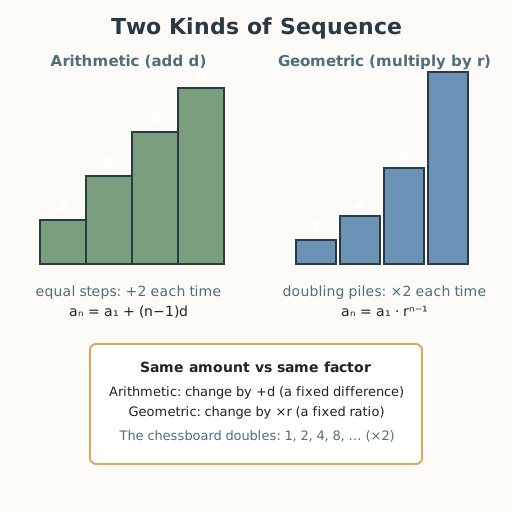
This lesson is written to the learner (“you”). The idea to land: an arithmetic sequence adds a fixed difference d each step (aₙ = a₁ + (n−1)d); a geometric sequence multiplies by a fixed ratio r each step (aₙ = a₁·r^(n−1)). Teach both directions explicitly — recognize (is the change +d or ×r?) and write (build the formula) — with worked examples and guided practice (S-011).
The intellectual lens: a sequence is the same rule applied over and over; the formula compresses that repetition into one line. The critical-thinking lens: learners check every formula by generating three terms and asking “does it match?” The global lens: the number system we use today — with its zero and place value — was developed in India and carried through Arabic-speaking scholars to Europe (S-023, S-240); the Fibonacci sequence entered Europe through Fibonacci’s Liber Abaci (1202) as he taught those very numerals. The egalitarianism lens: these ideas belong to no single people; mathematics is “drawn from many traditions, for everyone” — sequence work is not a ranking ritual but a shared tool. Preview: Lesson 2 turns sequences into series (sums), and Lessons 3–4 put those sums to work in finance and the environment.
Procedure
- Recall (5 min). From Grade 10, what is a growth factor? If something triples each year, what is its factor? Today we study the ordered lists those factors make.
- Meet arithmetic sequences (12 min). An arithmetic sequence adds the same common difference d each step. Worked example: 3, 7, 11, 15, … has d = 4. Its nth term is aₙ = a₁ + (n−1)d = 3 + (n−1)·4, so a₅ = 3 + 4·4 = 19. A recursive rule says aₙ = aₙ₋₁ + 4. Think of equal stair steps.
- Meet geometric sequences (12 min). A geometric sequence multiplies by the same common ratio r each step. Worked example: 3, 6, 12, 24, … has r = 2. Its nth term is aₙ = a₁·r^(n−1) = 3·2^(n−1), so a₅ = 3·16 = 48. Think of doubling piles.
- The chessboard story (6 min). A legend tells of a reward asked as one grain of rice on the first square, two on the second, four on the third, doubling to the 64th square — a geometric sequence whose total would cover the board many times over (S-429). Read it as a lesson in how fast ×2 grows, not as a trick.
- Guided practice (12 min). With a partner, decide whether each is arithmetic or geometric and write its formula: (a) 5, 9, 13, 17, … (b) 5, 10, 20, 40, … (c) a salary rising by a fixed 300 each year (d) a lake’s algae doubling every week. Check each formula by generating three terms.
- Independent practice (5 min). In your journal, write one arithmetic and one geometric situation from your own life, and give each its formula.
- Close (3 min). Say the difference between “+d” and “×r” in your own words.
Differentiation
- Support: Extend a few terms by hand first (add d, multiply by r), then match the pattern to a formula with whole numbers.
- Extension: Work with a fractional ratio (r = ½ for a halving sequence) and a negative difference; derive aₙ for each.
Assessment
- Formative (peer + self): Can the learner classify a sequence as arithmetic or geometric, state its d or r, and write an explicit formula, verified by generating terms?
- Portfolio artifact (unit): The completed problem sheet with the two self-written situations, added to the number toolkit.
Home connection
Find one “same amount” and one “same factor” change at home — steps on a staircase, a plant’s new leaves, a phone’s battery draining by a steady fraction. Write each as a sequence and give its formula.
Resources
- On worked examples and guided practice: Kirschner, Sweller & Clark (2006), https://doi.org/10.1207/s15326985ep4102_1 (S-011).
- On the Hindu-Arabic numerals and the rice-and-chessboard legend as shared history: Ifrah (2000) (S-023); Boyer & Merzbach, A History of Mathematics (S-429); MacTutor History of Mathematics Archive (S-240).