Lesson 02 — Series: Summing with Sigma Notation
Learners turn a sequence into a series (a sum), read and write sigma notation, and find totals using the arithmetic-series formula (the first-plus-last pairing) and the finite geometric-series formula. The pairing idea that sums 1 through n is met as a shared discovery, not one person's trick.
Objectives
Objectives
- D05.S1.11.01 Model and solve real problems with sequences and series, and interpret their meaning in financial or environmental contexts.
Essential question
How do I turn a sequence into a sum, write that sum with sigma notation, and find the total of an arithmetic or geometric series?
Key vocabulary
Materials
Standard materials
- Series problem sheet · 1 per learner Worked and practice problems for sigma notation and arithmetic/geometric series sums
- Math journal · 1 per learner
Low-tech / no-cost
- Counters, seeds, or pebbles Pair counters to feel why the arithmetic-sum formula averages the first and last term
- Paper strips Fold a strip to visualize summing a geometric series approaching a fixed total
Enriched / lab & device
- Calculator or spreadsheet · 1 per learner or pair To check a series sum against adding the terms one by one
Works in different contexts
- large-group Demonstrate the first-plus-last pairing whole-class, then learners sum one arithmetic and one geometric series in pairs
- multi-age Younger learners add a short series term by term; older learners derive and apply the closed formulas
- self-directed A learner follows the worked examples, then sums the practice set and checks by direct addition
- level-grouped Group by comfort with exponents; a ready group sums an infinite geometric series with |r| under 1
- outdoor-only Lay out a row of pebbles in an arithmetic pattern, then pair the first with the last to count the total
Lesson 2 — Series: Summing with Sigma Notation
Summary
Learners move from a sequence (a list) to a series (a sum of the list), read and write sigma notation for that sum, and find totals with two closed formulas: the arithmetic-series formula (pair the first with the last) and the finite geometric-series formula. They meet the pairing idea that sums 1 through n as a discovery shared across traditions.
Objectives
- Express and evaluate arithmetic and geometric series with sigma notation, and find finite sums using the first-plus-last pairing and the geometric-sum formula, in financial and environmental contexts. (D05.S1.11.01)
Connection
When you add up a whole run of payments, harvests, or days of growth, you are not adding one number but a list of numbers — a series. “How much in total over the year?” “How much rain fell all season?” “How much do all the loan payments add up to?” Each is a sum of a sequence, and sigma notation is the compact way to say “add up every term from here to here.”
Materials
- Series problem sheet
- Math journal
Preparation
- Copy or draw the problem sheet.
- Retrieval: from Lesson 1, the explicit formula for arithmetic (aₙ = a₁ + (n−1)d) and geometric (aₙ = a₁·r^(n−1)) sequences.
- Prepare worked examples for sigma notation, the arithmetic sum, and the geometric sum.
Facilitator note
This lesson is written to the learner (“you”). The ideas to land: sigma notation Σ sums a general term from a start index to an end index; an arithmetic series sums to Sₙ = n/2·(a₁ + aₙ) (first-plus-last pairing); a finite geometric series sums to Sₙ = a₁·(1 − rⁿ)/(1 − r). Teach the pairing as a concrete move first — fold the list in half — then compress it into the formula (S-011).
The intellectual lens: a series compresses a long addition into one formula; the sigma symbol says “sum this rule.” The critical-thinking lens: learners check every closed formula against adding a few terms directly. The global lens: the first-plus-last pairing is a discovery credited to several traditions, not one person alone (S-429, S-240) — treat it as shared mathematics. The egalitarianism lens: the same sum that counts a king’s treasury can count a village’s shared harvest; the tool serves everyone equally, and “mastery, not ranking” applies here too. Preview: Lessons 3–4 apply these sums to compound interest/debt and to environmental accumulation.
Procedure
- Recall (5 min). From Lesson 1, what are a₁, d, and r? Write the nth term of 2, 4, 8, 16, … and of 2, 4, 6, 8, ….
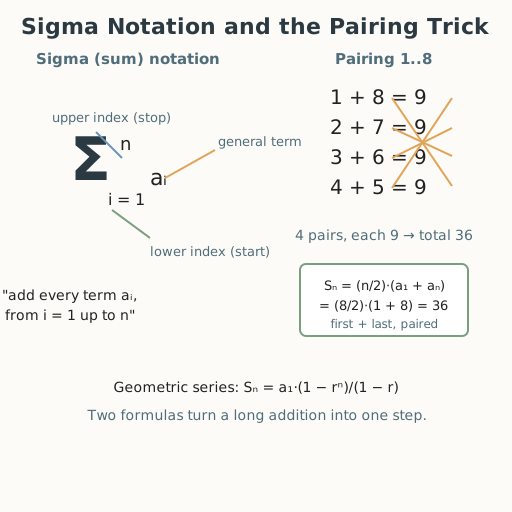
- Meet sigma notation (10 min). A series is the sum of a sequence. Σ (capital sigma) says “add”: Σᵢ₌₁ⁿ aᵢ means a₁ + a₂ + … + aₙ. Read the lower index (where to start), the upper index (where to stop), and the general term (what to add). Worked example: Σᵢ₌₁⁴ 2i = 2 + 4 + 6 + 8 = 20.
- Arithmetic series: the pairing (12 min). To sum 1 + 2 + … + 100, pair the first with the last (1 + 100 = 101), the second with the next-to-last (2 + 99 = 101), and so on — 50 pairs, each 101, so the sum is 50·101 = 5050. This is Sₙ = n/2·(a₁ + aₙ). Worked example: 3 + 7 + 11 + 15 + 19 has n = 5, so S₅ = 5/2·(3 + 19) = 55.
- Geometric series: the finite sum (12 min). The sum of a geometric sequence is Sₙ = a₁·(1 − rⁿ)/(1 − r). Worked example: 3 + 6 + 12 + 24 + 48 (a₁ = 3, r = 2, n = 5) → S₅ = 3·(1 − 32)/(1 − 2) = 3·31 = 93. Check: 3 + 6 + 12 + 24 + 48 = 93.
- Guided practice (10 min). With a partner, sum: (a) Σᵢ₌₁⁶ (2i + 1) (b) the first 20 terms of 5, 8, 11, 14, … (c) 1 + 2 + 4 + … + 64. Check each by adding the terms directly for at least the small ones.
- Independent practice (4 min). In your journal, write a sum from your own life (savings over several weeks, bus fares over a month) in sigma notation and total it.
- Close (2 min). Say what “first-plus-last pairing” means and why it works.
Differentiation
- Support: Sum only short series (n ≤ 5) by direct addition first, then match the same total to the formula.
- Extension: Sum an infinite geometric series with |r| < 1 (e.g., 1 + ½ + ¼ + …) and explain why it approaches a fixed value.
Assessment
- Formative (peer + self): Can the learner read and write sigma notation, and total an arithmetic and a geometric series with the closed formula, verified by a direct check?
- Portfolio artifact (unit): The problem sheet with the self-written sum, added to the number toolkit.
Home connection
Add up a real series at home — the pages of a book read each day for a week, the coins saved each day for a month. Write it in sigma notation and total it with the pairing idea or the geometric formula.
Resources
- On worked examples and guided practice: Kirschner, Sweller & Clark (2006), https://doi.org/10.1207/s15326985ep4102_1 (S-011).
- On the first-plus-last pairing and series history as shared mathematics: Boyer & Merzbach, A History of Mathematics (S-429); MacTutor History of Mathematics Archive (S-240).