Lesson 10 — Exponential and Logarithmic Models in the World
Learners use logarithms to solve the two great exponential questions — "how long until it halves (or doubles)?" and "what rate is at work?" — through half-life, doubling time, and radioactive dating. They connect the mathematics to medicine in the body, population, and the age of very old things.
Objectives
Objectives
- D05.S2.11.02 Use logarithmic and exponential relationships to solve problems involving growth, decay, and large ranges of scale.
Essential question
How do I use logarithms to solve for time or rate in real growth and decay — half-life, doubling time, and radioactive dating?
Key vocabulary
Materials
Standard materials
- Growth-and-decay modeling sheet · 1 per learner Worked and practice problems solving for time and rate with logarithms
- Math journal · 1 per learner
Low-tech / no-cost
- Paper and counters Halve a pile repeatedly to see half-life, and count how many halvings reach a small fraction
- A timeline drawn long Mark doubling or halving steps to feel how logarithms count the steps
Enriched / lab & device
- Calculator · 1 per learner or pair To evaluate natural and common logs in solving for time and rate
Works in different contexts
- large-group Solve one half-life and one doubling-time problem whole-class, then learners work in pairs on a mixed set
- multi-age Younger learners count halvings/doublings by hand; older learners solve symbolically with logs
- self-directed A learner follows the worked examples, then solves the practice set and checks each answer by substituting back
- level-grouped Group by comfort with logs; a ready group solves for an unknown rate rather than time
- outdoor-only Use a real halving (a shared amount split repeatedly) or a real doubling (a plant's new shoots) and count the steps
Lesson 10 — Exponential and Logarithmic Models in the World
Summary
Learners use logarithms to answer the two great questions of exponential change: “how long until it halves (or doubles)?” and “what rate is at work?” They solve half-life and doubling-time problems and meet radioactive dating as the tool that reads the age of very old things. The mathematics connects to medicine in the body, population, and the planet.
Objectives
- Solve growth and decay problems for time or rate using logarithms, and interpret the answers in real contexts such as half-life, doubling time, and radioactive dating. (D05.S2.11.02)
Connection
“Half of this medicine leaves your body every six hours.” “This population doubles every generation.” “This buried charcoal is 12 000 years old.” Each is a question about time in an exponential process, and time is what logarithms unlock: if you know the factor and the fraction, the log tells you how many steps have passed — whether the steps are hours, generations, or millennia.
Materials
- Growth-and-decay modeling sheet
- Math journal
Preparation
- Copy or draw the problem sheet.
- Retrieval: from Lesson 9, log_b(x) = y means b^y = x; from Grade 10, growth and decay factors and half-life (D05.S1.10.01).
- Prepare worked examples for half-life, doubling time, and dating.
Facilitator note
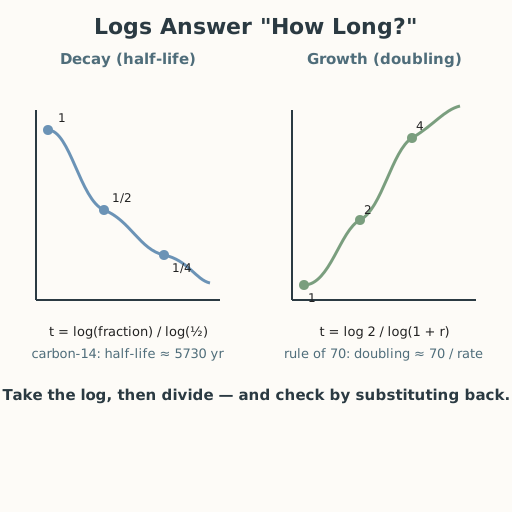
This lesson is written to the learner (“you”). The idea to land: to solve b^t = c for t, take logs of both sides: t = log(c)/log(b). For half-life, b = ½; for doubling, b = 2; for growth at rate r, b = 1 + r. Teach the one move — take the log, then divide — with worked examples and guided practice (S-011).
The environment lens: half-life is the honest language of how long pollution and radioactive material persist — carbon-14’s 5 730-year half-life is what lets us date ancient charcoal and climate records. The intellectual lens: one move (log both sides) turns a power equation into a linear one for the unknown time. The critical-thinking lens: learners check every answer by substituting it back into the original. The technology lens: dating labs, medical dose calculators, and climate models all solve these same log equations under the hood. Distinguish the mathematics (exact) from the real-world mess (rates are estimates). Preview: Lesson 11 begins geometry with the unit circle.
Procedure
- Recall (5 min). From Lesson 9, log₁₀(1000) = 3 because 10³ = 1000. Today we find the unknown power (time) the same way.
- The one move (10 min). To solve b^t = c, take logs of both sides and divide: t = log(c)/log(b). Worked example: a medicine halves every 6 hours (b = ½); after how many steps is 1/16 left? (½)^t = 1/16, so t = log(1/16)/log(½) = 4 steps, or 24 hours.
- Half-life and dating (15 min). Carbon-14 has a half-life of about 5 730 years. If a sample has ¼ of its carbon-14 left, two half-lives have passed — about 11 460 years. Worked example: a sample has 30% left. Solve (½)^(t/5730) = 0.30 → t = 5730·log(0.30)/log(0.5) ≈ 9 950 years (S-435). This is how the age of ancient wood and bone is estimated.
- Doubling time and the rule of 70 (10 min). A population growing at rate r doubles when (1 + r)^t = 2, so t = log(2)/log(1 + r). Worked example: at 2% a year, t = log(2)/log(1.02) ≈ 35 years. The rule of 70 approximates this: doubling time ≈ 70/(percent rate) ≈ 70/2 = 35 years.
- Guided practice (10 min). With a partner: (a) a pollutant halves every 20 years — how long until 1/8 remains? (b) a saving grows 7% a year — when does it double? (c) a sample has 12.5% of its carbon-14 left — how old is it? Check by substitution.
- Close (5 min). Say, in one sentence, how a logarithm answers “how long?” for a halving or doubling process.
Differentiation
- Support: Solve only whole-number-of-steps problems first (½, ¼, ⅛), then move to logs.
- Extension: Solve for an unknown rate: given a quantity triples in 20 years, find the yearly rate.
Assessment
- Formative (peer + self): Can the learner solve a growth/decay equation for time with a logarithm and interpret the result in a half-life, doubling-time, or dating context, with a substitution check?
- Portfolio artifact (unit): The completed modeling sheet, added to the pattern toolkit.
Home connection
Estimate a doubling time near home — how long a plant, a savings amount, or a family tradition’s scale doubles — and check it with the rule of 70.
Resources
- On worked examples and guided practice: Kirschner, Sweller & Clark (2006), https://doi.org/10.1207/s15326985ep4102_1 (S-011).
- On carbon-14 dating and log solutions: OpenStax, Algebra and Trigonometry (S-435); on climate-record dating context: IPCC (S-005).