Lesson 09 — Logarithms: Order, Growth, and Scale
Learners meet the logarithm as the inverse of the exponential, see how it turns multiplication into addition, and read the log scales that compress huge ranges — pH, decibels, and earthquake magnitude. They meet Napier's invention and the older insight (powers of ten) that it built on, as shared history.
Objectives
Objectives
- D05.S2.11.02 Use logarithmic and exponential relationships to solve problems involving growth, decay, and large ranges of scale.
Essential question
How does a logarithm turn multiplication into addition and compress huge ranges of scale, and why do we use log scales for sound, acidity, and earthquakes?
Key vocabulary
Materials
Standard materials
- Logarithm problem sheet · 1 per learner Worked and practice problems for evaluating logs and reading log scales
- Math journal · 1 per learner
Low-tech / no-cost
- Paper strips folded in half Each fold doubles the thickness — count folds to feel a logarithm (fold 7 = about 128 layers)
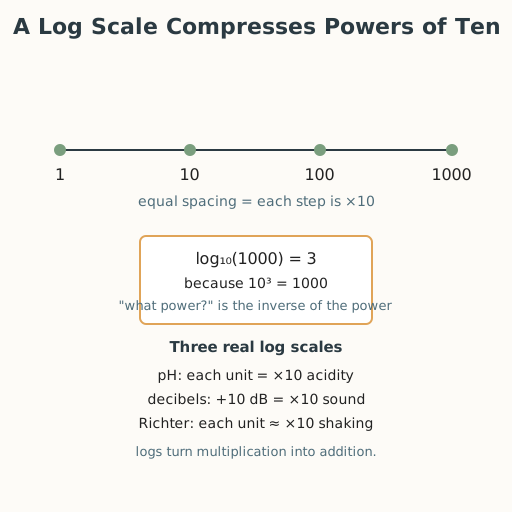
- A number line drawn large Mark 1, 10, 100, 1000 evenly spaced to see a log scale compress tenfold jumps
Enriched / lab & device
- Calculator · 1 per learner or pair To evaluate logs and check inverse pairs
- A sound-level or pH meter (if available) · 1 per group To read a real decibel or pH reading and place it on its log scale
Works in different contexts
- large-group Evaluate a few logs whole-class, then learners work in pairs on a mixed set (exponential to log and back)
- multi-age Younger learners fold paper to count doublings; older learners evaluate logs and convert between scales
- self-directed A learner follows the worked examples, then solves the practice set and checks each by exponentiation
- level-grouped Group by comfort with exponents; a ready group solves for an unknown base or works in base e
- outdoor-only Compare real sizes on a log scale — a leaf, a branch, a tree, a field — each about ten times the last
Lesson 9 — Logarithms: Order, Growth, and Scale
Summary
Learners meet the logarithm as the inverse of the exponential — log_b(x) = y means b^y = x — and see how it turns multiplication into addition and compresses vast ranges onto a readable log scale. They read the three everyday log scales: pH (acidity), decibels (sound), and Richter magnitude (earthquakes), and meet Napier’s invention and the powers-of-ten insight behind it.
Objectives
- Use logarithms as the inverse of exponentials and interpret logarithmic scales (pH, decibels, earthquake magnitude) to reason about growth, decay, and scale. (D05.S2.11.02)
Connection
Some ranges are too big to hold in your head: a whisper and a jet engine, an acid and a base, a small tremor and a great earthquake — each spans powers of ten, not small steps. A logarithm compresses those powers into small, comparable numbers: pH 3 vs pH 7, 40 vs 120 decibels, magnitude 5 vs 9. “Log base 10 of x” just asks: 10 to what power gives x? — the exponent, written small.
Materials
- Logarithm problem sheet
- Math journal
Preparation
- Copy or draw the problem sheet.
- Retrieval: from Grade 10, exponents and bases (D05.S1.10.01). A logarithm names the exponent.
- Prepare worked examples for evaluating logs and reading log scales.
Facilitator note
This lesson is written to the learner (“you”). The ideas to land: log_b(x) = y means b^y = x; a log turns multiplication into addition (log(x·y) = log x + log y); and a log scale spaces powers of ten evenly. Teach the inverse relationship explicitly — write “log” as “what power?” — and connect it to the three real scales (S-011).
The intellectual lens: a logarithm is the question “what power?” — the inverse of “raise b to a power.” The global lens: John Napier (1614) systematized logarithms for computation, but the underlying idea of using powers of ten to count huge quantities is far older, appearing in Archimedes’ Sand-Reckoner — a shared, layered history (S-429). The technology lens: decibels, pH, and Richter are the log scales that instruments and sensors report — reading them is reading a device. The environment lens: pH measures acidity (rain, soil, oceans), and each unit is a tenfold change — a small pH change can mean a large chemical change. Preview: Lesson 10 uses logs to solve growth and decay.
Procedure
- Recall (5 min). From Grade 10, 10³ = 1000. Today we ask it backward: what power makes 1000? The answer is log₁₀(1000) = 3.
- The inverse (12 min). log_b(x) = y means b^y = x. Worked examples: log₁₀(1000) = 3 (because 10³ = 1000); log₂(8) = 3 (because 2³ = 8); log₁₀(0.01) = −2 (because 10⁻² = 0.01). The common log is base 10; the natural log is base e ≈ 2.718.
- Multiplication becomes addition (8 min). Because exponents add when you multiply, logs add too: log(x·y) = log x + log y. Worked example: log₁₀(100·1000) = log₁₀(100) + log₁₀(1000) = 2 + 3 = 5, and 10⁵ = 100 000. This is why logs made hard multiplication easy before machines — and still describe growth neatly.
- Log scales: compress the range (15 min). On a log scale, each equal step is
a factor of ten. Read three real ones:
- pH: each unit is a tenfold change in acidity; pH 3 is a hundred times more acidic than pH 5.
- Decibels: each +10 dB is ten times the sound intensity; 120 dB is far more than 40 dB.
- Richter magnitude: each unit is about ten times the shaking; magnitude 7 releases vastly more energy than magnitude 5 (S-435).
- Guided practice (10 min). With a partner: (a) evaluate log₃(81), log₁₀(1 000 000), log₁₀(0.001); (b) say how many times more acidic pH 2 is than pH 6; (c) write “100 000” and “0.0001” as powers of ten.
- Close (5 min). Say what “log₁₀(x) = y” means in one sentence, and name one place a log scale appears in daily life.
Differentiation
- Support: Work only in base 10 with whole-number powers first (10, 100, 1000).
- Extension: Use the natural log to solve b^x = c for x, and convert between log bases.
Assessment
- Formative (peer + self): Can the learner evaluate a log, state the inverse relationship to powers, and read a pH, decibel, or magnitude value on its log scale?
- Portfolio artifact (unit): The log-scale reading sheet, added to the pattern toolkit.
Home connection
Fold a strip of paper in half and count the folds: 7 folds is about 128 layers, 10 folds about 1024. Write each fold count as a power of two — you are doing logs by hand.
Resources
- On worked examples and guided practice: Kirschner, Sweller & Clark (2006), https://doi.org/10.1207/s15326985ep4102_1 (S-011).
- On logarithms and their scales (pH, decibels, Richter): OpenStax, Algebra and Trigonometry (S-435); on the history of logarithms and Archimedes’ powers-of-ten: Boyer & Merzbach, A History of Mathematics (S-429).