Lesson 12 — Trigonometry of General Triangles
Learners extend trigonometry beyond right triangles with the Law of Sines and the Law of Cosines, solving general triangles to measure distances they cannot walk — across a river, a canyon, or between distant points. They meet the global, layered history of triangle-solving in astronomy and surveying.
Objectives
Objectives
- D05.S3.11.01 Use the unit circle and trigonometry of general triangles to model periodic relationships in real phenomena.
Essential question
How do the Law of Sines and the Law of Cosines let me solve any triangle — not just right triangles — to measure distances I cannot walk?
Key vocabulary
Materials
Standard materials
- Triangle-solving problem sheet · 1 per learner Worked and practice problems for the Law of Sines and Law of Cosines
- Math journal · 1 per learner
- Protractor and ruler · 1 set per pair
Low-tech / no-cost
- String, sticks, and a protractor Build a triangle with two known sides and an included angle to measure the third side
- Paper and pencil Draw a river and a baseline to plan a real measurement across it
Enriched / lab & device
- Calculator · 1 per learner or pair To evaluate the Laws of Sines and Cosines and handle the ambiguous case
- Map or navigation app (optional) · 1 per group To read real bearings and estimate distances by triangulation
Works in different contexts
- large-group Solve one Law of Cosines and one Law of Sines example whole-class, then learners solve a mixed set in pairs
- multi-age Younger learners draw and measure a triangle by hand; older learners compute with the laws and handle the ambiguous case
- self-directed A learner follows the worked examples, then solves the practice set and checks each answer against a sketch
- level-grouped Group by comfort with the unit circle; a ready group resolves the ambiguous SSA case fully
- outdoor-only Measure a real distance across a gap (a stream, a clearing) by laying a baseline and taking two angles
Lesson 12 — Trigonometry of General Triangles
Summary
Learners extend trigonometry from right triangles to general triangles with the Law of Sines and the Law of Cosines. They solve triangles to measure distances they cannot walk — across a river, a canyon, or between distant points — and meet the layered, global history of triangle-solving in astronomy and surveying.
Objectives
- Use the Law of Sines and the Law of Cosines to solve general triangles and model periodic and distance relationships in real surveying and navigation contexts. (D05.S3.11.01)
Connection
You cannot always walk the distance you need to know — across a river, up a cliff, between two mountain peaks. But you can measure a baseline you can walk, and the angles you can sight, and let the triangle do the walking for you. The Law of Sines and Law of Cosines are the rules that turn a few measured angles and sides into the distance you could not reach — the same trick surveyors, navigators, and astronomers have used for centuries.
Materials
- Triangle-solving problem sheet
- Protractor and ruler
- Math journal
Preparation
- Copy or draw the problem sheet.
- Retrieval: from Lesson 11, sine and cosine of any angle; from Grade 10, right triangle trigonometry (D05.S3.10.01).
- Prepare worked examples for each law and a surveying scenario.
Facilitator note
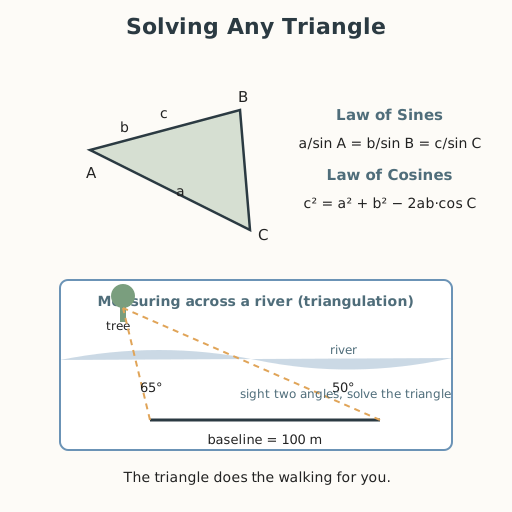
This lesson is written to the learner (“you”). The ideas to land: Law of Sines — a/sin A = b/sin B = c/sin C (use when you know an angle and its opposite side); Law of Cosines — c² = a² + b² − 2ab·cos C (use when you know two sides and the included angle, or three sides). Teach the two decision rules explicitly — which law fits what I know — with worked examples and guided practice (S-011).
The intellectual lens: two laws generalize the Pythagorean theorem to every triangle (the Law of Cosines becomes the Pythagorean theorem when C = 90°). The global lens: triangle-solving grew across cultures — chord tables in Greek astronomy, sine tables in India, and the cosine law refined by scholars such as al-Kashi in the Islamic world (S-429, S-240). The critical-thinking lens: learners sketch every triangle first and check that the answer fits the picture, especially in the ambiguous SSA case. The technology lens: GPS, radar, and mapping all depend on the same triangle-solving, now done by machines. Preview: Lesson 13 turns to three-dimensional shapes.
Procedure
- Recall (5 min). From Grade 10, the Pythagorean theorem works for right triangles. Today’s laws work for any triangle.
- Law of Cosines (15 min). For any triangle, c² = a² + b² − 2ab·cos C, where C is the angle between sides a and b. Worked example: a = 5, b = 7, C = 60° → c² = 25 + 49 − 2·5·7·cos 60° = 74 − 35 = 39, so c ≈ 6.24. When C = 90°, cos 90° = 0 and it reduces to the Pythagorean theorem.
- Law of Sines (12 min). a/sin A = b/sin B = c/sin C. Worked example: A = 40°, B = 60°, a = 8 → b = a·sin B/sin A = 8·sin 60°/sin 40° ≈ 10.78. Use it when you know an angle and its opposite side.
- Surveying across a river (10 min). Lay a baseline of 100 m along one bank, then sight the same tree across the river from each end, reading angles 65° and 50°. The third angle is 65°, and the Law of Sines gives the distance to the tree across the water. This is triangulation — measuring a distance you cannot walk.
- Guided practice (10 min). With a partner: (a) solve a triangle given two sides and the included angle (Law of Cosines); (b) solve given two angles and a side (Law of Sines); (c) sketch the SSA case and explain why it can have two answers.
- Close (3 min). Say which law you use when, and why the cosine law becomes the Pythagorean theorem at 90°.
Differentiation
- Support: Solve only Law of Cosines first with a 90° or 60° included angle; then add the Law of Sines with a sketch.
- Extension: Work the ambiguous SSA case fully (two possible triangles) and state when it collapses to one or none.
Assessment
- Formative (peer + self): Can the learner choose and apply the correct law to solve a general triangle and interpret the result in a surveying context, checked against a sketch?
- Portfolio artifact (unit): The river-survey solution, added to the geometry toolkit.
Home connection
Measure a real distance you cannot walk across — a street, a stream, a courtyard — by laying a short baseline and sighting two angles, then solve the triangle.
Resources
- On worked examples and guided practice: Kirschner, Sweller & Clark (2006), https://doi.org/10.1207/s15326985ep4102_1 (S-011).
- On the global history of triangle-solving (Greek chords, Indian sines, al-Kashi’s cosine law): MacTutor History of Mathematics Archive (S-240); Boyer & Merzbach, A History of Mathematics (S-429).