Lesson 13 — Composite Solids: Volume and Surface Area
Learners find the volume and surface area of composite solids — a silo, a tank, a building — by adding or subtracting the volumes of simpler shapes (prisms, cylinders, cones, spheres). They meet the ancient roots of volume formulas in Egypt, Mesopotamia, China, and India as a shared global achievement.
Objectives
Objectives
- D05.S3.11.02 Reason about three-dimensional shapes, finding the volume and surface area of composite solids in real contexts.
Essential question
How do I find the volume and surface area of a shape made of several simpler solids — a silo, a tank, a building — by adding or subtracting their parts?
Key vocabulary
Materials
Standard materials
- Composite-solid problem sheet · 1 per learner Worked and practice problems for volume and surface area of composite solids
- Math journal · 1 per learner
Low-tech / no-cost
- Boxes, cans, and a ball Stack a cylinder on a box, or cap a can, to build a composite solid and measure its parts
- Paper and scissors Cut nets for a prism and a pyramid and fit them into one shape
Enriched / lab & device
- Calculator · 1 per learner or pair To compute volumes and surface areas with pi
- Modeling clay or building blocks · 1 set per group To build a composite solid and reason about how much it holds and covers
Works in different contexts
- large-group Solve one composite-solid example whole-class, then learners solve a second in pairs
- multi-age Younger learners build and name the parts of a composite solid; older learners compute its volume and surface area
- self-directed A learner follows the worked examples, then solves the practice set and checks units on every answer
- level-grouped Group by comfort with area and circle formulas; a ready group solves a solid with a subtracted hole or hollow
- outdoor-only Measure a real composite object (a water tank, a grain bin, a silo) and estimate its volume
Lesson 13 — Composite Solids: Volume and Surface Area
Summary
Learners find the volume and surface area of composite solids — a silo, a water tank, a building — by adding or subtracting the volumes of simpler shapes: prisms, cylinders, cones, and spheres. They meet the ancient roots of these formulas in Egypt, Mesopotamia, China, and India, as a shared achievement.
Objectives
- Find the volume and surface area of composite solids by decomposing them into prisms, cylinders, cones, and spheres, and interpret the results in real contexts. (D05.S3.11.02)
Connection
Most things you can hold or live in are not one perfect shape — they are built up: a grain silo is a cylinder with a rounded cap; a house is a box with a sloped roof; a water tank may be a cylinder on a cone. To know how much a silo holds or how much paint a tank needs, you do not memorize a new formula — you split the shape into the simple solids you already know, find each, and add (or subtract) them.
Materials
- Composite-solid problem sheet
- Math journal
Preparation
- Copy or draw the problem sheet.
- Retrieval: from earlier grades, area and volume of prisms, cylinders, cones, and spheres (D05.S3.06.01).
- Prepare worked examples for a silo, a house, and a subtracted (hollow) solid.
Facilitator note
This lesson is written to the learner (“you”). The ideas to land: a composite solid is built from simpler solids; its volume is the sum (or difference) of their volumes, and its surface area is the sum of the exposed faces. Teach the decompose → compute → combine loop explicitly, and flag the one subtlety — when two solids share a face, that shared face is not part of the outer surface (S-011).
The environment lens: tanks, silos, and cisterns store water and grain — knowing their true volume is a question of water security and waste reduction. The intellectual lens: decomposition turns an unfamiliar shape into familiar ones. The global lens: volume formulas are ancient and shared — the Egyptians computed the volume of a truncated pyramid (Moscow Papyrus), the Chinese collected volume problems in the Nine Chapters, and Indian altar-builders used precise volumes in the Sulba Sutras (S-288, S-289, S-292, S-429). The egalitarianism lens: these tools belong to everyone — the same geometry that sizes a palace sizes a village cistern. Distinguish the formula (exact) from real-world estimation (measurements are approximate). Preview: Lesson 14 begins data with the normal distribution.
Procedure
- Recall (5 min). Name the volume formulas you know: prism (V = Bh), cylinder (V = πr²h), cone (V = ⅓πr²h), sphere (V = 4/3πr³).
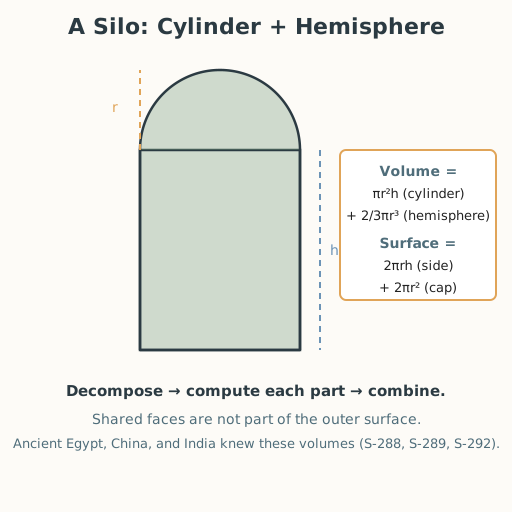
- Decompose: the silo (15 min). A silo is a cylinder capped by a hemisphere. Worked example: radius 2 m, cylinder height 10 m. Volume = cylinder + hemisphere = π(2)²(10) + ½·(4/3)π(2)³ = 40π + 16/3π = (120 + 16)/3·π = 136π/3 ≈ 142.4 m³. Surface area = cylinder’s side + hemisphere’s cap = 2π(2)(10) + 2π(2)² = 40π + 8π = 48π ≈ 150.8 m².
- Decompose: the house (10 min). A house is a rectangular prism with a triangular prism roof. Find the volume by adding the two prisms; find the surface by adding the exposed faces and omitting the shared floor of the roof.
- Subtract: the hollow solid (10 min). A pipe or a block with a hole drilled through is the difference of two solids: volume = outer − inner. Worked example: a cylinder of radius 5 and height 8 with a cylindrical hole of radius 2 removed → V = π(5² − 2²)(8) = 168π.
- Guided practice (10 min). With a partner: (a) find the volume of a cone-topped cylinder (radius 3, cylinder height 6, cone height 4); (b) find the surface area of a cube with a hemisphere carved out of one face; (c) name the shared face that must be left out of the surface.
- Close (5 min). Say the three-step loop (decompose, compute, combine) and why a shared face is not part of the outer surface.
Differentiation
- Support: Work with whole-number radii and heights, and one addition of two solids at a time.
- Extension: Solve a solid with both an added cap and a subtracted hole, and explain the surface-area handling of each.
Assessment
- Formative (peer + self): Can the learner decompose a composite solid, compute its volume and surface area, and correctly omit shared faces, with correct units?
- Portfolio artifact (unit): The silo or house solution, added to the geometry toolkit.
Home connection
Find a composite object at home — a cup with a base, a bottle, a lamp — and name the simple solids that make it up. Estimate its volume and check roughly by filling it with water if you can.
Resources
- On worked examples and guided practice: Kirschner, Sweller & Clark (2006), https://doi.org/10.1207/s15326985ep4102_1 (S-011).
- On the ancient, shared roots of volume formulas: MacTutor — Egyptian Papyri (S-288), Nine Chapters on the Mathematical Art (S-289), Indian Sulbasutras (S-292); Boyer & Merzbach, A History of Mathematics (S-429).