Lesson 03 — Scientific Ways of Knowing
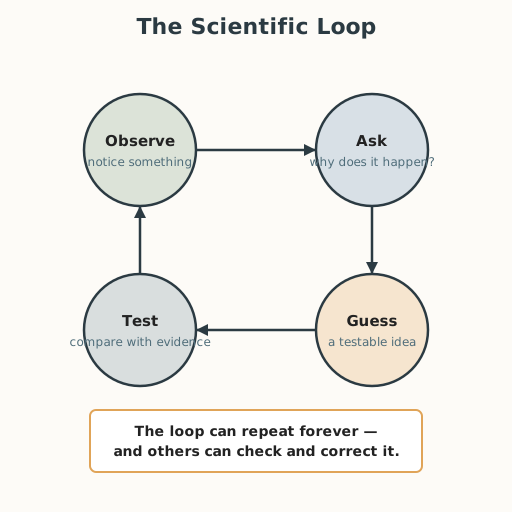
Learners examine science as one way of knowing among several: it observes, forms a testable hypothesis, makes predictions, and tests them against evidence, then submits results to peer review and replication so others can correct them. They name what this way offers and where it is limited, as the first column of a three-way comparison with indigenous and artistic knowing.
Objectives
Objectives
- D06.S1.11.02 Compare how different ways of knowing (scientific, indigenous, and artistic) generate and test knowledge, and what each offers.
Essential question
How does science generate and test knowledge, and what does this way of knowing offer — and where are its limits?
Key vocabulary
Materials
Standard materials
- Ways-of-knowing comparison chart · 1 per learner A three-column chart (scientific, indigenous, artistic) with rows: how it asks, how it tests, what it offers, where it is limited
- Science journal · 1 per learner
Low-tech / no-cost
- Paper and pencil Draw the comparison chart by hand
- A simple observable phenomenon (a dropped object, a boiling pot) The class observes, guesses, and tests one thing together, with no equipment
Enriched / lab & device
- Access to a peer-reviewed article or database (optional) · 1 per group To see peer review in action and notice how claims cite evidence
- A short case of a revised scientific model (optional) To see falsifiability at work — a model changed by new evidence
Works in different contexts
- large-group Run one observe-guess-test loop whole-class, then small groups fill in the comparison chart for one way of knowing each
- multi-age Younger learners describe "how do you know?" for one example; older learners analyze the full generate-and-test loop and its limits
- self-directed A learner works the observe-guess-test loop alone, then writes the comparison chart and a short reflection on science's limits
- level-grouped Group by reading comfort; a ready group reads a short case of a model that was revised and explains why it changed
- outdoor-only Observe one real outdoor phenomenon (a seed, a shadow, a bird's behavior), make a guess, and design a check on the spot
Lesson 3 — Scientific Ways of Knowing
Summary
Learners examine science as a way of knowing. It observes the world, forms a hypothesis that can be wrong, makes a prediction, and tests it against evidence; results are then checked by peer review and replication so other people can correct them. Learners name what this method offers — and where its limits lie — as the first column of a comparison with indigenous and artistic ways of knowing that the next lesson completes.
Objectives
- Explain how science generates and tests knowledge, and what this way of knowing offers and where it is limited. (D06.S1.11.02)
Connection
You already do science’s first move all the time: you notice something, guess why it happens, and check. “The soup is too salty — if I add water, it will taste milder.” That is observe → guess → test, and it is the seed of the whole method. What makes science distinctive is not that it is the only way to know — it is that it insists a guess be testable, that a test be repeatable, and that the result be open to correction by others. Knowing that is what lets you tell a careful claim from a confident one.
Materials
- Ways-of-knowing comparison chart
- Science journal
Preparation
- Copy or draw the comparison chart.
- Retrieval: from Lessons 1–2, the fair test and the reporting of uncertainty — these are the testing half of science. Today we see the whole loop and its limits.
- Prepare one shared observable phenomenon for the class observe-guess-test loop.
Facilitator note
This lesson is written to the learner (“you”). The ideas to land: science is one way of knowing among several; its loop is observe → ask → hypothesize (testably) → predict → test → compare, and then peer review and replication let others check and correct (S-489, S-250). A claim is scientific when it can be shown wrong by evidence (falsifiability); it offers reliable, self-correcting knowledge of how the natural world behaves, and it is limited because it is silent on meaning, value, and purpose. Hold this as description, not ranking: other ways of knowing are not “lesser science” but different ways (philosophy §11). Teach the loop explicitly with a worked example (S-011).
The intellectual lens: science’s power is not certainty but corrigibility — it invites correction. The critical-thinking lens: learners ask “is this guess testable, and who checked it?” The global lens: careful observation and testable guessing appear across human cultures; the method is a shared human achievement, not one people’s property. The ethics lens: peer review and open sharing make knowledge trustworthy because no single person has the last word. Preview: Lesson 4 completes the comparison with indigenous and artistic ways of knowing.
Procedure
- Recall (5 min). From Lessons 1–2, what made a test fair, and how did you report uncertainty? That is half of science — today we see the whole loop.
- Observe → guess → test (15 min). Together, observe one phenomenon (a dropped object, a boiling pot). Ask “why does that happen?” Guess a reason, then ask what you would have to see for the guess to be wrong. A guess you cannot check is not a scientific hypothesis. Run a tiny check if you can.
- The loop, named (10 min). Science is observe → ask → hypothesize → predict → test → compare, then start again. The hypothesis must be falsifiable: it must be possible to show it wrong. Worked example: “All swans are white” is testable (one black swan refutes it); “swans are beautiful” is not a scientific claim — it is a value, and science is silent on it.
- Correction by others (10 min). After a test, scientists write up the method and result so others can replicate it and review it. Mistakes are found and corrected this way (S-489). This self-correction is what makes the knowledge trustworthy, not the authority of any one scientist.
- What it offers, where it is limited (10 min). Science offers reliable, checkable knowledge of how the natural world behaves. It does not tell us what life means, what is good, or what is beautiful — those are questions for other ways of knowing. Fill in the “scientific” column of your comparison chart.
- Close (5 min). In your journal, write one sentence on what science offers and one on what it cannot do.
Differentiation
- Support: Work only the observe-guess-test loop with a single concrete example, and skip the formal vocabulary until the concept is felt.
- Extension: Read a short account of a scientific model that was revised by new evidence, and write which step of the loop changed and why.
Assessment
- Formative (peer + self): Can the learner name the steps of the loop, state why a hypothesis must be falsifiable, and give one strength and one limit of science?
- Portfolio artifact (unit): The “scientific” column of the comparison chart, completed and saved for Lesson 4’s full comparison.
Home connection
Notice one claim at home or in the news (“this medicine works,” “this diet is best”). Ask: is it testable? Who checked it? Can it be shown wrong? Write your answers.
Resources
- On worked examples and guided practice: Kirschner, Sweller & Clark (2006), https://doi.org/10.1207/s15326985ep4102_1 (S-011).
- On peer review and replication: Understanding Science (UC Berkeley), “Scrutinizing science: peer review” (S-489); “What is science?” on bias (S-250).