Lesson 04 — Indigenous and Artistic Ways of Knowing
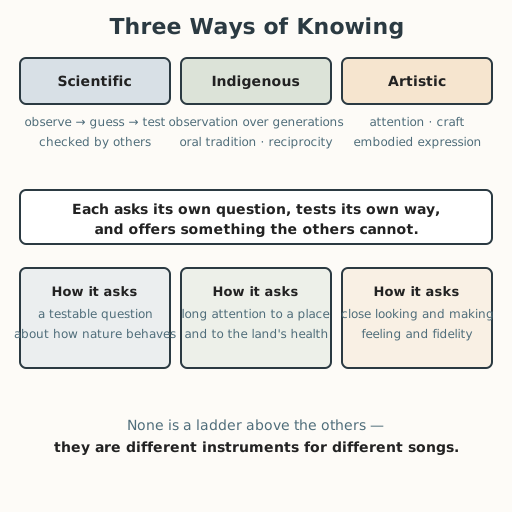
Learners complete the three-way comparison of ways of knowing. They examine indigenous ways of knowing — long, multi-generational observation, oral tradition, and reciprocity with the land — and artistic ways of knowing — attention, craft, and embodied expression that test truth by resonance and fidelity. They name what each offers that science alone cannot, and hold the three side by side without ranking.
Objectives
Objectives
- D06.S1.11.02 Compare how different ways of knowing (scientific, indigenous, and artistic) generate and test knowledge, and what each offers.
Essential question
How do indigenous and artistic ways of knowing generate and test knowledge, and what does each offer that science alone cannot?
Key vocabulary
Materials
Standard materials
- Ways-of-knowing comparison chart (from Lesson 3) · 1 per learner Complete the indigenous and artistic columns beside the scientific column
- Science journal · 1 per learner
Low-tech / no-cost
- Voice and memory Listen to or retell a short place-knowledge story from one's own family or community
- Paper and pencil Draw a seasonal round or a map of a place you know by heart, without any device
Enriched / lab & device
- A short, respected written or recorded account of an Indigenous knowledge practice · 1 per group e.g., cultural burning, seasonal calendars, plant knowledge — used respectfully as a living tradition, not a specimen
- A short artwork, song, or poem that encodes knowledge · 1 per group To examine how art carries and tests knowledge (fidelity, resonance, craft)
Works in different contexts
- large-group Groups each take one way of knowing (indigenous or artistic) and one example, then the class builds the full three-column comparison together
- multi-age Younger learners share a place or family knowledge they hold; older learners analyze how each way tests knowledge and what it offers
- self-directed A learner completes the comparison chart alone and writes a reflection on what each way of knowing offers
- level-grouped Group by reading comfort; a ready group compares two Indigenous practices across regions and notes what is shared and what is local
- outdoor-only In the open air, notice what you know about the place around you that a visitor would not — and how you came to know it
Lesson 4 — Indigenous and Artistic Ways of Knowing
Summary
Learners complete the three-way comparison begun in Lesson 3. They examine indigenous ways of knowing — observation built up over generations, carried in oral tradition, and bound to reciprocity with the land — and artistic ways of knowing — close attention, craft, and embodied expression that test truth by resonance and fidelity. They name what each offers that science alone cannot, and hold the three ways side by side without ranking them.
Objectives
- Compare scientific, indigenous, and artistic ways of knowing: how each generates and tests knowledge, and what each offers. (D06.S1.11.02)
Connection
Think of what you know that no test has ever measured: which field floods each year, when the fish return, how your grandmother’s recipe should feel between your fingers, what a song in your home language makes you feel. These are knowledge — real, hard-won, and passed on — yet they were not produced by a laboratory. Different ways of knowing are not rivals; they are different instruments for different songs. Naming them fairly, without ranking one above another, is part of honoring the many peoples who hold them.
Materials
- Ways-of-knowing comparison chart (from Lesson 3)
- Science journal
Preparation
- Retrieval: from Lesson 3, the scientific loop and its strengths and limits. Today we complete the other two columns.
- Prepare a respectful example of each: an Indigenous knowledge practice (such as cultural burning or a seasonal calendar) and an artwork or song that carries knowledge. Present these as living traditions of specific peoples, not as specimens.
Facilitator note
This lesson is written to the learner (“you”). The ideas to land: indigenous ways of knowing build knowledge through observation accumulated over generations, carried in oral tradition and law, and tested against the long-term health of land and people; artistic ways of knowing build knowledge through close attention, craft, and embodied expression, tested by resonance, fidelity, and the honesty of the making. These are not “lesser science” — they are different ways, each with its own standards (philosophy §11). Cite real, named practices: Aboriginal cultural burning (S-320, S-321), the reciprocity ethic in Robin Wall Kimmerer’s writing (S-427), and Aboriginal and Torres Strait Islander art and oral tradition carrying knowledge of Country (S-085). Present Indigenous knowledge as living and contemporary, held by specific peoples, never as a single undifferentiated “ancient wisdom.”
The global lens: knowledge lives in many traditions across the world; no single people invented knowing. The ethics lens: it is a question of justice to honor knowledge traditions that were suppressed and to name the peoples who hold them. The egalitarianism lens: holding ways of knowing side by side without ranking is an egalitarian act — knowledge is not a hierarchy. The intellectual lens: a fuller picture of the world comes from more than one way of looking. Preview: Lessons 5–8 turn to a specific claim — evolution — that science grounds in evidence, and ask how that sits beside beliefs about life’s meaning.
Procedure
- Recall (5 min). From Lesson 3, what does science offer, and what is it silent on? Today we complete the other two columns of the chart.
- Indigenous ways of knowing (15 min). These build knowledge by observing a place closely over many generations, carrying it in oral tradition, law, and practice, and testing it against the long-term health of the land and the people. Worked example: Aboriginal cultural burning uses cool, careful fire to promote plant growth and reduce wildfire risk — knowledge held and applied over thousands of years (S-320, S-321). The reciprocity ethic — taking only what sustains, giving back — is one form of this knowledge (S-427). Fill in the column: how it asks (by long attention to a place), how it tests (by the land’s health over generations), what it offers (deep, place-specific, relational knowledge).
- Artistic ways of knowing (15 min). Art knows by attention and making: a painter sees a color the rest of us pass by, a song holds a feeling that a thermometer cannot, a story carries a truth about being human. It tests itself by fidelity (does it ring true?), craft (is it well made?), and resonance (does it move and teach?). Worked example: Aboriginal and Torres Strait Islander art and songline traditions carry knowledge of land, water, and law through story and image (S-085). Fill in the column.
- Compare without ranking (15 min). Put the three columns side by side. Ask: how does each ask, how does each test, and what does each offer? Notice that the three answer different questions — and that a full human life needs all three.
- Close (5 min). In your journal, write one sentence on what indigenous and artistic knowing each offer that science cannot.
Differentiation
- Support: Share one place or family knowledge of your own and tell how you came to know it, before filling in any formal vocabulary.
- Extension: Compare two Indigenous knowledge practices from different regions, noting what is shared (long observation, reciprocity) and what is particular to each place and people.
Assessment
- Formative (peer + self): Can the learner state how indigenous and artistic ways of knowing each generate and test knowledge, and give one thing each offers that science does not — without ranking the three?
- Portfolio artifact (unit): The completed three-column comparison chart.
Home connection
Ask an elder or neighbor in your own life: “What do you know about this place that you learned by watching it, not from a book?” Write down their answer and how they came to know it.
Resources
- On cultural burning as living Indigenous knowledge: CSIRO, “Indigenous Cultural Burning” (S-320); Firesticks Alliance (now Living Knowledge Network) (S-321).
- On reciprocity and Indigenous knowledge of plants: Robin Wall Kimmerer, Braiding Sweetgrass (S-427).
- On Aboriginal and Torres Strait Islander art and oral tradition carrying knowledge of Country: AIATSIS (S-085).