Lesson 05 — Evidence for Evolution: Variation, Inheritance, Selection
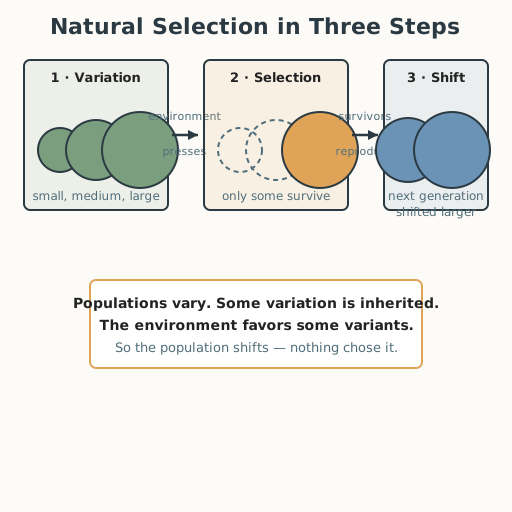
Learners build the evidence-based account of evolution by natural selection: populations vary, some variation is inherited, and when the environment makes some variants more likely to survive and reproduce, the population shifts over generations. They meet a real observed case — Darwin's finches — as measured evidence, not story.
Objectives
Objectives
- D06.S2.11.01 Explain the evidence for evolution and common ancestry, and distinguish this from beliefs about life's meaning.
Essential question
What is the evidence that variation, inheritance, and natural selection shape populations over time?
Key vocabulary
Materials
Standard materials
- Evolution evidence organizer · 1 per learner A table for each line of evidence: variation, inheritance, selection, and an observed example
- Science journal · 1 per learner
Low-tech / no-cost
- Mixed found objects (seeds, pebbles of different sizes) Model selection by hand — separate a mixed pile by a rule (e.g., larger ones survive) and watch the pile shift
- Paper and pencil Draw a simple before-and-after of a population under selection
Enriched / lab & device
- Access to a short video or article on an observed case (e.g., Darwin's finches) · 1 per group To see natural selection measured in the wild across years
- Spreadsheet (optional) To plot a population's trait shift before and after a selection event
Works in different contexts
- large-group Run one whole-class selection model with found objects, then small groups each build one line of evidence on the organizer
- multi-age Younger learners act out variation and sorting by a rule; older learners analyze the full variation-inheritance-selection chain and an observed case
- self-directed A learner completes the organizer alone and writes a short explanation of one observed case of selection
- level-grouped Group by reading comfort; a ready group reads the finch-beak case and states the exact trait, the pressure, and the measured shift
- outdoor-only Find real variation outdoors — leaf sizes, seed shapes — and name the rule (heat, drought, grazing) that might sort them
Lesson 5 — Evidence for Evolution: Variation, Inheritance, Selection
Summary
Learners build the evidence-based account of evolution by natural selection: populations show variation; some variation is inherited; and when the environment makes some variants more likely to survive and reproduce, the population shifts over generations. They meet a real, measured case — Darwin’s finches on Daphne Major — as evidence, not story, and begin the unit’s distinction between evidence for evolution and beliefs about life’s meaning.
Objectives
- Explain the evidence that variation, inheritance, and natural selection shape populations over time. (D06.S2.11.01)
Connection
Why are the dogs in one street so different from the dogs in another, or the insects on one plant a slightly different shade than on the next? Every population is a mix — no two members are exactly alike — and some of that difference runs in families. When the world favors one kind over another (the heat, the food, the predator), the mix slowly changes. You can watch the logic of this in a handful of seeds sorted by a sieve; the same logic, played out over thousands of generations, is evolution.
Materials
- Evolution evidence organizer
- Science journal
Preparation
- Copy or draw the evolution evidence organizer.
- Retrieval: from Grade 10, heredity and mutation (D06.S2.10.01) and ecosystems’ interdependence (D06.S2.09.01). Today we chain those into the mechanism of selection.
- Prepare mixed found objects for a hands-on selection model.
Facilitator note
This lesson is written to the learner (“you”). The ideas to land: evolution by natural selection rests on three observed facts — populations vary, some variation is inherited, and some variants survive and reproduce more under a given environment — from which the population’s shift over generations follows (S-303). Teach the chain explicitly with a worked example and guided practice (S-011), and ground it in a measured case: in the Galápagos, Grant and Grant recorded beak size in Geospiza fortis shifting after drought changed the food supply (S-305). Emphasize that this is evidence, not a claim to be accepted on authority, and that nothing “decided” the outcome — the environment selects without purpose.
The intellectual lens: the power of the account is that three simple, observable facts, together, produce change over time. The critical-thinking lens: learners ask “is the variation really inherited, and is the pressure really differential?” before accepting any selection story. The global lens: the finch work is one measured case among many across the world’s ecosystems; evolution is a description of life everywhere. The ethics lens: describing how life changes says nothing about what life means — that distinction is previewed here and deepened in Lesson 7. Preview: Lesson 6 turns selection into common ancestry and the tree of life.
Procedure
- Recall (5 min). From Grade 10, what is heredity, and what is a mutation? Today we chain variation and heredity into the mechanism of evolution.
- Variation (10 min). Every population is a mix: no two members are exactly alike. Look at your found objects — sizes and shapes differ. Record this first fact on your organizer.
- Inheritance (10 min). Some variation is heritable — it can pass from parent to offspring (S-177). Worked example: in a population of plants, taller and shorter forms run in families; the differences are not only luck of the field.
- Selection (15 min). When the environment makes some variants more likely to survive and reproduce, those become more common over generations — natural selection (S-303). Model it: apply a rule to your pile (only the larger seeds “survive”), and watch the surviving pile differ from the original. Nothing chose; the rule simply sorted.
- A measured case (10 min). On Daphne Major in the Galápagos, a drought changed the seeds, and birds with larger beaks survived and reproduced more; the beak size of the population shifted measurably in the following years (S-305). This is evolution measured in the wild, not assumed.
- Close (5 min). In your journal, write the three facts (variation, inheritance, selection) in one sentence that explains why a population changes.
Differentiation
- Support: Act out the three steps with a single concrete pile and one simple rule; name the steps without the full vocabulary.
- Extension: For the finch case, state the exact trait, the environmental pressure, and the direction of the measured shift, and explain why one good year could shift it back.
Assessment
- Formative (peer + self): Can the learner state the three observed facts and use them to explain a population’s shift, citing the finch case as measured evidence?
- Portfolio artifact (unit): The completed evolution evidence organizer.
Home connection
Find variation in one living population near you — the weeds in a crack, the birds at a feeder, the plants in a garden. Name the trait that varies, and guess what rule (the heat, the shade, the food) might sort it.
Resources
- On natural selection: Darwin, On the Origin of Species (1859) (S-303); Encyclopaedia Britannica, “Heredity” (S-177).
- On the measured finch case: Grant & Grant, Darwin’s finches on Daphne Major (S-305).
- On worked examples and guided practice: Kirschner, Sweller & Clark (2006) (S-011).