Lesson 06 — Common Ancestry and the Tree of Life
Learners build the case for common ancestry from three lines of evidence: fossils laid down in deep time, homologous structures shared across species, and DNA sequences that grow more similar the more recently two species branched. They read all three as a tree of life — a branching pattern, not a ladder — and note what each line of evidence can and cannot show.
Objectives
Objectives
- D06.S2.11.01 Explain the evidence for evolution and common ancestry, and distinguish this from beliefs about life's meaning.
Essential question
What is the evidence that living things share common ancestors, and how is that evidence read from fossils, anatomy, and DNA?
Key vocabulary
Materials
Standard materials
- Common-ancestry evidence chart · 1 per learner Rows for each line of evidence (fossils, anatomy, DNA) with a column for what it shows and one for its limits
- Science journal · 1 per learner
Low-tech / no-cost
- A hand, a paw, and a fin (drawn or remembered) Compare the shared bone plan of a hand, a whale flipper, and a bat wing as homologous structures
- Paper and pencil Draw a simple branching tree and add two species that share a recent branch
Enriched / lab & device
- A short database view or article on DNA sequence similarity · 1 per group To see shared ancestry read in molecules, not only in bones
- Fossil images or a museum site (optional) To see transitional forms and the branching pattern over deep time
Works in different contexts
- large-group Build one shared tree of life on the board, then small groups each trace one line of evidence on the chart
- multi-age Younger learners compare two visible body plans; older learners explain how fossils, anatomy, and DNA each read common ancestry
- self-directed A learner completes the chart alone and writes a paragraph explaining one line of evidence
- level-grouped Group by reading comfort; a ready group compares DNA evidence with fossil evidence and states what each can and cannot show
- outdoor-only Compare the body plans of living things found outdoors (a leaf, a feather, a bone) and infer which are built on a shared plan
Lesson 6 — Common Ancestry and the Tree of Life
Summary
Learners build the case for common ancestry from three lines of evidence: fossils laid down over deep time, homologous structures shared across species, and DNA sequences that grow more similar the more recently two species branched. They read all three as a tree of life — a branching pattern, not a ladder with humans “on top” — and state what each line of evidence can and cannot show.
Objectives
- Explain the evidence for common ancestry from fossils, anatomy, and DNA, and read it as a branching tree of life. (D06.S2.11.01)
Connection
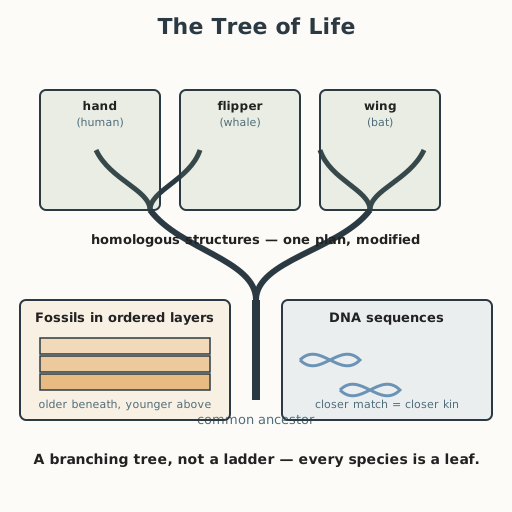
Look at your own hand: the pattern of bones — one, then two, then a fan — appears, rearranged, in a whale’s flipper, a bat’s wing, and a bird’s wing. The most natural reading is not that each was invented separately, but that all four were modified from one shared plan. And just as your close relatives resemble you more than distant strangers do, the DNA of two species is more alike the more recently they split from a common ancestor. Read together, these are the marks of one family — the tree of life.
Materials
- Common-ancestry evidence chart
- Science journal
Preparation
- Copy or draw the common-ancestry evidence chart.
- Retrieval: from Lesson 5, variation, inheritance, and selection. Today we ask what those, run backward in time, imply: shared ancestors.
- Prepare drawings or images of homologous structures and a simple branching tree.
Facilitator note
This lesson is written to the learner (“you”). The ideas to land: common ancestry is supported by three converging lines of evidence — the fossil record in ordered rock layers, homologous structures (the same body plan modified in different species), and DNA sequences whose similarity tracks how recently two species branched (S-303, S-177). The result is a branching tree, not a ladder — every living species is a leaf, none “higher” than another. Teach each line with a worked example (S-011), and hold the humility: fossils are partial, and DNA shows relationship but not “progress.” Earth itself is about 4.54 billion years old — standard geology (S-308) — and life’s fossil record stretches across deep time in ordered rock layers.
The intellectual lens: independent lines of evidence that point the same way are stronger than any one line alone. The critical-thinking lens: learners ask of each line “what exactly does this show, and what does it not show?” The global lens: the tree of life includes every people and every species on equal footing — it is a picture of relatedness, not rank. The ethics lens: reading ourselves as one branch among many, not the crown of a ladder, quietly reshapes how we treat other species (previewing Lesson 7). Preview: Lesson 7 turns to the distinction between this evidence and beliefs about life’s meaning.
Procedure
- Recall (5 min). From Lesson 5, what makes a population shift over generations? Today we run that process backward: what does it imply about shared beginnings?
- Fossils and deep time (12 min). Fossils appear in ordered layers of rock: older forms lie beneath younger ones, and forms appear, persist, and vanish in sequence over deep time (S-308). This is a record of change, not a snapshot. Record on your chart: what fossils show (change and sequence) and their limit (the record is incomplete).
- Homologous structures (12 min). A homologous structure is the same body plan modified for different uses — a human hand, a whale flipper, a bat wing. Their shared pattern is best explained by a common ancestor, not separate invention (S-303). Compare them, and record what anatomy shows.
- DNA evidence (12 min). Species that branched recently share more similar DNA sequences than species that branched long ago — the same logic by which relatives resemble each other more than strangers do (S-177). Record what DNA shows, and its limit: it measures how related, not “how advanced.”
- Read the tree (10 min). Draw a branching tree. Every living species is a leaf; branches that meet low on the tree shared an ancestor long ago, branches that meet high shared one recently. There is no “top” and no “higher” species — only related leaves.
- Close (4 min). In your journal, write one sentence each for what fossils, anatomy, and DNA tell us about our place among living things.
Differentiation
- Support: Compare just two visible body plans (hand and flipper) and draw a two-branch tree, leaving DNA as a mention.
- Extension: Explain why DNA and fossils are independent lines of evidence, and what it means that they point the same way; note a case where one line alone would mislead.
Assessment
- Formative (peer + self): Can the learner name three lines of evidence for common ancestry, say what each shows and its limit, and read the relationship as a branching tree rather than a ladder?
- Portfolio artifact (unit): The completed common-ancestry evidence chart.
Home connection
Find two living things you can see from home — two trees, two birds, two plants — and write which traits they share and which differ, and what that might say about how closely related they are.
Resources
- On common ancestry and homologous structures: Darwin, On the Origin of Species (1859) (S-303); Encyclopaedia Britannica, “Heredity” (S-177).
- On the age of the Earth and the fossil record: USGS, “Geologic Time: Age of the Earth” (S-308).
- On worked examples and guided practice: Kirschner, Sweller & Clark (2006) (S-011).