Lesson 07 — Evidence and Meaning, and the Ethics of Other Species
Learners draw the distinction the unit has been building toward: evidence claims (how life actually changes, settled by observation) are different from value claims (what life means and what we owe other species, settled by reasoning and care). They then analyze the ethics of human relationships with other species, weighing instrumental against intrinsic value and meeting a reciprocity ethic from an Indigenous tradition.
Objectives
Objectives
- D06.S2.11.02 Analyze the ethics of human relationships with other species and ecosystems, including conservation and restoration.
Essential question
How do I distinguish the evidence for evolution from beliefs about life's meaning, and what is our ethical relationship with other species?
Key vocabulary
Materials
Standard materials
- Evidence-vs-value and ethics organizer · 1 per learner Two panels: one sorting claims into evidence vs value, one analyzing a stance toward another species
- Science journal · 1 per learner
Low-tech / no-cost
- Claim cards (paper slips) Sortable sentences, some evidence ('populations change over generations'), some value ('animals deserve care')
- Paper and pencil Write one's own stance toward a species and its reasons
Enriched / lab & device
- A short account of a culture's ethic toward animals or land · 1 per group e.g., a reciprocity ethic — used respectfully as a living tradition, not a specimen
- A case study of a real animal-welfare or habitat decision · 1 per group To analyze a real trade-off between human and non-human interests
Works in different contexts
- large-group Sort claim cards whole-class into evidence and value, then small groups each analyze one stance toward a species and report its reasons
- multi-age Younger learners name what they owe a familiar animal; older learners sort evidence vs value claims and argue a considered stance
- self-directed A learner sorts the claims alone, then writes a one-paragraph argument for a stance toward one species, naming its reasons
- level-grouped Group by reading comfort; a ready group analyzes a real trade-off (habitat vs development) and weighs the reasons on both sides
- outdoor-only Observe a living thing outdoors and ask: does it have value only because it is useful to us, or for its own sake? Argue either way
Lesson 7 — Evidence and Meaning, and the Ethics of Other Species
Summary
Learners draw the distinction the unit has been building toward: evidence claims (how life actually changes, settled by observation) are different from value claims (what life means and what we owe other species, settled by reasoning and care). They then analyze the ethics of human relationships with other species, weighing a species’ instrumental value (useful to us) against its intrinsic value (worth caring for in its own right), and meet a reciprocity ethic from an Indigenous tradition.
Objectives
- Distinguish the evidence for evolution from beliefs about life’s meaning, and analyze the ethics of human relationships with other species. (D06.S2.11.02)
Connection
Two different sentences are often tangled together: “populations change over generations” (a claim about how things are, testable and settled by evidence) and “other animals deserve our care” (a claim about how we ought to act, settled by reasoning and conscience). Evolution answers the first; it is silent on the second. Untangling them lets you hold the science firmly and think clearly about what you owe the creatures around you — the dog, the bird, the river, the forest — without pretending one answers the other.
Materials
- Evidence-vs-value and ethics organizer
- Science journal
Preparation
- Copy or draw the organizer; prepare claim cards to sort.
- Retrieval: from Lessons 5–6, the evidence for evolution and common ancestry. Today we ask what that evidence does not decide.
- Prepare a respectful example of a reciprocity ethic toward the living world (e.g., the ethic in Kimmerer’s Braiding Sweetgrass, S-427).
Facilitator note
This lesson is written to the learner (“you”). The ideas to land: evidence claims (descriptive — “populations change”) and value claims (normative — “animals deserve care”) are different kinds of claim, settled by different means; the evidence for evolution establishes the first and is silent on the second (S-303). Then the ethics analysis: a species can have instrumental value (what it gives us) and/or intrinsic value (worth in itself), and different ethical stances weigh these differently. Hold the value questions open (philosophy §11) — the lesson’s job is to help learners reason about them, not to decree an answer. Meet a reciprocity ethic from an Indigenous tradition as a living way of relating (S-427), not as a specimen.
The ethics lens: this is the lesson’s center — reasoning about what we owe others. The egalitarianism lens: the question “who counts?” is an egalitarian question — whether moral standing extends beyond the human. The critical-thinking lens: learners separate the two claim types before arguing, so evidence is never stretched to settle values. The global lens: many cultures hold different, serious ethics toward other species; all deserve a fair hearing. Preview: Lesson 8 extends this ethics to whole ecosystems — conservation and restoration.
Procedure
- Recall (5 min). From Lessons 5–6, what does the evidence show about how life changes? Today: what does that evidence not decide?
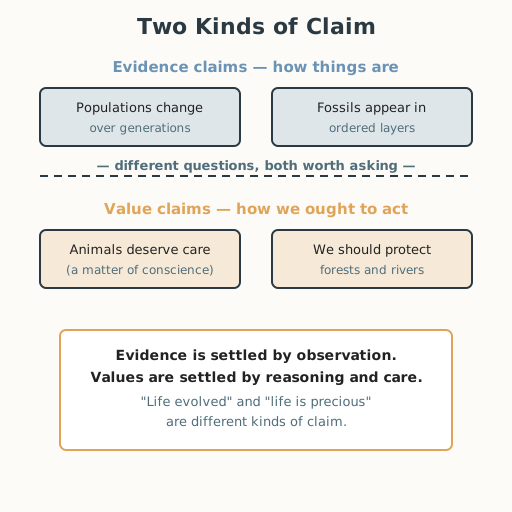
- Sort the claims (12 min). Sort the cards into two piles: evidence claims (how things are — “populations change over generations,” “fossils appear in ordered layers”) and value claims (how we ought to act — “animals deserve care,” “we should protect forests”). Notice they are settled differently: evidence by observation, values by reasoning and conscience. The evidence for evolution settles the first pile and is silent on the second (S-303).
- Instrumental and intrinsic value (12 min). Ask of one species: is it valuable only because it is useful to us (instrumental value — food, medicine, work), or does it have intrinsic value (worth in itself, apart from use)? Different people, and different cultures, answer differently — and that difference is a value difference, not a scientific one.
- A reciprocity ethic (12 min). Some traditions ground the relationship in reciprocity: the living world sustains us, so we owe it care in return — a relationship, not a resource (S-427). Compare this with the instrumental view: what changes in how you would treat a forest or a river?
- Argue a stance (10 min). In your journal, write a short argument for one stance toward a species you know — instrumental, intrinsic, or reciprocal — naming your reasons and at least one reason someone might disagree.
- Close (4 min). Say, in your own words, why “life evolved” and “life is precious” are different kinds of claim.
Differentiation
- Support: Sort only the clearest cards and name what you owe one familiar animal, leaving formal vocabulary aside.
- Extension: Analyze a real trade-off (habitat versus development), weigh instrumental and intrinsic reasons on both sides, and argue a considered position.
Assessment
- Formative (peer + self): Can the learner place a claim in the correct pile (evidence vs value), explain the difference, and argue a stance toward another species with reasons and a fair counterpoint?
- Portfolio artifact (unit): The completed evidence-vs-value and ethics organizer.
Home connection
Notice one way your household already treats another species — a pet, a plant, an insect, a food animal. Write whether that treatment rests on instrumental value, intrinsic value, or reciprocity.
Resources
- On the evidence for evolution (the descriptive claim): Darwin, On the Origin of Species (1859) (S-303).
- On a reciprocity ethic toward the living world: Robin Wall Kimmerer, Braiding Sweetgrass (S-427).
- On worked examples and guided practice: Kirschner, Sweller & Clark (2006) (S-011).