Lesson 08 — Conservation, Restoration, and Ecosystems
Learners extend the ethics of other species to whole ecosystems. They trace how a change in one part of a food web ripples through the rest, meet biodiversity as the source of resilience, and analyze conservation (protecting what remains) and restoration (helping a damaged system recover) as real, hopeful human responses.
Objectives
Objectives
- D06.S2.11.02 Analyze the ethics of human relationships with other species and ecosystems, including conservation and restoration.
Essential question
How do conservation and restoration work, and what does it mean to care for whole ecosystems rather than single species?
Key vocabulary
Materials
Standard materials
- Ecosystem ethics case sheet · 1 per learner A short case of an ecosystem under pressure, with room to analyze what is at stake and design a response
- Science journal · 1 per learner
Low-tech / no-cost
- Paper and pencil Draw a small food web and show what changes when one part is removed
- Found natural objects (leaves, stones, twigs) Build a tiny model ecosystem and remove one piece to see the ripple
Enriched / lab & device
- A short account of a real restoration project · 1 per group e.g., a rewilding, a coral or wetland restoration — analyzed as a real, hopeful effort
- A biodiversity data set or map (optional) To see how biodiversity and resilience are measured across regions
Works in different contexts
- large-group Analyze one ecosystem case whole-class, then small groups each design a conservation or restoration response and present it
- multi-age Younger learners draw the food web and remove one piece; older learners analyze the full case and weigh a restoration plan
- self-directed A learner works the case alone and writes a short conservation or restoration plan with reasons
- level-grouped Group by reading comfort; a ready group weighs two restoration strategies against each other on resilience and cost
- outdoor-only Choose a real local ecosystem, name its parts and one threat, and design a small, realistic care action
Lesson 8 — Conservation, Restoration, and Ecosystems
Summary
Learners extend the ethics of other species to whole ecosystems. They trace how a change in one part of a food web ripples through the rest, meet biodiversity as the source of a system’s resilience, and analyze conservation (protecting what remains) and restoration (helping a damaged system recover) as real, hopeful human responses — the closing artifact of the unit’s living-systems strand.
Objectives
- Analyze the ethics of human relationships with ecosystems, including conservation and restoration. (D06.S2.11.02)
Connection
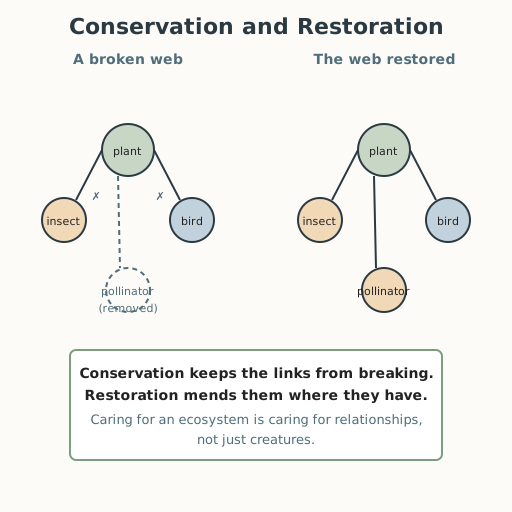
A forest is not a shelf of separate animals; it is a web. Remove the wolves, and the deer may over-browse; remove a pollinator, and the plants that depended on it thin out; drain a wetland, and the flood it once absorbed falls on the town instead. Caring for the living world therefore means caring for relationships, not just individual creatures. Conservation keeps those relationships from breaking; restoration mends them where they have. Both are things real people are doing, right now, all over the world — and the reasons for doing them are both practical (we depend on these systems) and ethical (they matter in themselves).
Materials
- Ecosystem ethics case sheet
- Science journal
Preparation
- Copy or draw the case sheet.
- Retrieval: from Lesson 7, instrumental and intrinsic value and the reciprocity ethic. Today we apply those to whole systems.
- Prepare a short, real restoration example and a food web to draw.
Facilitator note
This lesson is written to the learner (“you”). The ideas to land: an ecosystem’s parts are linked, so a change to one ripples to others (S-244); biodiversity — the variety of living things — makes a system resilient to shock, and its loss is the central threat to ecosystems and human well-being (S-437); conservation protects what remains, restoration helps a damaged system recover. Frame both as real, ongoing human work — hopeful, not despairing (facilitation: always connect difficulty to agency). Meet a keystone-species example (S-176) and carrying capacity (S-436) as the system ideas they are. Hold the ethics open: the practical and the intrinsic reasons for care are both legitimate, and learners reason toward their own position.
The environment lens: this is the lesson’s center — living systems and our responsibility to them. The ethics lens: care for a system, not just its parts, is an ethical stance learners argue and defend. The egalitarianism lens: who bears the cost and who gains the benefit of conservation is a justice question, not only an ecological one. The intellectual lens: the food web and resilience are system concepts that organize the facts. Preview: Lesson 9 turns from living systems to physical ones — matter at the atomic scale.
Procedure
- Recall (5 min). From Lesson 7, what is the difference between instrumental and intrinsic value? Today we apply those to whole ecosystems.
- Ripples in the web (12 min). Draw a small food web. Remove one part — a pollinator, a predator, a wetland. Trace what happens to the parts that depended on it (S-244). A keystone species is one whose removal ripples far out of proportion to its numbers (S-176). Notice: ecosystems are relationships, not shelves.
- Biodiversity and resilience (12 min). Biodiversity is the variety of living things in a place. Systems with more variety absorb shock better — if one species fails, another can fill its role. The loss of biodiversity is a central threat to ecosystems and to the food, water, and health they give us (S-437).
- Conservation and restoration (12 min). Conservation protects what remains (reserves, limits, protection of a key species). Restoration helps a damaged system recover (replanting, rewetting a drained wetland, returning a missing species). Both are real, ongoing human work. Meet one real example — a wetland or forest or reef being restored somewhere in the world.
- Design a response (10 min). On your case sheet, design a small conservation or restoration response for the ecosystem you drew: name the threat, one realistic action, and one reason it matters (practical, ethical, or both).
- Close (4 min). In your journal, write one sentence on why caring for an ecosystem is caring for relationships, not just creatures.
Differentiation
- Support: Draw a three-link food chain and remove one link; name one care action in plain words.
- Extension: Weigh two restoration strategies on resilience, cost, and who benefits or bears the cost, and argue which a community should choose.
Assessment
- Formative (peer + self): Can the learner trace a ripple through a food web, explain how biodiversity supports resilience, and design a conservation or restoration response with a stated reason?
- Portfolio artifact (unit): The completed ecosystem ethics case sheet.
Home connection
Find one local ecosystem — a garden, a pond, a stand of trees — and name its parts, one threat, and one small care action a person could actually take this season.
Resources
- On food webs and keystone species: BBC Bitesize, “Ecosystems and habitats: food chains and webs” (S-244); National Geographic Education, “Role of Keystone Species” (S-176).
- On biodiversity and resilience: IPBES, Global Assessment Report (S-437); Encyclopaedia Britannica, “Carrying capacity” (S-436).
- On worked examples and guided practice: Kirschner, Sweller & Clark (2006) (S-011).