Lesson 14 — Comparing Cosmological Models, Weighing Evidence
Learners compare cosmological models: the Big Bang, the once-competing steady-state model that evidence set aside, and cultural origin accounts. They weigh the evidence that favored the Big Bang, see falsifiability at work in the history of cosmology, and hold scientific models and cultural accounts in respectful relation — each answering a different question, none a dogma.
Objectives
Objectives
- D06.S4.11.01 Compare cosmological models and weigh the evidence for each, holding them as models rather than certainties.
Essential question
How do I compare different cosmological models, weigh the evidence for each, and hold them all as models rather than certainties?
Key vocabulary
Materials
Standard materials
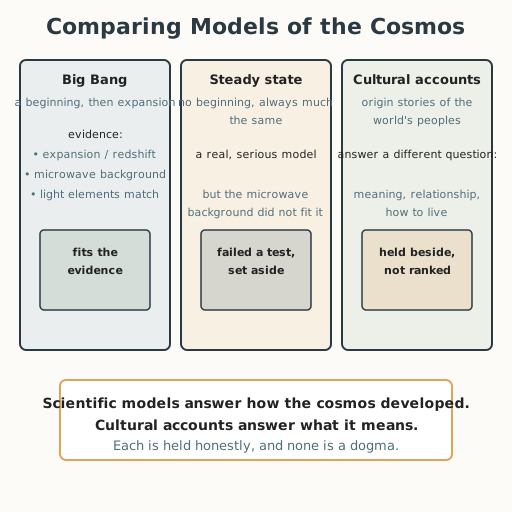
- Cosmological-models comparison chart · 1 per learner Columns for several models (Big Bang, steady state, and one cultural account) with rows for what each claims, its evidence, and its status as a model
- Science journal · 1 per learner
Low-tech / no-cost
- Paper and pencil Draw the comparison chart by hand
- Claim cards (paper slips) Sort claims and evidence to their models, and mark which are testable
Enriched / lab & device
- A short account of the steady-state model and why it was set aside (optional) · 1 per group To see falsifiability in the history of cosmology — a model tested and revised
- A respectful retelling of a cultural origin account (optional) e.g., a Māori or Haudenosaunee origin story — presented as a living tradition, not a specimen
Works in different contexts
- large-group Build the comparison chart whole-class, then small groups each take one model and present its claim, evidence, and status
- multi-age Younger learners retell two origin accounts side by side; older learners weigh the evidence for the scientific models and state why each is a model
- self-directed A learner completes the chart alone and writes a reflection on why models are revised and what other accounts offer
- level-grouped Group by reading comfort; a ready group explains exactly which evidence favored the Big Bang over the steady state
- outdoor-only Look at the sky and compare two accounts of its beginning — one scientific, one cultural — asking what each is *for*
Lesson 14 — Comparing Cosmological Models, Weighing Evidence
Summary
Learners compare cosmological models: the Big Bang, the once-competing steady-state model that evidence set aside, and cultural origin accounts. They weigh the evidence that favored the Big Bang, see falsifiability at work in the history of cosmology, and hold scientific models and cultural accounts in respectful relation — each answering a different question, none a dogma (philosophy §11).
Objectives
- Compare cosmological models, weigh the evidence for each, and hold them all as models rather than certainties. (D06.S4.11.01)
Connection
Not long ago, serious scientists disagreed about whether the universe had a beginning. The steady-state model held that the universe had always been much the same; the Big Bang model held that it began hot and dense and has expanded since. Evidence — especially the discovery of the cosmic microwave background — settled the contest, and the steady-state model was set aside. That is how scientific models work: they are compared, tested, and revised. And beside these scientific accounts sit the origin stories of the world’s peoples, which answer a different question — not how it mechanically began but what it means and how we should live — and which we hold with the same respect, and the same honesty about what each is.
Materials
- Cosmological-models comparison chart
- Science journal
Preparation
- Copy or draw the comparison chart; prepare claim cards.
- Retrieval: from Lesson 13, the Big Bang model and its evidence. Today we place it beside its rivals and see why it won.
- Prepare a respectful example of a cultural origin account (e.g., Māori or Haudenosaunee), presented as a living tradition of a specific people.
Facilitator note
This lesson is written to the learner (“you”). The ideas to land: cosmological models are compared by evidence and falsifiability; the Big Bang beat the steady-state model — a universe with no beginning or end, proposed by Bondi, Gold, and Hoyle (S-497) — because the cosmic microwave background was observed (S-002), and a universe with no hot, dense beginning could not account for it, so the steady-state model was set aside (S-497); and cultural origin accounts answer questions of meaning and relationship, which scientific models do not attempt, so the two are held side by side, not ranked against each other (philosophy §11). Present the cultural account as a living tradition of a named people, never as a specimen or a “failed” science. Teach the comparison with a worked example (S-011).
The critical-thinking lens: weighing models by evidence — and by what would falsify each — is the heart of the lesson. The global lens: origin accounts exist in every culture; a full picture includes them all, each on its own terms. The ethics lens: honesty about the limits of each account — scientific or cultural — is a form of respect for the truth and for the peoples who hold the stories. The intellectual lens: distinguishing kinds of claim (mechanical how vs. meaning) is the mark of a mature mind. Preview: Lesson 15 turns from the cosmos to the coupled systems of the Earth we actually live on.
Procedure
- Recall (5 min). From Lesson 13, what evidence supports the Big Bang? Today we see how it won out over a rival, and how it sits beside other kinds of account.
- Two scientific models (12 min). The steady-state model held that the universe has no beginning and stays much the same; the Big Bang model held that it began hot and dense and has expanded since. Compare their claims on your chart.
- Weighing the evidence (12 min). The cosmic microwave background — the faint glow of the early universe — is exactly what the Big Bang predicts (S-002), and it does not fit the steady-state model, so that model was set aside (S-497). This is how evidence decides between models: the one that cannot account for the observation is set aside. Record this on your chart.
- Models are revisable (8 min). The steady-state model was once serious science; it was not wrong people but a model that failed a test. Even the Big Bang remains a model — the best we have, still open to revision. Write what “model” means in this sense.
- Cultural origin accounts (12 min). Beside the scientific models, place a cultural origin account from a named people. It is not a failed science; it answers a different question — meaning, relationship, how to live. Hold the two side by side: one for how the cosmos developed, one for what it means (philosophy §11).
- Close (5 min). In your journal, write one sentence on why the Big Bang won the scientific contest, and one on what a cultural origin account offers that a scientific model does not.
Differentiation
- Support: Retell the two scientific models and the one piece of evidence that decided between them, in your own words.
- Extension: State the exact prediction each model makes about the microwave background, and explain why the steady-state model’s failure was a falsification rather than a mistake of measurement.
Assessment
- Formative (peer + self): Can the learner compare two scientific models, state the evidence that decided between them, and explain how scientific models relate to cultural origin accounts — without ranking one above the other?
- Portfolio artifact (unit): The completed cosmological-models comparison chart.
Home connection
Ask someone at home what story your family or community tells about beginnings — and what that story is for. Write it down, and note what question it answers.
Resources
- On the steady-state model and its decline: Encyclopaedia Britannica, “Steady-state theory” (S-497).
- On the Big Bang and the cosmic microwave background as decisive evidence: NASA, “The Big Bang” (S-002).
- On holding scientific and cultural accounts side by side: the curriculum’s stance is
set out in
docs/philosophy.md§11. - On worked examples and guided practice: Kirschner, Sweller & Clark (2006) (S-011).