Lesson 03 — The Art of Curation: Selection & Order
Learners curate a small exhibition: they select a set of artworks (their own or others') around a theme, decide an order that makes the whole say more than any single piece, and write the reasoning behind the selection and order. They learn that curation is itself an act of meaning-making — a composition made of other people's compositions.
Objectives
Objectives
- D07.S1.11.02 Curate a small exhibition of artworks, their own or others', and write the reasoning behind the selection and order.
Essential question
How do I select and order artworks into a small exhibition so that the whole says something more than any single piece?
Key vocabulary
Materials
Standard materials
- Curation planning sheet · 1 per learner A grid for listing candidate works, then recording the chosen set, the order, and the reason for each placement
- A small set of artworks · 6–10 items The learners' own works from Lesson 2, plus optional found images or reproductions of works by others
- Art journal · 1 per learner
Low-tech / no-cost
- Paper reproductions or drawings Works can be drawn, cut from newspapers, or described on index cards and laid out on a table or floor
- Wall or table surface Any flat space becomes a gallery for laying out and reordering the work
Enriched / lab & device
- A digital layout tool or slideshow · 1 per group To mock up a virtual exhibition wall or sequence with free tools
- A visit to a local gallery, museum, or market stall To observe how a real space arranges works and to read its wall texts
Works in different contexts
- large-group Small groups each curate a wall of 4–6 works, then present their order and reasoning to the class in two minutes
- multi-age Younger learners order works by one simple feeling (calm to loud); older learners argue for an order that builds an argument
- self-directed A learner curates their own Lesson-2 work plus found images, writes the reasoning for each placement, and self-checks against the theme
- level-grouped Group by written-reasoning readiness; a ready group writes full wall text, others write one sentence per placement
- outdoor-only Lay works on the ground or against a wall and "walk the exhibition" as a group, pausing at each stop to name the effect
Lesson 3 — The Art of Curation: Selection & Order
Summary
Learners curate a small exhibition — a set of artworks (their own or others’) chosen around a theme and placed in a deliberate order. They write the reasoning behind the selection (why these works) and the order (why this sequence), and discover that curation is itself a form of meaning-making: a composition built out of other people’s compositions.
Objectives
- Curate a small exhibition of artworks, their own or others’, and write the reasoning behind the selection and order. (D07.S1.11.02)
Connection
Think of a playlist you made once — you did not just throw songs in a heap; you put them in an order so the whole evening would go somewhere. A gallery wall is the same act in space: a curator picks which works share a room and which one you meet first, second, last, so that walking through the room tells something. Curation is not organizing; it is composing — and the medium is other people’s art.
Materials
- Curation planning sheet
- A small set of artworks (6–10 items)
- Art journal
Preparation
- Gather the set of works: learners’ Lesson-2 artworks, plus optional reproductions of others’ works (respecting that other cultures’ arts are met as living traditions, with attribution, never as specimens).
- Retrieval: from Lesson 2, how elements and principles steer feeling — curation steers feeling across several works at once.
- Model one worked example: a three-work mini-exhibition and its written reasoning.
Facilitator note
This lesson is written to the learner (“you”). The ideas to land: curation has two deliberate moves — selection (choosing a set that serves a theme) and order (arranging it so the whole says something more than any part); the written reasoning makes both moves explicit. Teach the two moves with a worked example and guided practice (S-011); the theme and the works stay the learner’s own.
The intellectual lens: the reasoning “why this, why now, why here” is argument — the same muscle as essay-writing, wielded in space. The critical-thinking lens: learners justify each placement with evidence (“this work comes first because its calm mood sets up the urgency of the next”), not just taste. The global lens: museums and galleries are one way to keep art before the public eye; markets, homes, shrines, and festivals are others — curation is a human practice, not a Western invention. The community lens: curation is a gift to an audience; a good exhibition is for someone, and learners name who they are curating for.
Honor living traditions: if learners include another culture’s work, attribution and permission matter — the appreciation-versus-appropriation rule from Grade 10 governs here (S-056, as a frame for heritage carried hand to hand).
Procedure
- Recall (5 min). What was the last playlist, shelf, or wall you arranged on purpose? What did the order do? That is curation.
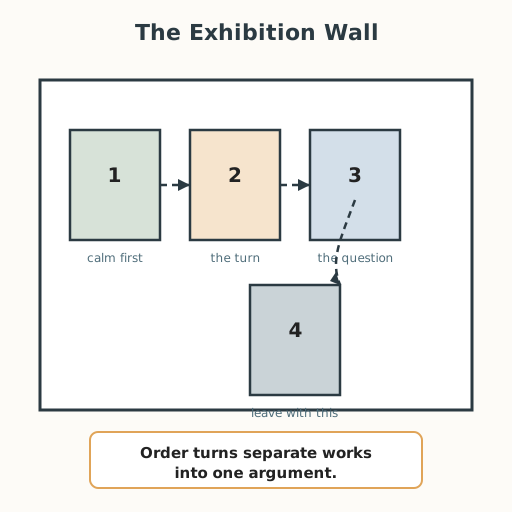
- Meet selection and order (12 min). Selection = choosing a set that serves a theme. Order = arranging it so the sequence builds. Worked example: a three-work show on “water.” The curator picks a calm image of a full river first, a dry cracked riverbed second, and a child carrying a water jug last — so the viewer moves from plenty to loss to who it costs. The order, not any single image, carries the argument.
- Select (12 min). From the available works, choose 3–5 that serve one theme. On your sheet, list what you chose and write one line on why each work earns its place (and what you left out, and why).
- Order (12 min). Arrange the chosen works in a sequence that says something more than any single piece. Try at least two different orders before you decide. The first and last positions carry the most weight — what should a viewer meet first? Leave with what?
- Write the reasoning (10 min). In your journal, write the wall text: a title for the show, a two-sentence theme statement, and one sentence on why this order.
- Walk it (4 min). With a partner, walk your exhibition in the order you chose. Ask: what did the whole say that one piece could not?
Differentiation
- Support: Curate just three works, and use frames (“this one first because…,” “this one last because…”) to build the reasoning.
- Extension: Add a juxtaposition — two works placed side by side so their contrast creates a third meaning — and write what that pairing does.
Assessment
- Formative (peer + self): Can the learner state the theme, justify each selection, and explain why the chosen order (rather than another) serves the theme?
- Portfolio artifact (unit): The curation planning sheet plus the written wall text, saved for the Lesson 10 gallery.
Home connection
Arrange four things you already own — photos, books, bowls — into a small “exhibition” with a title and an order. Write one sentence on why that order. Invite one person to walk it and say what the whole made them think.
Resources
- On intangible cultural heritage carried hand to hand (framing living traditions with respect): UNESCO Intangible Cultural Heritage (S-056).
- On art history and world art as general authority: The Met, Heilbrunn Timeline (S-114).
- On worked examples and guided practice: Kirschner, Sweller & Clark (2006), https://doi.org/10.1207/s15326985ep4102_1 (S-011).