Lesson 04 — Composing a Response in Sound
Learners arrange or compose a short piece of music or organized sound that responds to their chosen issue, choosing elements of music — melody, rhythm, timbre, dynamics, tempo, texture — deliberately to produce an intended effect. They notate the piece simply (as a graphic score if useful) and explain, in writing, what they wanted a listener to feel or think.
Objectives
Objectives
- D07.S2.11.01 Arrange or compose a piece that responds to a social or environmental issue and explain its intended effect.
Essential question
How do I arrange or compose a piece of music or sound that responds to a social or environmental issue and moves a listener?
Key vocabulary
Materials
Standard materials
- Sound-composition planning sheet · 1 per learner A guide for choosing two elements of music to carry the message, with space for a simple notation or graphic score
- Voices, body percussion, and found sound-makers · shared Anything that makes a sound can be an instrument — hands, feet, cups, paper, stones
- Art journal · 1 per learner
Low-tech / no-cost
- Found objects as instruments Sticks, stones, bottles, buckets — pitched and unpitched sound from the environment
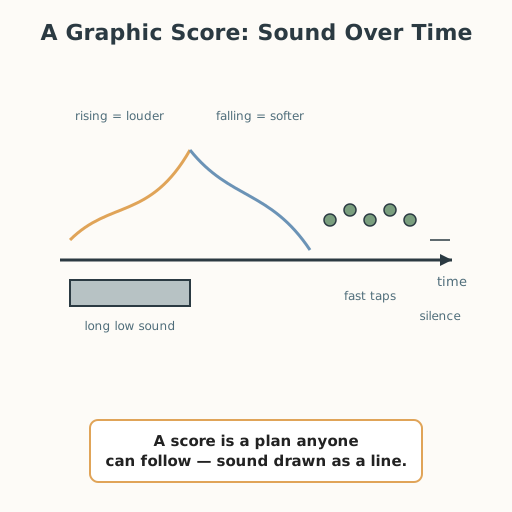
- A graphic score drawn on paper Lines and symbols that record the piece so another person could follow it
Enriched / lab & device
- A free digital audio tool (BandLab or Audacity) · 1 per learner or pair To record, layer, and shape the piece with free tools (S-443, S-444)
- A portable recorder or phone (optional) To capture field sounds of the issue itself (traffic, water, wind)
Works in different contexts
- large-group Work in small sound ensembles; each group composes a 30–60 second piece and performs it, then states its intended effect in one sentence
- multi-age Younger learners arrange one element (loud/soft, fast/slow); older learners compose with two or three elements and notate the piece
- self-directed A learner composes alone, records or notates it, and self-checks whether the chosen elements produce the intended effect
- level-grouped Group by notation readiness; a ready group writes a graphic or staff score others can follow, others record verbally
- outdoor-only Compose with the environment's own sounds — layer field recordings, footsteps, and found percussion into a short piece
Lesson 4 — Composing a Response in Sound
Summary
Learners arrange or compose a short piece of music or organized sound that responds to their chosen issue. They choose elements of music — melody, rhythm, harmony, timbre, dynamics, tempo, texture, form — deliberately, notate the piece simply (as a graphic score if useful), and explain in writing the intended effect on a listener.
Objectives
- Arrange or compose a piece that responds to a social or environmental issue and explain its intended effect. (D07.S2.11.01)
Connection
You already know how sound does things to you: a slow, heavy drum can make a room feel serious; a fast high whistle can make you alert; a single voice after a long silence can stop a crowd. Composers choose those effects on purpose. A protest song, a film’s soundtrack, a piece of music written for a river or a city — all of them are answers to one question: what should this make a listener feel, and how do I build that with sound?
Materials
- Sound-composition planning sheet
- Voices, body percussion, and found sound-makers
- Art journal
Preparation
- Copy the planning sheet.
- Retrieval: from Grade 10 (D07.S2.10.01), composing and recording a piece with a clear idea; from Lesson 1, each learner’s issue and intention.
- Prepare one demonstration: the same short pattern played three ways (slow/soft, fast/ loud, with a silence) so the class can hear how elements change the effect.
Facilitator note
This lesson is written to the learner (“you”). The ideas to land: the elements of music are the levers a composer pulls — melody, rhythm, harmony, timbre, dynamics, tempo, texture, form (S-368); pulling a lever changes the listener’s feeling, and the written explanation names which lever and why. Teach the move “choose two elements → build a short piece → say the intended effect” with a worked example and guided practice (S-011); the issue and the feeling stay the learner’s own.
The intellectual lens: composing is reasoning in sound — a sequence of deliberate choices, not an accident. The critical-thinking lens: learners separate observation (“the tempo is slow, the volume soft”) from judgment (“it feels mournful”). The global lens: music that answers injustice exists across cultures — reggae grew among marginalized groups in western Kingston and became “a voice for all” on injustice, resistance, love, and humanity (S-450); nueva canción in Latin America fused folk forms with protest and social change, and its musicians faced censorship and violence under dictatorship (S-449). Meet these as living traditions to honor with respectful questions, never to imitate carelessly. The environment lens: sound can also be the issue — a piece built from recorded water, wind, or traffic lets the environment itself speak.
Procedure
- Recall (5 min). From Lesson 1, your issue and intention. Today the same intention becomes a sound.
- Meet the levers (12 min). The elements of music are melody, rhythm, harmony, timbre, dynamics, tempo, texture, and form (S-368). Worked example: a composer responding to noise and haste builds a piece that begins fast and loud (tempo, dynamics), then drops to a single soft note held long, with silence around it — the silence is the point. Name the lever, hear the effect.
- Choose and plan (8 min). On your sheet, choose two elements to carry your message, and sketch a simple graphic score: a line or symbols that show what happens over time (loud/soft, fast/slow, high/low).
- Build it (15 min). Using voices, body percussion, and found sound-makers, compose a short piece (30–60 seconds) that answers your issue. Perform it, listen, and adjust until the chosen elements do what you meant.
- Notate and explain (10 min). Write your score so another person could follow it, then add two sentences: which two elements you used, and the intended effect on the listener.
- Share and check (5 min). Play your piece for a partner. Ask only: what did it make you feel, and which moment made that happen? Compare their answer to your intention.
Differentiation
- Support: Work with one element (loud/soft or fast/slow) and a single repeated pattern, then say in one sentence what it should make a listener feel.
- Extension: Use three elements, write a fuller score, and note where a listener might read the piece differently than intended — and why.
Assessment
- Formative (peer + self): Can the learner name the two elements they chose, point to where each appears in the piece, and explain how each produces the intended effect?
- Portfolio artifact (unit): The notated (or recorded) piece plus its written intended-effect explanation, saved for the Lesson 10 gallery.
Home connection
Listen to one piece of music at home or in your neighborhood and name two elements the maker is using. Write one sentence on what the piece is trying to make you feel, and whether it works on you.
Resources
- On the elements of music: “Elements of music” (S-368).
- On music responding to injustice across cultures: UNESCO, Reggae Music of Jamaica (S-450); Britannica, Nueva canción (S-449).
- On free/open audio tools: BandLab (S-443); Audacity (S-444).
- On worked examples and guided practice: Kirschner, Sweller & Clark (2006), https://doi.org/10.1207/s15326985ep4102_1 (S-011).