Lesson 05 — Curating a Listening Program Across Cultures
Learners curate a listening program: they select works from several cultures around a theme, decide an order that honors each tradition and makes the whole say something, and write program notes — the reasoning behind the selection. They meet other cultures' music as living heritage carried hand to hand, never as specimens to collect.
Objectives
Objectives
- D07.S2.11.02 Curate a listening program of works from several cultures and write the reasoning behind the selection.
Essential question
How do I select and order works from several cultures into a listening program, and write the reasoning behind the selection?
Key vocabulary
Materials
Standard materials
- Listening-program planning sheet · 1 per learner A grid for listing candidate works by culture and tradition, then recording the chosen set, order, and reason for each
- Access to a small set of recorded works · 6–10 works Recordings from several cultures (or live performances by learners and community members), with attribution
- Art journal · 1 per learner
Low-tech / no-cost
- Live or remembered music Learners, families, and community members sing or play works from their own traditions — no recording needed
- Descriptions on index cards Where recordings are unavailable, each work can be named and described, and the sequence reasoned on paper
Enriched / lab & device
- Smithsonian Folkways or another world-music collection A respectful, well-attributed source of recordings and teaching notes from many traditions (S-188)
- Streaming or library access with attribution To build the program from real, credited recordings
Works in different contexts
- large-group Each small group curates a 3-work mini-program and presents it, naming each work's tradition and the reason for its place
- multi-age Younger learners order works by one audible quality (quiet to loud, slow to fast); older learners argue for a sequence that makes a point across cultures
- self-directed A learner builds the program from available recordings or remembered music, writes the program notes, and self-checks each reason against the selection
- level-grouped Group by written-reasoning readiness; a ready group writes full program notes with attribution and a theme, others write one sentence per work
- outdoor-only Build the program around the environment's own sounds and remembered songs, and "listen" the sequence as a group, pausing between works
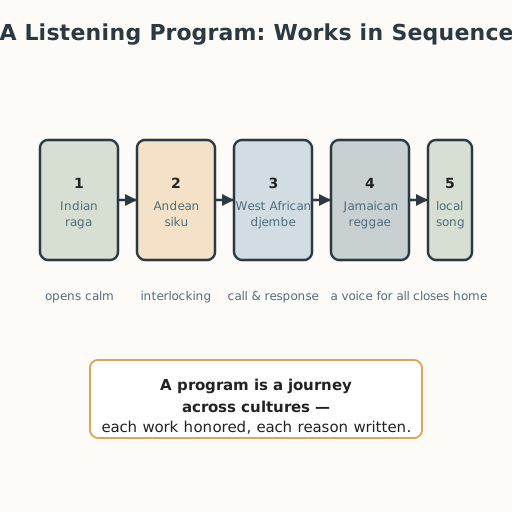
Lesson 5 — Curating a Listening Program Across Cultures
Summary
Learners curate a listening program: they select works from several cultures around a theme, decide an order that honors each tradition and makes the whole say something more than any single work, and write program notes — the reasoning behind the selection. They meet other cultures’ music as living heritage carried hand to hand, never as specimens to collect.
Objectives
- Curate a listening program of works from several cultures and write the reasoning behind the selection. (D07.S2.11.02)
Connection
A festival stage, a radio hour, a wedding, a funeral — every one of them is a program: someone chose which songs or pieces would come first, which would follow, which would close. A thoughtful program does not just play music; it travels — from one feeling to another, and sometimes from one people’s way of making music to another’s. Today you are that someone: the person who decides what a listener hears, in what order, and why.
Materials
- Listening-program planning sheet
- Access to a small set of recorded works (6–10)
- Art journal
Preparation
- Gather the candidate works (recordings or live performances), each with attribution — the name of the tradition and, where known, the performers and community.
- Retrieval: from Lesson 3, the two moves of curation (selection and order); from Grade 10 (D07.S2.10.02), respectful engagement versus appropriation.
- Model one worked example: a three-work program with written reasons.
Facilitator note
This lesson is written to the learner (“you”). The ideas to land: a listening program is a curated sequence across cultures; the written reasoning must honor each tradition (attribution, context) while explaining the selection and order. Teach the two moves with a worked example and guided practice (S-011). Hold the hard rule from Grade 10: respectful engagement, not appropriation — music is met as a living tradition, credited and asked about, never taken (philosophy §4).
The intellectual lens: program notes are argument — each choice is defended with a reason about the music itself (its scale, rhythm, timbre, or mood), not just a feeling. The global lens: learners meet real, named traditions — the raga of Indian classical music, a melodic framework with its own scale, characteristic notes, and associated mood or time (S-366); the maqam, the modal system of Arab, Turkish, and Persian music with characteristic intervals (S-367); Andean siku panpipes played in interlocking pairs and West African djembe drumming with layered rhythms and call-and-response (S-188). Each is a living way of making meaning in sound. The egalitarianism lens: no tradition is “better” or more “advanced” than another; a program that places them side by side treats each as a full voice. The community lens: where possible, invite the people of a tradition — classmates, families, neighbors — to play or speak, so the program is with a community, not about it.
Procedure
- Recall (5 min). From Lesson 3, what were the two moves of curation? Today you use them on sound, and across cultures.
- Meet the works, respectfully (12 min). Listen to (or name) 6–10 works from several cultures. For each, record: the tradition it comes from, one thing you notice in the music itself (its scale, rhythm, timbre, mood), and a respectful question you would ask its people. Attribution is not optional.
- Select (12 min). Choose 3–5 works that serve one theme (for example: water, home, grief, resistance, joy). On your sheet, write one line on why each earns its place — naming something audible in the music, not just a label.
- Order (12 min). Arrange the chosen works so the sequence honors each tradition and makes a point. What should a listener hear first? What should close the program? Try two orders before deciding.
- Write the program notes (10 min). Give the program a title and a two-sentence theme, then one sentence on the reason for each placement, with full attribution.
- Share (4 min). Tell a partner your program’s title, its works in order, and the one-sentence reason for the first and last choices.
Differentiation
- Support: Build a three-work program with sentence frames (“this work comes second because…”), and listen for one audible quality in each work.
- Extension: Add a bridge between two works — a note on what they share or contrast — and write it into the program notes.
Assessment
- Formative (peer + self): Can the learner name each work’s tradition, state the theme, and justify each selection and placement with a reason about the music itself?
- Portfolio artifact (unit): The planning sheet plus the written program notes, saved for the Lesson 10 gallery.
Home connection
Ask a family member or neighbor to sing or play one piece from their tradition, or to name one they love. Write down the tradition it comes from, one thing you notice in the music, and one respectful question you would ask.
Resources
- On world music and living traditions: Smithsonian Folkways Recordings (S-188); UNESCO Intangible Cultural Heritage (S-056).
- On specific traditions: Britannica, Raga (S-366); Britannica, Maqam (S-367); UNESCO, Reggae Music of Jamaica (S-450).
- On worked examples and guided practice: Kirschner, Sweller & Clark (2006), https://doi.org/10.1207/s15326985ep4102_1 (S-011).